
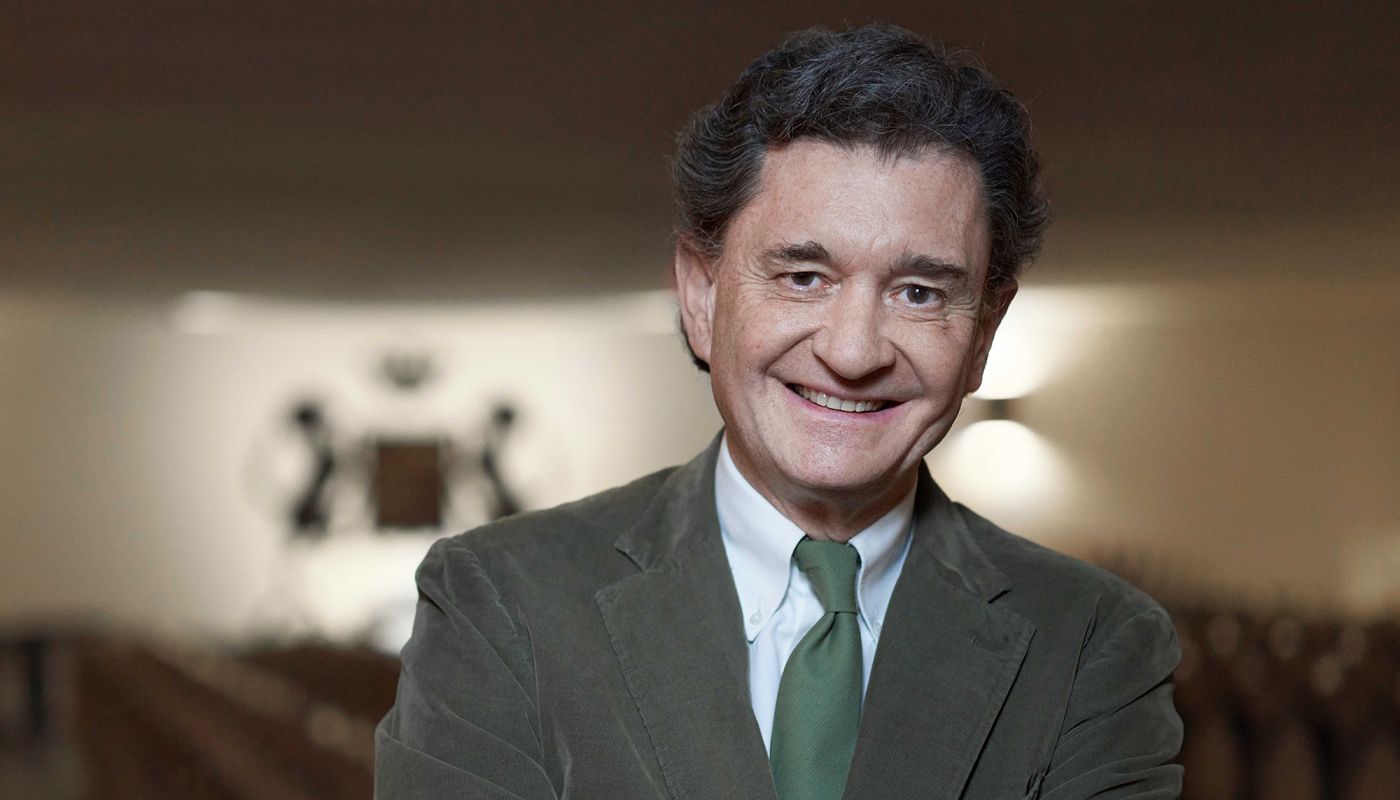
Philippe Sereys de Rothschild is unnervingly like his late mother, Baroness Philippine de Rothschild of Bordeaux first growth Château Mouton Rothschild. He has the same breathless delivery of clipped English and easy charm. ‘God, you’re early’, was how he greeted me in the lobby of The Connaught hotel in London, where we were due to meet for an interview, as he breezed in after lunch.
It’s true that, most unusually, I was about 15 minutes early and that, just like his mother, he was, eventually and predictably, late for our assignation in the sommelier’s basement hideout, after having gone back to his room – but only by nine minutes. His mother was usually at least half an hour late. But then she, like Sereys de Rothschild’s late father Jacques Sereys, was an actor, and a baroness to boot, so was routinely excused.
She died in 2014, leaving the family’s three Pauillac châteaux – Mouton Rothschild, Clerc Milon and d’Armailhac – to him and his siblings Camille and Julien. Philippe, the elder son whose professional life post Harvard Business School had been largely in finance, took some time to decide whether to follow her as head of the family wine business Baron Philippe de Rothschild SA, leading exporter of Bordeaux AOC wines in the form of the famous Mouton Cadet. ‘It took me three or four years to decide what I really wanted to do’, he admitted. ‘I realised very quickly that if I wanted to do wine properly I had to do it 100%. I never felt it as an obligation but I love wine. And part of my life has been at Mouton.’
So in 2018 he became chairman and CEO of the wine company that bears the name of his grandfather, who famously restored the fortunes of Château Mouton Rothschild to such an extent since taking it over as a young man that in 1973 he managed to get it promoted from second to first growth, the only such change ever to the famous 1855 classification.
He told me that he now spends three or four days a week in Pauillac and a year ago completed renovating to his satisfaction the 97-m-long (285 ft), low stable wing known as Grand Mouton seen in the distance below – as opposed to the much more conventional Victorian château built in the middle of the courtyard known as Petit Mouton, where his mother stayed. He hasn’t taken over the east-facing upper room where his grandfather, in bed, famously received his many contacts in wine and the arts, instead choosing for himself a bedroom looking west over these vines. ‘It’s an absolute delight waking up to that view, a life-changer.’

Many, many years ago I stayed at Mouton, when pugnacious theatre director Joan Littlewood was also in residence, in the Grand Mouton setting created by the quirky and aesthetically sensitive Baron Philippe (‘medieval times’, marvelled his grandson when I mentioned this). We reminisced about its special qualities. ‘Mouton is full of spirits. Every object is there for a purpose, which gives the place a soul.’ The dining table still has no fixed abode, apparently. Just like Versailles, according to Philippe the Younger.
He readily admits he’s no wine technician but sees his job as ensuring Mouton continues to earn its first-growth status. ‘People don’t realise how staying at the top is an everyday challenge. You can’t take your eye off the ball. You need permanent attention to detail. If your wines are served two or three degrees too warm, they don’t taste well, for instance. And you need to do everything better every year. It takes a lot of energy but it’s necessary because the wine business is hugely competitive.
'Not only is it more and more competitive, but we’re more exposed to the media, which is a good and bad thing now that more and more people want to make the best wines.’ He’s referring to wine critics’ commercially important scores here, and the en primeur circus that takes place every spring when wine critics and merchants descend on Bordeaux to taste the most recent vintage from cask when it’s only a few months old. ‘It’s a real luxury. We should feel lucky and thankful that then, for two weeks, most of wine media concentrate on Bordeaux. It doesn’t happen anywhere else.’ My mention of the November Hospices de Beaune auction in Burgundy fell on deaf ears.
Well versed in increasing criticism of the en primeur system of selling bordeaux as futures and the extent to which lesser vineyards are being grubbed up at pace because there is no market for their produce, I ventured to him that Bordeaux is in a bit of a pickle. Would he agree? There was an immediate and fervent ‘yes’, followed by ‘perhaps that’s a bit of an understatement. Yes, it’s going through a hard time but it won’t stop us from making great wine. The product and the market are two different things. The market is difficult in many ways you can explain. The Chinese have slowed down. There are questions on the US market. Interest rates are higher. And post-Covid there are excess stocks.’
So what’s the solution, I asked. ‘To be more and more present on the markets’, he said firmly, ‘to talk about our wines’. We were sitting overlooked by magnums of mature vintages of Mouton and bottles of the famous 1982 vintage set aside for that night’s Mouton dinner at The Connaught. He’d just come back from events in Dubai and the previous evening had hosted a tasting at the smart Mayfair wine store Hedonism. He’s a fan of the distribution job done by the Bordeaux négociants, ‘and then my job is to seduce the consumers’. All is by no means lost according to him. ‘In Dubai lots of people drink a lot of wine. The pessimists should go to Aspen, Singapore, Miami, St Barts …’
Given interest rates and a stagnant market, he must be pleased at the moment that Mouton, unlike many Bordeaux châteaux, doesn’t own one of Bordeaux’s many négociants, currently so expensively stocked. But what about bordeaux wine very much at the other end of the scale? Surely the price they pay for ingredients for their best-selling Mouton Cadet blend and their other Bordeaux branded wines has plummeted? He denied this, evincing long-term contracts with 160 growers, and seemed surprised that I suggested, correctly, that most of them are in the Entre-Deux-Mers, where most AOC Bordeaux is grown.
The company has an array of branded wines from the Languedoc and Chile as well as their fine-wine joint ventures Opus One in California and Almaviva in Chile. Sereys de Rothschild reports that he makes sure he tastes each new release ‘as a consumer’ and then discusses them with the relevant winemaker.
Unlike his grandfather who had a running battle with his relatives at first growth Château Lafite Rothschild across the vines, this Philippe gets on particularly well with his cousin Saskia de Rothschild, who has been instituting all sorts of environmental improvements at Lafite. I was about to lecture him about the fact that Mouton’s bottles have been the heaviest of those of the first growths when he volunteered that they were reducing them from 900 g (32 oz) to closer to 500 g. Result!
He and his siblings have established a foundation in memory of their mother. It's designed to introduce young people in and around Bordeaux to the full range of métiers associated with the performing arts, by no means all of them involving actual performance. He spent much of his childhood in theatres while his father rehearsed, was never tempted by the stage himself, but clearly has huge respect for all those associated with it.
He’s also proud of having instituted for Mouton Cadet a ‘creative lab’ whereby his three children and those of his sister Camille are encouraged to get together round a table in Paris with marketing and technical people to suggest ideas and react to new products, labels and so on. ‘I’m an old thing and I can’t understand what the young think. The best people to advise are clearly the children. It’s fun for them, and they do it gracefully and very seriously. The team listens to them, and it puts them in touch with the business. It’s a win-win. But of course there is no obligation for any of them to go into wine. Just as my mother made very clear there wasn’t for me.’
But that didn’t stop his antecedents insisting that, at the age of 18, ‘Philip Sereys’ was sent to pound the fiery pavements of New York one summer as a lowly salesman for Lauber Imports. An order for a case of halves of Yquem was the high point of this experience. ‘It’s the most frustrating thing I’ve ever done. I now admire salespeople so much because it’s such a difficult job.’ More difficult than presenting 1982 Mouton at The Connaught, that’s for sure.
Favourites from the Mouton stable
Branded wines
Mouton Cadet x Nathan Sauvignon Blanc 2024 Bordeaux 12.5%
Under £12, this vintage expected in the UK soon
Mouton Cadet, Cuvée Héritage 2022 Bordeaux 14.5%
£14.84 Vinatis
Baronesa P 2021 Maipo 14.5%
The 2020 is £61.02 Vinatis and £65 Millesima
Château wines for current drinking
Château Mouton Rothschild
1945, 1949, 1959, 1961, 1982, 1986, 2009, 2016
Château d’Armailhac
2010 £68.51 Lay & Wheeler, £73 Cru World Wine
2014 £54 Waud Wines
Château Clerc Milon
2005 £93.46 Lay & Wheeler
2006 £77.86 Lay & Wheeler, £83 Cru World Wine
2009 £117 Four Walls Wine Company, £117.20 Atlas Fine Wines
2010 £62.40 per half Four Walls Wine Company
2016 £89.50 Mumbles Fine Wines
Portrait of Philippe Sereys de Rothschild by Mathieu Anglada. Mouton vines photographed by Pierre Grenet, Astoria Studio.
Back to basics
| What is a Bordeaux first growth? |
|
For Napoleon III’s Universal Exhibition in 1855 in Paris, the wine brokers of Bordeaux were asked to draw up a list of the region’s top wine estates. There had been several informal ones in the past and, based on the prices fetched, they agreed a ranking of about 60 estates in the Médoc, pretty much the only serious wine-growing region then for red bordeaux. They divided the estates, soon to be called crus classés, or classed growths, into divisions very like a football league table today. There were five divisions. Those in the bottom one were, and still are, called fifth growths and those at the top are first growths.
In 1855 there were just four first growths: two in the commune of Pauillac, one in Margaux, and the brokers also included the famous Château Haut-Brion on the outskirts of the city in Pessac. Other Bordeaux regions have since developed their own classifications but it took until 1973 for the one and only revision of this one.
The wines of the first growths have very distinct characters. Châteaux Mouton and Lafite Rothschild may be close neighbours north of the town of Pauillac but they could hardly taste more different. Mouton is exuberantly rich and vibrant – arresting and engaging like Baron Philippe, who managed the feat of having it promoted from second growth. Lafite is much more reserved and elegant – more like a ballet dancer – but deceptively long-lived. The way the two châteaux conduct themselves during the en primeur season mirrors this. At Mouton they are almost embarrassingly media-aware whereas at Lafite they are distinctly stand-offish. The third Pauillac first growth, Ch Latour, overlooks the Gironde estuary at the southern end of the town and makes the longest-lived, most concentrated wine of all. Its owner François Pinault withdrew it from the en primeur system back in 2012.
South in the village of Margaux is Bordeaux’s grandest château building of all, the classical Château Margaux, where the wine ideally expresses the perfume of wines from that appellation. As for Château Haut-Brion, in what are now the southern suburbs of Bordeaux itself, my predecessor as FT wine writer, Bordeaux specialist Edmund Penning-Rowsell, always used to say that it smelled of warm bricks and I think he’s right. Haut-Brion tends to mature earlier than the Médoc firsts but it too can last for many a decade. |
| For much more detail, see The Oxford Companion to Wine. |













