Forty-eight hours in China recently was not enough for any profound investigation of the exploding wine scene there but it was enough for me to realise that at long last there are some exciting new developments in Chinese-grown wine.
My two previous visits had been in 2002 and 2008 and on the second I had been deeply depressed by the fact that, while the rest of the world was making better wine with every vintage, the quality of Chinese wine seemed to have stagnated. The typical Chinese wine still tastes like a very poor quality Bordeaux Rouge: sometimes not recognisably vinous, thin from overproduction, tart from underripeness, and often tough, thanks to an obsession with the unyielding Cabernet Sauvignon grape that has dominated vineyard plantings in China's new wine-drinking era. This seems to me to be precisely the sort of wine least likely to woo a neophyte wine drinker, and least likely to be a good match for Chinese food.
But at long last I encountered a wine made from 100% Chinese grapes that would surely be an absolutely perfect introduction to wine for anyone such as the more than a billion Chinese who have never so far tasted it. And with its convincing core of fruit, easy grapiness and sizzling crispness, it would be a suitable foil for all manner of mild, spicy, sweet and sticky morsels destined for their chopsticks. The only trouble is that it is white, and therefore in theory of limited appeal to Chinese consumers.
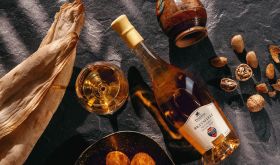
Symphony, the wine in question, is a joint venture. It is made at Grace Vineyard, by far the most successful producer of Chinese red wine to date, based in Shanxi province, with an Australian winemaker and a Hong Kong fortune behind it. But the idea for this lively, young off-dry Muscat came from Torres China, one of China's more successful distribution companies, set up with great prescience by the dominant Catalan winemaker Miguel Torres as long ago as 1997. They made 10,000 bottles of the first, 2008 vintage and saw them sell out long before next month's launch of a slightly drier 2009. From the 2010 vintage there will be a red version.
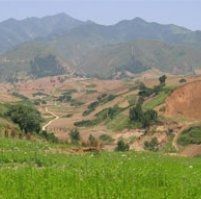
I was also heartened to come across truly inspiring red wines from two new wineries. Jade Valley, a thoroughly modern spa resort and winery, also in Shanxi, is artfully set in a particularly bucolic valley (pictured) not far from the site of the famous terracotta warriors by owner Qingyun Ma, one of China's most influential architects. I tasted the current release Sauvignon Blanc, which really does taste fresh, fruity and like a Sauvignon Blanc; a barrel sample of their 2009 Cabernet that was apparently made with help from Opus One winemaker Michael Silacci from Napa Valley, its 2006 counterpart that was perfectly respectable, and a 2006 Pinot Noir that was the biggest shock of all. This was delicate, fruity, perfumed and did actually taste of Pinot Noir (quite a feat for a Pinot Noir grown anywhere, let alone in the wilds of China). This is clearly a small, newish Chinese producer that is worthy of anyone's attention.
And then Silver Heights, up in the Helan Mountain region of Ningxia province west of Shanxi, is another bright light to have emerged on the modern Chinese wine scene. Silver Heights' Summit red Bordeaux blend is made by one of China's few female winemakers Emma Gao. She trained in Bordeaux and it certainly shows. The 2007 has the most delightfully natural fragrance and delicacy while the 2008 is clearly more ambitious. The vineyard, at 1,200 m altitude, belongs to her family and the small quantity made is distributed by Torres, for whom she once worked.
Ningxia seems to be the most popular province for the latest round of investment in Chinese vineyards. The climate here is much drier than that of Shandong province on the east coast, where so many of the first vineyards of the modern era were located. Yet winter temperatures rarely fall as fatally low as in Xinjiang in the far west, where vines have to be banked up for survival every autumn, and which is so far from China's main centres of wine-drinking population. (This is the region with a considerable Muslim population. The Chinese government is keen to see the wine enterprises that have so far been established here, including the vast Suntime, play their part in improving the local economy, which is seen as an important route to soothing the region's ethnic unrest.)
Pernod Ricard have also invested in Helan Mountain. After an early involvement in the Dragon's Seal brand, the French multinational has now set up in a joint venture with locals in Ningxia province and an Australo-Chinese team is already making a range of solid varietals using Helan Mountain as a brand name. (Chinese laws on appellations and the protection of place names are so far non-existent.). Jacob's Creek winemaker Phil Laffer, who has spent some time there, told me that the principal challenges are convincing local farmers to grow grapes for optimum wine quality rather than maximum yield (an endemic problem throughout China), some less than satisfactory trellising techniques that leave the grapes so close to the ground that they sometimes need to have the soil rinsed off them, and an inconveniently wide variation in ripeness levels. Because of the cold winters here, the Pernod Ricard team are considering planting Cabernet Severny, which incorporates genes from the Mongolian species Vitis amurensis.
One company, Tontine Wines, specialises in wines made from all-amurensis vines grown in Jiangxi province in the south east of China. Nearly three quarters of the wines they sell under the Tongtian and Tongtian Hong labels are sweet and they have had such sales success that this year they are planning to increase annual production from19,000 tonnes to 39,000 tonnes.
Doubtless many more foreign bees are currently buzzing round the honeypot that is the potential for Chinese wine. Honiton Energy, an alternative energy company based in Beijing, plans to invest $50-100 million in establishing a Chinese wine operation that will include importing a 'big volume of wine from a reasonably good, large, but financially troubled winery in either New Zealand or Australia, and rebrand[ing] it in China. The bulk of our investment here to be spent in marketing.' This is presumably to tide them over while their Chinese vineyards are established.
The eyes of the fine-wine market in China are on the joint venture announced last year between the owners of Château Lafite (whose French wines' commercial success in China has been truly astounding) and the Chinese giant CITIC group. To the surprise of many, they have chosen to invest in Penglai in humid Shandong, as has another Bordeaux–Chinese joint venture. Great River Hill winery has been established with Laixi city with initial plantings of 16 hectares of Cabernet Sauvignon last spring and will be supplemented by a further 84 ha of other varieties while a winery is built. The main partner is Dr Karl-Heinz Hauptmann, co-owner of Bessa Valley in Bulgaria with Stephan von Niepperg of Ch Canon la Gaffelière in St-Émilion, with practical expertise from Marc Dworkin of Bordeaux. The first wines are expected in 2012.
For a long time, the so-called Domain Sino-France winery in Hebei was envied as being capable of producing some unusually good Chinese wine, with a particularly admired Chinese winemaker. Wine distributors ASC were keen to acquire this property but the deal fell through and it has been acquired by the Taiwanese family that owns the neighbouring land. But the key to success in China is distribution. By no means all of these hopeful new wine producers have the networks in place for selling their wines. Only the giant companies COFCO with their Great Wall and premium brand Château Junding, Changyu, Dynasty and Dragon Seal can afford the sums necessary to buy their way in to mass distribution in the complex jungle that is the Chinese wine market.
See my tasting notes on current Chinese wines.