
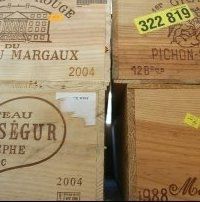
The Atlantic ocean has always represented a gulf in the fine-wine market, but the gulf has deepened, and widened, considerably of late. Now that Hong Kong has become such an important centre for fine-wine auctions, not least because American auctioneers Acker Merrall & Condit have been targeting Hong Kong so vigorously, a considerable quantity of fine wine that would once have stayed in the US and moved between American cellars can now be found in Asia, particularly Hong Kong and mainland China.
But many of the fine-wine brokers, traders and merchants who cluster around London and represent a considerable proportion of the world's fine-wine activity will have nothing to do with wine bought in the US and Asia. For Gary Boom, who founded Bordeaux Index in London in 1997 for example, this has been an article of faith. 'We only ever purchase European stock and we feel that all UK merchants should follow suit. It is our firm belief that stock that has been across the oceans and back has too many risks attached. Shipping and air freight leave a lot to be desired even today and in general the condition of the wines is not as good as European stock. The supply chain is simply too long in most cases'.
And accounts casting doubt on the probity of some links in that supply chain such as this week's long exposé by Mike Steinberger on Slate.com are unlikely to make British buyers any more enthusiastic about sourcing fine wine in the US.
Adam Brett-Smith of traditional wine merchants Corney & Barrow explains his view: 'I think that provenance will be one of the biggest differentiating factors in the buying/selling of fine wine. Provenance also encompasses the issue of fake wines and the conditions under which wines are stored, handled and shipped. When we set up our broking operation it was in acknowledgment of the existing brokers' success but was also a deliberate attempt to redefine how brokers operated, with specific reference to sourcing. With this in mind and right from the beginning we set out the following criteria of where we DO NOT source, criteria which are perhaps seen as more relevant today than they were back in the early 1990s: We do not source from the US. We do not source from Asia. We do not source from auction.'
For Corneys, as for most of the traditional merchants who decided to give the brokers a run for their money by setting up their own broking divisions, it is their own customers who provide much of what they trade, thereby offering the most convenient and reliable internal marketplace. If you have hundreds of thousands of cases of fine wine that have been sitting in your customers' reserves section of a top-quality bonded warehouse such as Octavian at Corsham ever since they were first shipped from Bordeaux, why venture out into the big, wide, unpredictable world to source wine?
Simon Staples of Berry Bros & Rudd is in a similar position. 'Our private clients are our biggest suppliers currently and this will become even more important when BBX [their new customers' online trading platform] is launched in a few weeks. The stock is stored here [in Berrys' own cellars in Basingstoke] in the most perfect conditions; the warehouse varied less than a degree in the last year and humidity is very constant. We also buy from five or six UK merchants, perhaps four European merchants and from the négociants of course. Never from auction, rarely from private homes. We hardly ever have old wine on our list because I'm increasingly worried about fakes and "world traded stock". I really would not buy for myself a case of anything older than 2001 from anyone unless I know where it's been. There have been far too many experiences of badly stored older wine compared with perfect stock.'
Wines that are sold in the US tend to have slip labels citing the name of the American importer and the warning label citing the evils of alcohol that is mandatory in the US, so, unless a wily trader carefully removes these slip labels, it is usually very obvious which bottles have crossed the Atlantic twice. As Mark Bedini of Fine & Rare Wines explains, 'We never sell US or other non-European sourced stock without it being clearly highlighted on the offer, or included in the wine description', and prices for such bottles are routinely lower than those apparently bought in Europe – unless the bottles contain American wine of course.
Chris Davies of fine-wine traders Turville Valley Wines has even come across wines whose back labels have been deliberately removed because they cited a US importer, but those same back labels had the information on volume and alcoholic strength that is mandatory in the EU, thereby rendering the wine unsaleable in Europe. 'For us the Far East is a no-no and we never buy anything that's been there, or that's been there and back. That said, unless such bottles have importer's labels attached to them, or there is a shipping label on the case, there is no way of telling where the wine has been. For this reason, as well as many other reasons, we buy only from suppliers we have got to know and trust.'
He is far from the only one to refer to the importance of specific trusted suppliers. For Stephen Browett of the biggest fine-wine traders Farr Vintners, 'we don't have so much a policy of "where", more of "how" wines have been stored. Provenance and good storage are the key issues rather than blanket "France = good" and "anywhere else = bad." We would not, for example, buy wine that has been stored next to a hot kitchen in the south of France but we would buy wine that has been stored in a cold cellar in Sweden or Denmark. [I concur that the cooler a wine is stored, the longer it lasts.] The issue of strip labels sometimes comes up. If we are offered a parcel of wine that has never been distributed outside Europe but may have been labelled up (for example with [Diageo's US importer] Chateau and Estates strip labels for the US market) we are happy to sell the wine (described as such) provided we have proof of perfect provenance and storage.'
One of Farr's earliest rivals was Wilkinson Vintners. Ex-Christie's Paul Bowker of Wilkinson comments on the changes in sourcing he has seen over the years. 'Our speciality has always been acquiring lovely, well-stored wines from private cellars in the UK. This has always been the mainstay of our business (as you know we really do focus on physically available vintages, rather than en primeur) and we always like to have a list which is overflowing with great wines from the 1970s, 1980s, 1990s and early 2000s.
'Historically, this meant that the majority of the wines that we bought came, literally, out of private cellars in country houses. We would always make a point of collecting them ourselves, so that we could see the wine in situ, where and how it was stored. As the wine market has developed and changed, with a shift in focus towards investment, the "private cellars" that we buy are just as likely to have been bought en primeur and stored under bond at Octavian, LCB, Vinotheque etc. In many ways, this is a positive, since there is a paper trail, we can tell how long it has been stored there and buy with confidence knowing that the wine has always been well stored. It also avoids the issue which often arises in traditional cellars with good humidity, where levels may be perfect but labels are, as we would say in my Christie's days, "bin-soiled" – a deal-breaker as far as most Asian customers are concerned. This is not to say that wine does not come out of traditional cellars – our van is collecting these on a daily basis. Merely that more and more wine is being purchased and held under bond.
'Recent years have seen the imbalance between supply and demand worsen (with the resulting price increases that we have seen). This, combined with a more competitive market (more merchants and more auctioneers competing for the stock) has made it inevitable that everyone widens their net in terms of sourcing. Although the UK is still, on a day-to-day basis, our main source of supply, we do purchase extensively on the European mainland (and often find, incidentally, a superb standard of cellaring in countries such as Germany, Switzerland, etc). One of the most impressive cellars that we have bought recently came from Scandinavia – a stunning collection, in pristine condition.
'Further afield is more problematic. We scarcely purchase anything at all outside of Europe. Wine to Asia is very much one-way traffic (and, I think, will remain as such). The US is equally not a major source of supply, although we have on occasions bought great cellars from there (selling them as such).
'We still love working in the way that we have historically worked. Nothing gives us greater pleasure than finding a lovely cellar of well-kept wine in a private house. But the market has changed beyond recognition, and it is important to adapt to that.'
It should be noted that many of these brokers, traders and merchants, including Bordeaux Index, now have an outpost in Hong Kong. Presumably even Gary Boom feels that bottles can withstand one long journey between London and Hong Kong, so long as it is in an easterly direction.













