We all are very fond of and fatally attracted towards the tools of our passion. I paid a little fortune on eBay for a 1980s bone corkscrew in a lovely British green velvet box signed by Hugh Johnson. I wouldn’t dare to use it but just touching and observing it makes me feel part of the ‘family’. Don’t laugh at me because I know that you understand. Didn’t you once spend a small fortune on those lead-free crystal tasting glasses or decanter, strangely omitting to confess the real value of the items to your companion in order to avoid a guaranteed break up? We have to admit to ourselves that we are obsessed about wine.
There are plenty of wine tools out there and, admittedly, most of them are anything but necessary. The issue is: how important are these ‘somethings’ for increasing our enjoyment? Everyone has their own recipe, all different, all thoroughly justified.
Today I want to focus your attention on the strangest and most misunderstood of the wine tools. All of us know of it, but very few of us can say anything about its usefulness.
The tastevin or – better – the taste vin is the subject of my discourse. I am sure you have been told that this little silver-coated bulged cup has been surpassed by the invention of the crystal tasting glass. With due respect, this is wrong. In my opinion it is not a battle between silver and glass, but one between light and shadow, quite literally. Keep on reading and you’ll understand.
I won’t bother you about the ancient Hellenic cups (which, by the way, were quite similar to the tool we are discussing). Let’s just say that the history of the tastevin begins earlier than we tend to think, from the very moment people started to pay more for certain wines than for others. Thus wine began to travel and be exchanged. The first necessity for the traders was to identify with precision and speed the health and value of a certain lot of wine before for paying it.
Most wine faults then were discernible by sight, and in ancient times spoiled wines were surely the majority because wine hygiene and tools for its conservation were lacking. The problem was to evaluate wines when there was a scarcity of proper illumination because electricity had not yet been invented.
Nowadays tasters don’t have to worry; all they need is a pristine white paper or cloth (I use the sleeve of my white shirt), a proper crystal glass and a well-lit place.
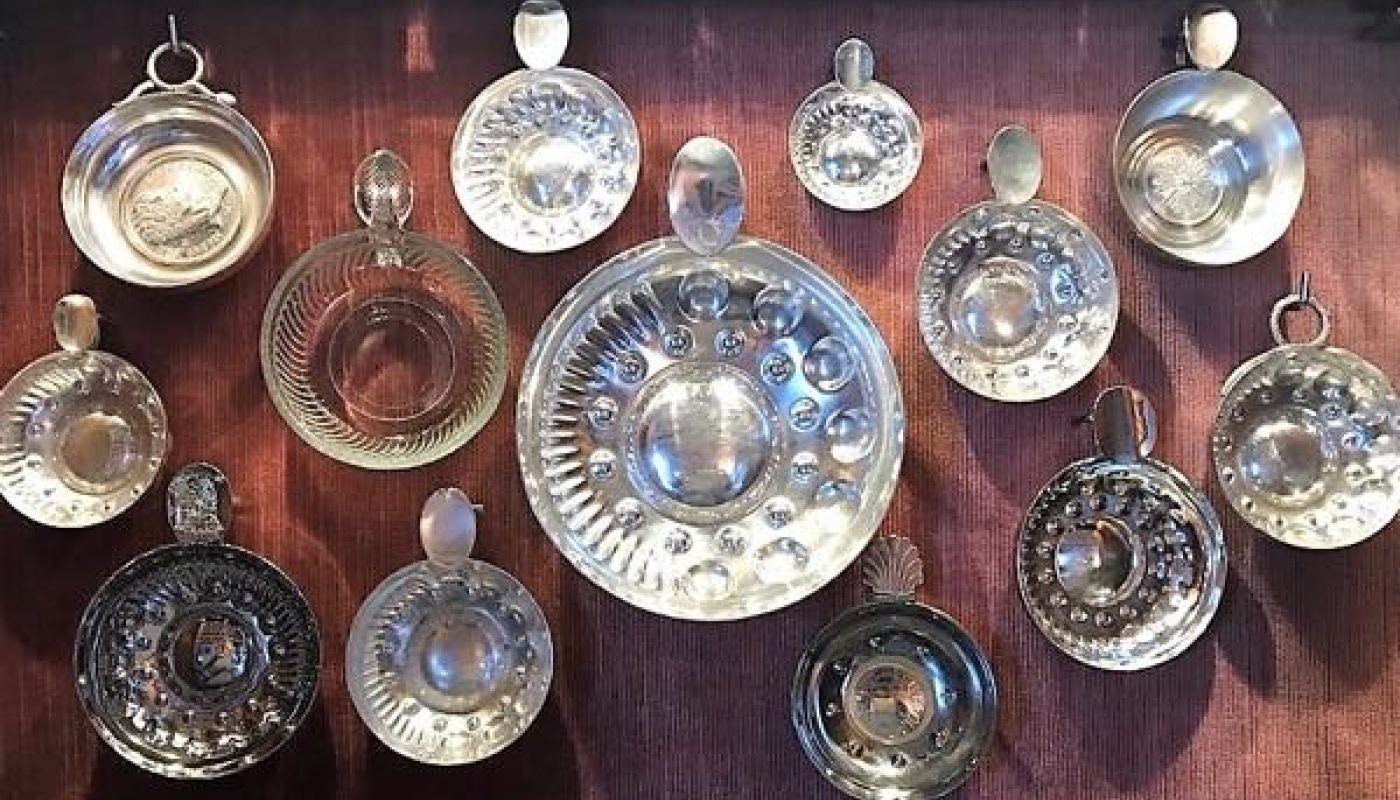
But it’s impossible to evaluate the colour without proper light. It happened to me in a wine exam when I completely failed the colour description because the light was too strong and badly angled. I had no white paper or cloth because I was standing. On that occasion I wished I had had this little old silvered tool because it is portable and creates a white light directly in the right place, at the bottom of the wine, even with a feeble source of reflected light. (Actually I have a little collection of them – pictured above – without my wife knowing the real value, of course.)
The white background is, along with proper light, crucial for a correct visual evaluation. Tastevins can work without either of these two things which, by the way, are not often available in the depths of a cellar. Soon enough wine traders discovered that the shining metal at the bottom of a cup reflected the natural or artificial (candle) light creating a perfect white reflection. The only condition was that the cup had to be shallow, otherwise the rays couldn’t get to the bottom and give the necessary reflection. The result was very similar to the light of something white under our wine glasses in tastings.
Someone in Burgundy discovered at some point that bulges in the cup maximised the reflections, fragmenting and multiplying them, so they simply put bulges inside their cups. Others, as in Bordeaux, preferred sleek metal: the important thing is the reflection, not the bulges. In fact it is the silver coating that is important, whatever the light, even in the semi-obscurity of a cave or below deck on a ship – all places where the trading was done in the past. Some poetry was then introduced (with wine this usually happens, thank God): the comma-shaped bulges for whites, the round bulges for reds, the little bulges for aeration, the seller’s tastevin, the buyer’s tastevin. You can find all these sorts of stories in several texts if you want to research further. In my experience, the only important things are the composition of the object (silver being the best), and the central great bulge, the ‘navel’, which boosts the light.
If a wine is not clear, no other test is necessary. It is not tradeable. That’s the reason the world’s wine traders used this tool until the advent of electricity. From 1600 (and before) to early 1900, virtually every trader had a silver tastevin in their pocket or around their neck on the characteristic chain. They were so accustomed to their own implement that they didn’t even need any other for comparative tasting. They trusted only their own personal tastevin, and they were very able indeed, their wealth depending on their skill. No wonder our little friend is nowadays a symbol conveying connoisseurship.
The twentieth century came, bringing the winning trio of glass, light bulb and white tablecloth, and this splendid object was set aside: a John Deere tractor versus a Shire horse. So nowadays we have these charming shining cups, with the names of our great-great-grandfathers engraved on one side. It remains to be understood whether they can still give us additional comprehension, or fun, or both (if, at this very moment, you are thinking about an ashtray, my hit men will find you).
This tool will never be a glass, the width of the rim and the Marangoni arches need a crystal glass to be assessed, but it is very useful and can make the difference for visual understanding in less-than-perfect tasting conditions. We have to admit that, in our technical tastings, it has no use, but on the contrary in hedonistic situations, it has its uses. For a great bottle on a great evening, with people able to understand the importance of the colour of a wine as part of the whole drinking experience, how much pleasure it can convey, it is perfect.
I am not finished yet. There’s a pair of bonus tracks to be considered: after tasting from a normal glass, put some drops of wine on a tastevin, it doesn’t ask for much. Keep it still and look. Then start to tilt and rotate it, gently, to find the right refraction, then look again.
Now smell those drops after having smelt the wine from the glass. Then sip after having sipped from the glass. The wine won’t be different, and at the same time won’t be the same. It is like observing a diamond from another facet. It will help you to form the three-dimensional impression so dear to Professor Peynaud.
No wine lover should be deprived of the potential bliss given by this magic cup, not instead of the glass but alongside it – on informal occasions, with uncommon bottles and sensitive people.
So, go on, buy some tastevins (one is not enough if you want to compare the colour of different wines), and enjoy using them, along with the glasses, in some tastings among wine lovers and friends, where very often the light is not perfect but the situation definitely is. It will be like looking into a crystal ball.