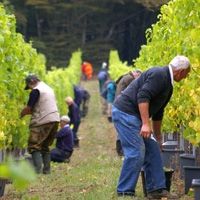
Wine is made in the vineyard, as we are increasingly told. But by whom?
One absolutely crucial aspect of wine production that is, curiously, hardly ever written about is vineyard labour. Wine needs grapes which need vines which need people to ensure that they are persuaded to grow in a way beneficial to wine production as opposed to climbing at random up trees, posts and the like. And once a year grapes need to be picked, often with care, sometimes with sunstroke, and usually with backache.
Despite widespread recession and high levels of unemployment in much of the world, and despite the glamour that now attaches to wine, it has in recent years become more and more difficult to recruit agricultural labourers in general, including vineyard workers – which has potentially serious consequences for the future of wine production.
Even in the UK where I live and where one of our most chronic social problems is long-term unemployment, and especially the dearth of prospects for young people, those fittest and arguably best suited to demanding manual outdoor labour, farmers have the utmost difficulty persuading Britons to go out into their fields and have generally had to rely on itinerant immigrants from eastern Europe. The nub of the problem is the very low going rate for agricultural pay, exacerbated by quite how physically demanding the job is.
In France only the very top estates and/or those with the most hard-working and loyal troupe of friends, family and workers can rely on any consistency among those who pick their grapes. Burgundy is the wine region most famous for the extent to which even the wine superstars get their hands and boots dirty by working in the vineyards. But they can't do everything themselves. Even a Burgundian vigneron as well respected as Anne Gros of Vosne-Romanée told me how, in 2010, her harvest was spread out over such an extended period that she simply had to rely on whomever the contractor could supply on a given day for a given vineyard.
It is hardly surprising that the proportion of French grapes that are picked by machine continues to rise each year, even though one would expect the widespread unemployment in southern Europe might translate into increasing numbers of potential grape pickers moving north each autumn, as was traditionally the way. A group of workers might start in the earliest-maturing vineyards of Roussillon and gradually move north towards the latest harvest in the Loire valley, always visiting the same estates.
Further east, and with some of the world's steepest and most difficult-to-work vineyards in the Mosel Valley, German vintners have for years had to rely on eastern Europeans to take over from the increasingly elderly native Germans with experience of vineyard work. Poles and now Romanians regularly invade German vineyards for the annual grape harvest, some of them leaving their own farms back home to be cared for by migrants from even more straitened economies such as those of Belarus or Moldova. This phenomenon is not unknown in Iberia, where, at least until Spain's short-lived economic boom, Spaniards would migrate north to pick crops in France while an increasing proportion of the work on Spanish farms has been done by immigrants from North Africa – who have also been employed by Italian farmers.
American vineyards, and especially those in California, have long provided the most dramatic lesson in dissociation between wine production and viticulture. For almost as long as California has had a flourishing wine industry it has depended utterly on the skills of a Mexican labour force whose knowledge of vines, vineyards and viticulture generally far outstrips that of those whose names are on the labels. Mexican skills and speed of tasks such as picking and grafting have a worldwide reputation and, only partly thanks to well organised unions, pay rates for vineyard workers here tend to be rather better than elsewhere. We have even seen over the last decade or so the emergence of some wineries actually owned and operated by the descendants of Mexican families who arrived in California as itinerant vineyard labourers, and an increasing number of California wine producers are now explicitly acknowledging the role played by their hugely experienced vineyard managers.
This is why Mexicans in search of vineyard work determinedly migrate north, whether legally or, very often, not. South American vineyard workers have been notoriously downtrodden, even if not perhaps quite as dramatically as South Africa's farmworkers were until recently. Persisting social structures in Argentina and particularly Chile have traditionally restricted vineyard ownership to a small, economically privileged elite, although this is starting to change, accelerated by the arrival of so many vineyard investors from more socially liberal Europe, attracted by relatively low land costs and predictable weather. But the average South American vineyard worker is very much less likely to see themselves not just as an employee but as part of a winemaking team than, say, their Australian counterparts.
Australian wine producers may have an admirably democratic attitude towards those they employ in the vineyard, but the problem is, even more than in Europe and North America, an acute shortage of vineyard labour. The Australian bush is famously under-populated and in recent years pointed bamboo coolie hats and carefully swathed Asian scarves have become commonplace sights in Australia's vineyards as the wine industry has leant more and more on labour from the likes of Cambodia and Vietnam, countries with long traditions of skilled agricultural workers.
For all these reasons, the technology industry has in parallel worked hard to develop ways of mechanising regular vineyard tasks, not just picking but pruning, pre-pruning, lifting canopy wires, trimming, and even banking up vines in preparation for particularly cold winters. (The mass migration from country to city in China is already having implications for the burgeoning wine industry there, for example.) But, as was proved in Coonawarra in South Australia, fine wine viticulture can often be too sensitive and complex to mechanise completely. And this is likely to be accentuated as the world learns to cope with increasingly unpredictable weather patterns.
So I see sourcing of vineyard workers as a serious and pressing problem for the world's wine producers, wherever they are. It seems inevitable to me that the cost of vineyard labour will have to increase – and we consumers will have eventually to pay for it.