14 March 2004 The following was written for the newspaper published at Alimentaria, the food and wine fair held in Barcelona last week where I was invited to give a talk at the wine forum in one corner of the Intervin wine part of the event, now in its own smart new hall. The mood was sombre on Friday morning, for the most understandable and heart-rending reasons [this was just after the Madrid train bombings that killed 193]. I fear I may have done little to lift the Spanish spirit that we have seen so admirably evident at the vast public demonstrations subsequently.
Spanish wine is at a fascinating point in its evolution. The world no longer wants the bulk wines that sustained the export market for so many years – the sort of wine shipped to Britain in bulk, for example, to be sold as sticky yellow 'Spanish Sauternes', the first wine I can remember. This is probably a good thing, although it means that the total volume of wine exported from Spain has been declining inexorably – though it was given a fillip last year by vast amounts of Spanish bulk wine and grape concentrate imported mysteriously, by the French.
Meanwhile, the quality of Spanish wine and the average value of a litre of it has been climbing steadily, as doubtless anyone living in Spain has noticed. This has coincided with a dramatic upgrade in status and image for wine as a subject in Spain. Wine connoisseurship has become a perfectly respectable leisure pursuit for middle class Spaniards rather than a thoroughly agricultural, peasant activity. It was not always like this.
But then Spanish wine itself has changed enormously. I can remember when Torres Viña Sol and Marqués de Cáceres Blanco were regarded as things as strange and as futuristic as a journey to the moon. Fresh, unoxidised, fruity white wine! Not a trace of brown in the colour, nor a trace of oxidation on the nose or palate.
Nowadays we expect all white and rosado wines to be as fresh and technically perfect as this, just as we expect most red wines to be fruity and clean-smelling. Fruit has started to replace oak as the dominant flavour of Spanish wine, thank goodness.
But perhaps the single most exciting aspect of the Spanish wine scene is the unpredictability of it. It was not so long ago that all good quality Spanish red came from Rioja. Then Ribera del Duero exploded and sprouted dozens of new bodegas so that many of the most admired Spanish reds came from this high, wide valley east of Valladolid.
Today, seriously ambitious, well-qualified, well-travelled winemakers are practising their craft in the most unlikely corners of Spain. In the last few months I have tasted wines that are top quality on any international basis from Ampurdán, Bierzo, Mallorca, Manchuela, Valdeorras...and so it goes on. As the co-author of the most recent, fifth, edition of the classic of wine geography, The World Atlas of Wine, I have come to dread the constant evolution of the Spanish wine map – so different from the neat, ordered appellations of France, and even more anarchic and unexpected than the wine map of Italy.
Nor is there any sign that we have reached the end of Spain's journey to become a modern wine superpower. There is no shortage of still-uncharted territory for the vine. Spain has a greater area of vineyard than any other country in the world but is still in the process of exploring the vine's reaction to every single corner of the country.
Along with geographical exploration has come ampelographical exploration. Spain's rich heritage of grape varieties is currently being re-evaluated. One of many results is the rediscovery of some indigenous grape varieties which had previously been ignored. Callet and Garro are obvious examples, but I have also enjoyed Marmajuelo from the Canary Islands, Pareleta from Somontano, Mencía from Bierzo, Prieto Picudo from León and many more. I cannot express too forcefully my hope that Spain will retain its local specialities and not allow too great an invasion of international vine varieties such as Chardonnay (for which so much of Spain is too hot anyway), Merlot and Cabernet.
It is interesting to compare foreigners' reactions to Spanish grape varieties with their local reputations. The most obvious example of wide divergence is Monastrell which for years was rather scorned for its overblown reds of the Levante. But this is the same grape variety as Mourvèdre which in the south of France, and particularly in Bandol, enjoys a certain (slightly exaggerated in my view) cachet. The variety is responsible for one of the most expensive Châteauneuf-du-Papes, Hommage à Jacques Perrin from Château de Beaucastel, and has been elevated to almost cult status in California and then Australia, particularly when blended with Garnacha/Grenache and Syrah/Shiraz.
This has been followed in Spain by certain foreign importers having special blends of Monastrell with other varieties, Merlot in particular, made in Spain expressly for export at a time when Monastrell was still not enjoying a particularly high reputation at home.
Then we come on to Garnacha. Again, it has been my impression that Spanish winemakers are not desperately enthusiastic about this vine variety, seeing it as essentially rather rustic and many rungs down the ladder of status than, say, the aristocratic Tempranillo. Yet, like Monastrell, it enjoys a much higher reputation outside Spain and I firmly believe that, in the right vineyards, Garnacha is an under-used resource in Spain.
It is impossible to give a comprehensive overview in such a short article but no wine-loving outsider can leave the topic of Spain without mentioning sherry, and the inexplicable way in which the rest of the world completely ignores this unique and now keenly priced drink. What is the solution? I have noticed that over the years questions along the lines of 'How would you revive the market for sherry?' pop up with almost predictable frequency in the exams run by Britain's flourishing wine education bodies. I'm sure that behind the scenes there are desperate importers seeking inspiration.
I have heard all sorts of suggestions advanced: that sherry should be vintage dated to inject some interest in, and press coverage of, new releases each year; that it should be sold exclusively in half-bottles; that it should be promoted more actively with specific foods.
Now that more and more table wines are being made to sell at the same strength as sherry, I certainly don't see its potency as a major problem. In fact I offer my very own advertising slogan: 'Fino – the refreshing 15 per center'.
But what I would do is force those in charge of the major sherry companies to live for at least a year a long, long way from the cosy confines of Jerez and right in the middle of one of their most important markets. There they should absorb the habits, mores and preferences of their potential customers and work out how to turn them all on to this magical drink.
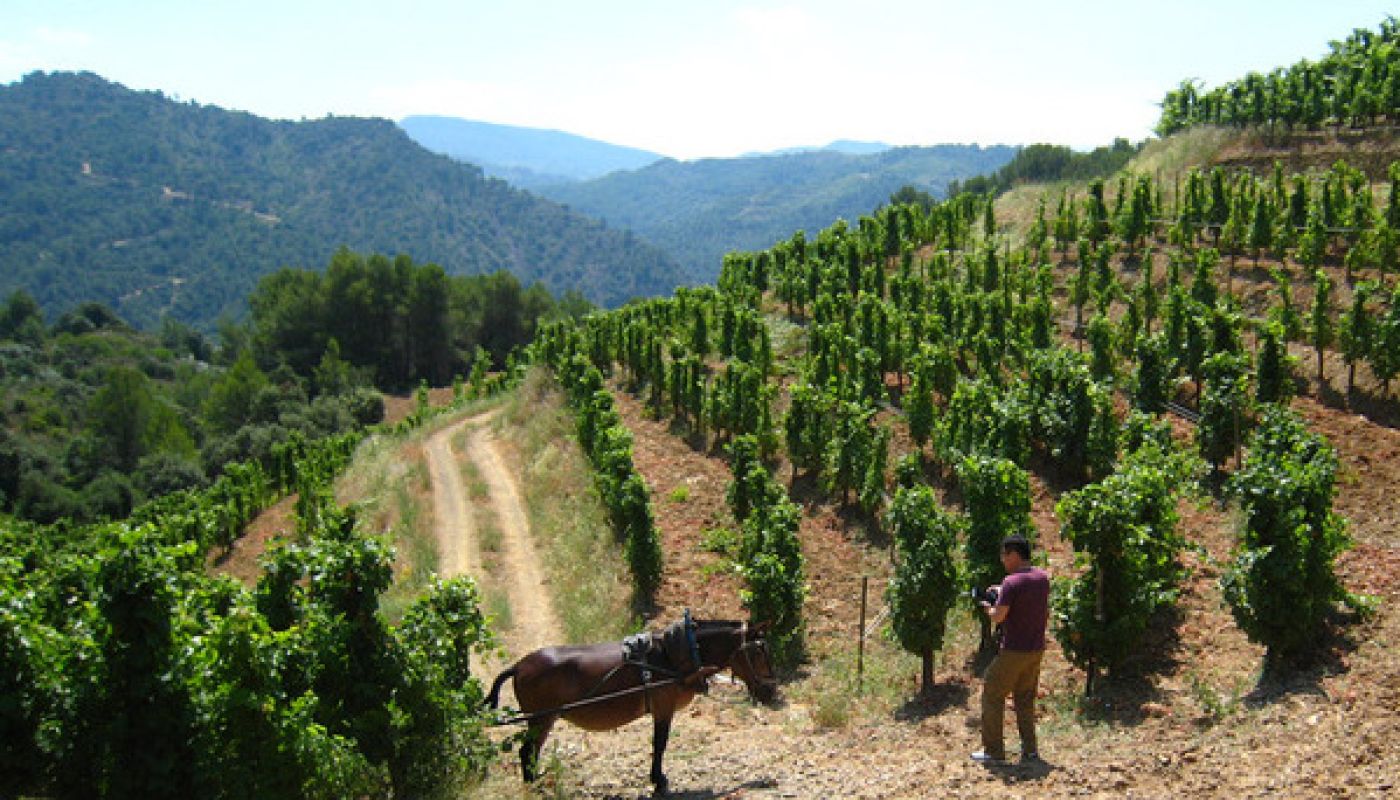
Our picture of one of Álvaro Palacios' Priorat vineyards was found on the blog Umami.