Jancis writes Apologies for the hiatus in publishing entries in our wine writing competition. There are so many of them (180 pairs of articles) that it would be a bit daunting even if I weren’t in the middle of moving house for the first time in 33 years. We will do our best to announce a winner by the end of the year but I’m afraid we cannot guarantee it. Today's article is one of those sent by the Reverend Robert Stanier, who describes himself thus:
I am 41 years old. I am a vicar in Surbiton (as it happens, where Charles Berry of Berry Brothers & Rudd once lived), am married and we have three small children. I first became interested in wine when I was staying at a house my parents at that time owned in Burgundy and started visiting domaines nearby.
Germany and the Mosel: vines without drinkers
Wine to answer a question most people do not think to ask.
There are only three countries in the world that hold a white wine as their main suit. If you pass by Hungary, whose unctuously regal Tokaji provides sweet delights at fearsome prices, that leaves New Zealand and Germany.
New Zealand has been the rising phenomenon of the last 10 years, and its trump card is Sauvignon Blanc. It is the default setting for the canapé season, but it also takes over much of the British summer. And it is now, to Aussie chagrin, the most popular white wine even in Australia. You can see why: crisp and incredibly reliable, affordable if not exactly cheap, it offers a tasting certainty for six or seven pounds. And it’s been around for only 30 years or so.
Germany on the other hand has been making wine for centuries. Its Riesling is known to be a class apart, and yet who actually drinks it? A quick glance at my local supermarket shelves found 10 New Zealand Sauvignon Blancs and a lone representative of German Riesling, tucked in below the Italian whites feeling rather sorry for itself.
I would say there are two consumers of German wine.
The first is the old-school wine connoisseur. When Berry Brothers republished its 1909 wine catalogue, it revealed that there were basically three regions from which the English drank wine: Bordeaux, Burgundy and the Mosel. When my grandfather became a university academic in the 1930s, the older dons would drive out in the long vacation into the Mosel Valley to scout out bargains for the college wine cellar. Doubtless, the gorgeous German hillsides eased the journey. The point is, though, clearly they had a great affinity for this wine. It was the drink of the six o’clock aperitif, and the wine for intellectuals discussing the respective merits of Hegel and Kant. For some it still is.
But then came the arrival of Liebfraumilch. In the cash-strapped 1970s, pretty much the only wine that was affordable and available in British shops was this German speciality. Simple, sweet and easily drinkable, it was the first mass-market white wine. It was so popular that it even went down a storm at Abigail’s Party, and therein lies the problem.
Too dumb at one end, too intellectual at the other, German wine currently bypasses 95% of British wine drinkers, and it had largely bypassed me until a holiday a few summers ago in the Mosel where I set out to discover what I had been missing.
Part of the problem is the labelling. There is a system for labelling German wine, but it is not one that actually tells you very much: a Spätlese could be sweet, but it could almost as easily be dry – you just do not always know from the label. The fact that the winemakers I spoke to actually admired the French in this respect spoke volumes: the rest of the world has bypassed French labelling because consumers want to know the varietal not the region, and yet the Germans still cannot see past their neighbours in terms of marketing.
And yet there is a subtler problem too. It now seems to me that German wine offers the answer to a question that the British wine consumer does not think to ask. For the British, you do not drink wine before six o’clock in the evening, except possibly with lunch. Moreover, wine, unlike beer or spirits, is something to be consumed with food.
And yet when I asked the local Mosel winemakers what they would suggest to eat with their wine, they would simply reply: ‘It can be enjoyed on its own.’ At a pinch, they would suggest fish to accompany one of their drier Rieslings.
And indeed in cafe after cafe in mid afternoon in the Mosel Valley, the tables were filled with people sitting around with glasses of white wine and nothing else. Or, stranger still, white wine with cakes. In fact, the chief question posed by waiters in the afternoon was whether we would like coffee or wine with our cakes. Coffee or wine? These alternatives do not make sense in English. In England, we have coffee or tea, and generally tea is the drink of the afternoon. Not so in Germany.
This is partly because German wines are often very modest in alcohol content and partly because the Germans do not fear sweetness in a wine, so its appeal is not limited to accompanying savoury dishes. This is anathema to the typical Brit who thinks they know something about wine.
When I was briefly the bar manager at my theological college, it was my job to buy in the wine. When someone did not like the white, they did not say, ‘I don’t like it.’ Rather, they said, ‘It’s too sweet.’ This was not because it was sweet: we were serving bone-dry Pinot Grigio. Rather, they knew that sweetness in a white wine was a sin worthy of its rejection, and so they justified their dislike with this reason.
I reckon that discovering a white wine might even be ‘off-dry’ is sufficient reason to put British wine drinkers off going near anything German.
This is a shame because they are missing out on a classic wine experience. To drink a good Mosel Riesling, and the Mosel region is teeming with independent producers all making their own delicious version at around €10 a bottle, is a pleasure all of its own. And yet it is not the type of pleasure you would expect.
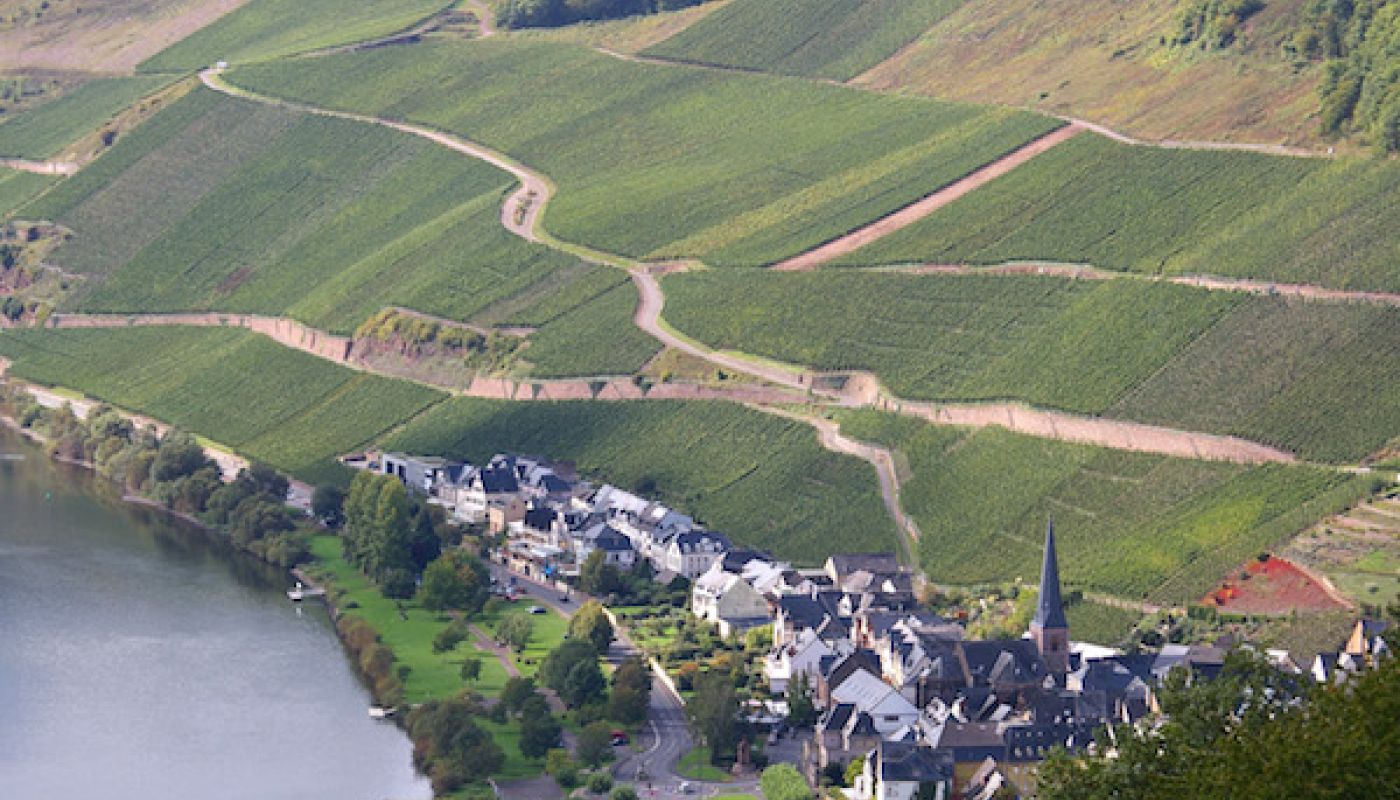
From the ludicrously steep slopes where this wine is produced, you would assume the result would be an extreme type of wine, but it is not: or rather, the only extremity is in just how balanced it all is. The winemakers told me that this was the result of their work in the vineyard, and then the key decision of when to break off fermentation, and stop allowing the sugar to turn to alcohol. The terroir was, if not quite incidental, then certainly not at the top of their reasoning for how to make the wine. This is curious because the Mosel Valley has to be one of the most unique terroirs in the world. Clinging to the vertiginous slopes of the Mosel Valley, the vines draw on sunshine, both direct and reflected off the river’s surface, thus giving the grapes a twofold source of light. In other circumstances, this might be too much, but this is light that is relatively weak because we are so far north of the equator, thus allowing a gentler form of grape maturity.
The result? Neither too acid nor too fruity; neither too sweet nor too dry. Like Goldilocks tasting baby bear’s porridge, you consume it and think, ‘This is just right.’
This wine will not overpower you (it is probably only 9% alcohol); it will not compel itself on you: rather, it will simply accompany you for half an hour, at ease with itself, allowing you to contemplate life and then move on, largely as sober as you were before you drank it.
Think of Miles Davis in his Kind of Blue period; or a good slow left-armer wheeling away on the fourth day of a Test match; or Bjorn Borg’s unruffled ground strokes bringing him Wimbledon glory. Balance and elegance. These are the qualities of a good Mosel Riesling.
And if all those comparisons feel slightly dated, that is perhaps no coincidence. We live in a more instant age, an age of the quick hit, and the power play. When was the last time you heard someone laud the qualities of self-control, poise or grace? And yet these are what Mosel Riesling has to offer.
For too long, the only English to appreciate Riesling have been the type of people who knew about German wine before Liebfraumilch took over in the 1970s: the old connoisseurs. And yet, just six hours’ drive from London, we have a wine classic on our hands. Moreover, with its modest alcohol level, it eases modern health concerns about alcohol consumption. Just as pertinent, outside the big names, it offers its pleasures at prices that this vicar can for the most part afford. It is too good to remain forgotten.
© Robert Stanier, 2016
The picture of Ürzig is Richard Hemming MW's.