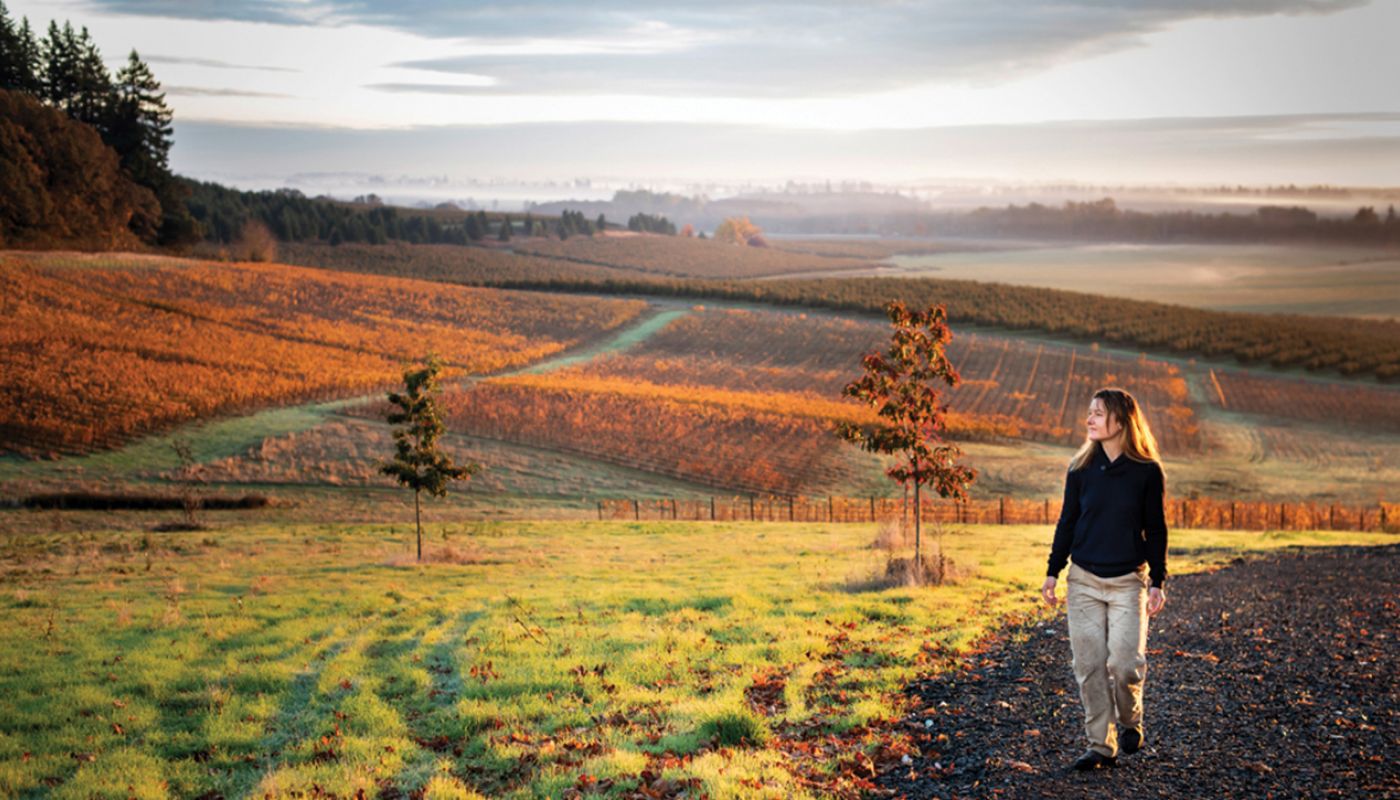
Mimi Casteel of Hope Well Wine in Oregon is Crusading for Regenerative Agriculture
Maybe wine isn’t entirely what I thought it was, was the phrase that circled my mind like water rushing to the drain; it was my main takeaway from watching a two-hour YouTube video called ‘Regenerative Landscapes Seminar,’ which featured a panel of speakers presenting to a room of wine writers and beverages professionals. One speaker in particular, Mimi Casteel, spoke with such a fervent glow, I found myself captivated by the information she shared, as though I were watching Beyoncé perform at the Video Music Awards and exit with the flourish of a mic drop.
I was so intrigued by Mimi, I determined to learn more about her work. From my East London flat, I learned that she is the founder and owner of Hope Well Wine, a vineyard and winery in Salem, Oregon, which is just down the road from the vineyard she grew up on, Bethel Heights (owned by her parents). Oregon, hm; it was not the wine region I had top-of-mind – in fact, I had just signed a book deal with HarperCollins to write about wine (among my other favorite fermented items) in Italy. As an American expat in Europe, I had been drawn to study Italy’s viticulture – the land of the Romans, the country that boasts more indigenous grape varieties than anywhere else on earth. I had an apprenticeship at a vineyard in northern Italy and had recently returned from trip in which I zig-zagged down through the country (with stops in Piedmont, Umbria, Lazio, Puglia) and concluded my research on the slopes of Sicily’s Mount Etna.
Oregon was a tangent, but I was still in information-gathering mode, and if this Oregon wine producer could elucidate any of my Italian wine adventures, I felt the research would be time well spent. As far as I’d come in my wine education, I knew I still had a lot to learn.
When I had decided to write about my travels through Italy’s vineyards, about a year prior, I didn’t know much beyond the basics. Having been in food media for the better part of a decade, though, my rolodex was well-equipped with people who knew a great deal – its producers and heroes, its debates and trajectory. I emailed, texted, and rang about a dozen of these acquaintances (it was the wine writer Megan Krigbaum who first told me about Mimi), and I learned more from those conversations than from the wine classes I also enrolled in (and have since graduated from). Nothing beats an engaging conversation with a passionate, informed enophile.
I reached out to Mimi and set up a phone call with her, hopeful that she would speak to me with the zeal she exhibited when she presented about regenerative agriculture (which might sound like a new term, but during her presentation, Mimi sat upright in her chair insisting that it might seem innovative, but that it’s based on history; it’s a very old concept. I stand corrected. She seemed to convince every person in the audience with her fervor).
We corresponded via email and arranged to talk one afternoon in London, which was 5am her time, Pacific Standard Time. ‘Are you sure that’s not too early for you?’ I asked.
‘I like getting up early,’ Mimi replied. Turns out, at 5am she could talk to me unencumbered before her daughters woke up, and before the farm work began. I’d soon learn that she would forgo sleep entirely if it meant reaching more people to share her passion on the dire necessity that farmers and especially wine growers, like herself, immediately begin farming in a more sustainable way. Mimi lives to advocate for working in tandem with nature; to champion a bold elimination of chemicals.
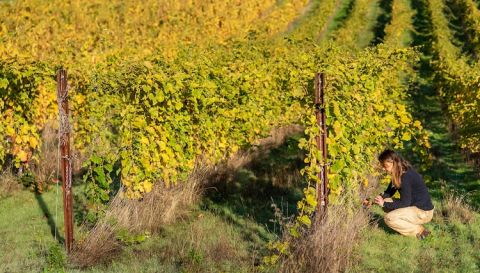
Oh, natural wine, you might be thinking – that’s what I thought at first, too. For my research about wine in Italy, I concentrated on had producers making wine by farming organically, growing grapes using ‘low intervention’ farming tactics and making natural wine: without many additives, if any at all. (In Italy, I’d meet with people like Danilo Marcucci in Umbria to Arianna Occhipinti in Sicily, and many more). I thought my interview with Mimi would fit squarely under the headline of natural wine, but I missed the mark just a bit. Mimi’s style of sustainability borrows from various camps – the biodynamics crew and the permaculture folks, etc. – and has one very specific focus: soil.
‘For most people, when they think of terroir, their mind goes straight to soil,’ Mimi told me. ‘They have a vision of soil that’s freshly plowed by a horse – bare, brown soil, and almost fluffy. But that’s not all terroir is.’
‘What else is there?’ I asked.
There’s a ‘nexus’ of living things underfoot, she explained, ‘These organisms communicate with each other, and if we repeatedly disturb the habitat, then those communication networks need to be rebuilt.’ To Mimi, boosting the habitat of the soil means farming without irrigation and without tilling. She grows not just grapes, but other fruits and vegetables, too, for the same purpose. She even introduces animals on her farm (pigs and ducks, for example) to further support this habitat.
What about weeds? you might ask. Well, Mimi hates the word ‘weeds,’ and insists they’re not invasive, but rather just one aspect of a healthy ecosystem. Now before you start to write her off, if you disagree with her practices, you need to know about her academic and professional background.
After her childhood on her family’s vineyard, Mimi got her BA in Classics and History from Tulane University, then worked with the National Forests after graduation, which stoked her interest in ecology and botany. From there, she earned her Masters of Science in Forest Science and afterward spent several years working as a botanist and ecologist for the Forest Service. Eventually, she felt the pull of her roots and moved back to her family’s vineyard in Oregon. In 2015 she opened her own vineyard, Hope Well Wine, where she makes Chardonnay and Pinot Noir.
As we spoke, she referenced these various previous experiences and I suddenly understood how Mimi was able to speak so incredibly effectively on this topic: She’s a farmer. She’s a scientist. She’s a businesswoman. She’s a lover of wine. All of these parts of her identity arm her with the knowledge of how to move forward in a sustainable manner, and gravity with which to communicate that message. She can speak to everyone – from the poetic among us (‘Wine is the nexus of food and art.’) to the practical (‘Agriculture is now second only to energy production in the production of greenhouse gases.’)
Regardless of how effectively she code-switches, the bottom line remains the same: the agricultural system needs to put the health of the soil first. Mimi talked to me with an urgency in her voice. ‘It’s not too late to turn [the harm done to the earth] around,’ she said.
The reason she is hopeful that wine can be the conduit to regenerative agriculture becoming widespread good practice for farming across industries is because wine is such a transcendent product. ‘It touches people in a way [other agricultural products] don’t.’ She believes wine drinkers can be the tastemakers and the loudspeakers for this change, but first, winemakers like her must show them the difference. If she can get drinkers to understand the crucial importance of a soil’s biodiverse habitat and taste that the final product is more delicious because of it, then the mountain to climb doesn’t feel as daunting. In an article written in PUNCH magazine, Leslie Periseau writes, ‘The fact that Casteel’s methods make better wine is almost beside the point, but one worth considering nonetheless.’
Similarly, the importance Mimi places on the well-being of her workers (many of whom are immigrants who have worked that land for more years than she’s owned it) is seemingly a tangent but is just as significant in the conversation of sustainability.
So, just as Mimi relies on her team to make great wine, Mimi is counting on convincing wine drinkers that the agricultural norm must shift to more regenerative practices. The demand from drinkers will mean more vineyards will seriously consider shifting their production methods. ‘Wine growers have always been the leaders of communities,’ Mimi told me. ‘And for that reason, we should question our own conceptions of how we do this the best way.’
Mimi’s farms offers a microcosm of what’s possible, and what could be the future of winemaking. Just as I considered, Maybe wine isn’t entirely what I thought it was, after seeing Mimi speak in the YouTube video, I hung up the phone with her and thought, Wine will only have a future if…
I pivoted back to writing my manuscript, about all the Italian vineyards where I had sipped, spit, and conversed, but everything was cast in a new light after my nearly two-hour long conversation with Mimi. She’s doing something extraordinary in Oregon, and if it weren’t for a global pandemic, I’d be there to taste her wines (duh) and to see her garden of Eden with my own eyes.
(Both images are by photographer Aubrie Legault)
















