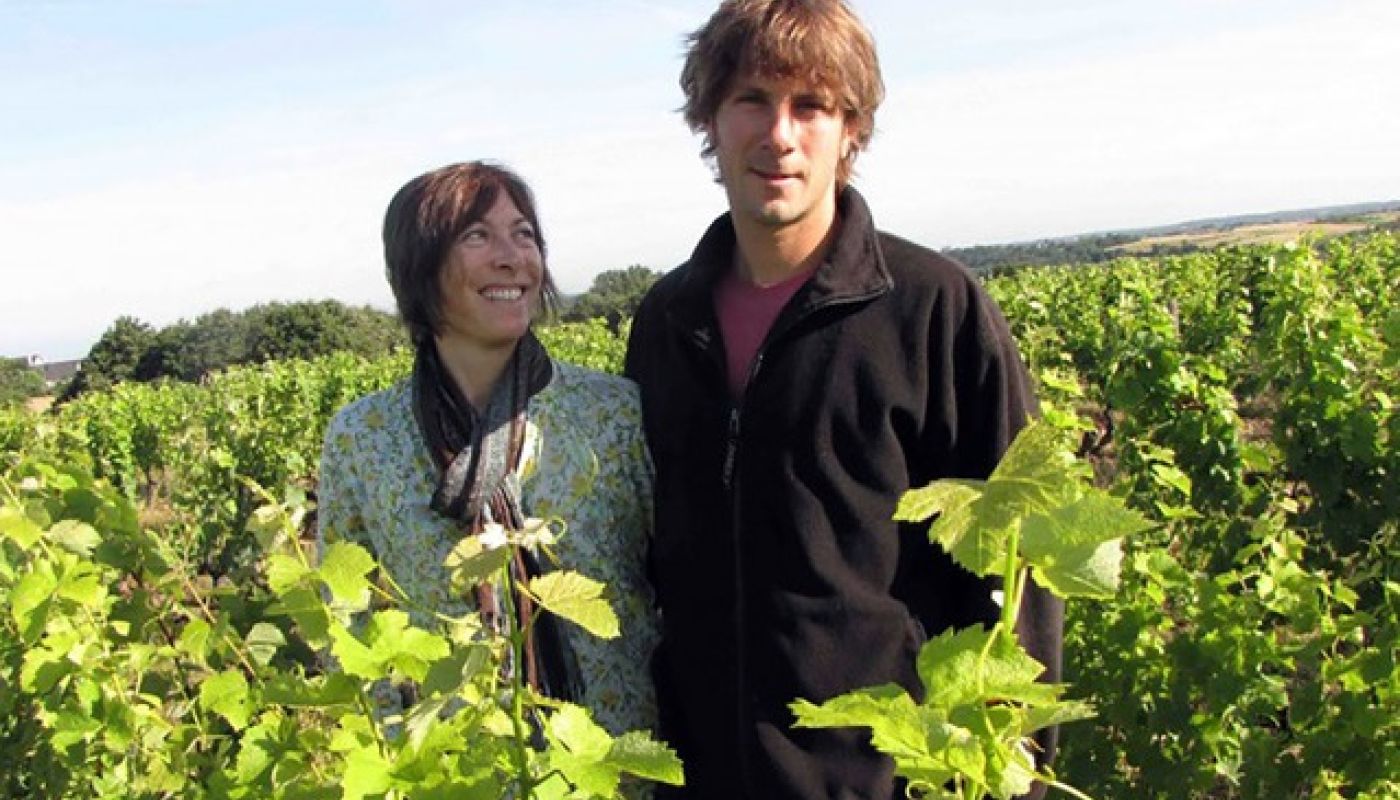
La Grange Tiphaine: Damien and Coralie Delechenau finding balance
It is a clear, crisp April morning in 2017 in the vineyards of Montlouis-Sur-Loire, a village nestled on the banks of the Loire River. This part of the Loire Valley, La Touraine, is rich in history, chateaux – including Leonardo da Vinci’s final resting place ten kilometers to the west in Amboise – and the agricultural bounty the Loire affords. Such breathlessly still, cloudless mornings are a boon for the numerous montgolfières – hot air balloonists – who take to the air at dawn at this time of year. However, for the dozens of winemakers in Montlouis, cool spring mornings mean frost, which threatens the entire vintage. This day, the serenity is pierced by another of Leonardo’s designs: helicopters descend to a few hundred feet above the vines of Montlouis, disturbing the calm, circulating warm air from above and saving the season.
This kind of modern intervention is not what you might expect in an appellation widely regarded as one of the most organic in France. Yet the swarm of helicopters that spring morning was an idea spearheaded by the leading advocate of clean farming and sustainability in the region: Damien Delecheneau.
This is the challenge of the Loire. A unique confluence of weather conditions, the proximity of the river and climate change have led to ever-increasing problems with frost, sometimes with devastating effects. In 2016, the area saw a 70% loss of fruit to frost. Twelve months later, the threat had returned. Helicopters are one of the most effective defenses against frost – in a matter of minutes a helicopter can push down the hot air layered above the surface, raising air temperature at ground level above freezing and rescuing the precious buds. But they are certainly not environmentally friendly, nor popular with neighbors in the wee hours of the morning. Damien Delecheneau, the president of the appellation and one of the most respected organic and biodynamic voices in the region, was faced with this dilemma: two or three hours of exhaust fumes in order to save not only the grapes, but the season, the many jobs, and ultimately a community that relies on the work and products.
In the end practicality won, and the group of vignerons who used the helicopters in Montlouis saved their crops. Conversely, Damien suffered a complete loss at his vineyards in nearby Amboise, where he did not intervene. A tough lesson, but just one of the many challenges facing small organic and sustainability-minded producers here. The usual rules don’t work in the Loire. For Damien the answer always lies in finding the right balance. Balance of the old traditions and new technology, what is good for the land and what is best for the wines.
La Grange Tiphaine is the 15 hectare domaine of Damien and his wife and business partner Coralie Delecheneau (pictured above). Damien is the fourth generation to work this land, and after studying oenology and viticulture in Bordeaux and working at wineries in California and South Africa, he returned to the Loire in 2002 to take over, growing grapes in Montlouis-Sur-Loire and Amboise. After two decades he now crafts nearly a dozen award-winning wines that evoke the terroir in its purest sense. La Grange Tiphaine produces elegant, precise wines from five grapes: the white Chenin blanc, and four reds: Côt (Malbec), Cabernet Franc, Gamay, and even a rare local variety Grolleau. Sparkling, dry, sweet – no matter the style, each is distinctive and well … balanced. Damien has a rare, astonishing scientific approach to natural winemaking. From the hands-off approach in the vineyard to the low technology design of the winery, his efforts to ensure quality while using as few additives as possible rival some of the most technically advanced wineries in the world.
On his return almost two decades ago, Damien had already set his mind to changing over the production to organic, not because he had studied it extensively or seen it first-hand in his travels, but simply because he knew it was what the land needed. He found a few mentors, and absorbed everything he could from the organic leaders around him, experimenting all along the way. At first it seemed easy, but they quickly found challenges. As Coralie told me, ‘The soil remembers. The first years of transition are easier as the soil seems to remember the chemicals, but after a few years, once again the soil is clean, and the work becomes more technical and challenging.’
At this point came the first need to find balance. A complete conversion in one vintage on a commercially productive vineyard would cause the vines to suffer. All pesticides were eliminated, but some herbicides had to remain. Each passing year led to more decisions, how to create the best wines and help the land heal, with the least intervention.
Eventually the Delecheneaus discovered the biodynamic ethos, and began implementing those practices, but again in a balanced fashion. Instead of consulting one of the biodynamic wine gurus, they learned from biodynamic ‘maraîchers’ – people growing vegetable gardens and selling their products in local farmers’ markets. This led to what Coralie calls a ‘pure understanding’ of the practices and various preparations. The domaine was certified biodynamic in 2014. The result of all this effort? According to Coralie, the vineyards now have, ‘Noticeable balance – health, roots, soils, leaves, grasses, animals, insects. A balance of everything.’
Developing the Grange Tiphaine Living Ecosystem
While they struggle to compete with helicopters in terms of carbon intensity, cows produce 250–500 liters of methane daily. And yet, a frequent sight on the unplanted land adjacent to Damien and Coralie’s vines in Montlouis are a herd of cattle. One of the foundations of biodynamic farming is the use of compost instead of chemical fertilizers. Cows produce methane, but not only methane. Damien and Coralie lend a parcel of land they own that is not suitable for vines to a local ‘éleveur’ (livestock breeder), who in return provides the manure from the animals grazing on La Grange Tiphaine grass. They combine this with straw and apply biodynamic preparations, in time with the cycle of the moon, to create a compost for the vines. The Delecheneau are currently looking to take a further step in biodiversity of their vineyard with the introduction of sheep, geese and ducks to roam between the vines, both grazing and enriching the soils.
This is another extension of the goal of minimal machinery from tilling to planting to pruning. La Grange Tiphaine strive to only do things once. They prune carefully early, only leave a few buds – the exact number they want at harvest – to avoid waste of a green harvest later. They use very little water, try do as much as possible with their own hands and are fiercely protective of the ecosystems they create for their vines, many of which are more than 100 years old. The leave the natural grasses in between the vines uncut, only occasionally encouraging them to mulch when needed.
Of course the harvest is all done by hand, often in many successive ‘tries’ – passes through vines to meticulously take just the ripest grapes from each bunch. Their Chenin Blanc for example comes almost exclusively from one plot, picked four times over the autumn – first for pétillant (sparkling wine), then sec (dry), then demi-sec (off-dry) and finally moelleux (sweet). It is time-consuming, exacting work, but the kind of thing that makes the wines so precise.
In the winery, the grapes pass gently through a pneumatic press, then are gravity fed into inert vats in the winery below and allowed to cold settle. The fermentations are often plot by plot and variety by variety. But there are challenges here too. They began with many of the tenants of organic and biodynamic winemaking, but again found the need for balance. Early on, they eliminated filtering in the wines, but noticed it led to reduction so have returned to a small amount of filtration to ensure brightness. They also dropped to very low or no sulfur, but started to see some oxidation, so now use a bit more. Again, balance.
Damien is also working hard to spread the sustainable message far and wide. In Montlouis, where he presides over winemakers both organic and traditional, he pushed through an appellation-wide ‘désherbage’, a total ban of all weed-control chemicals in 2018 one of the first to do so in France. He also teaches at the Lycée Viticole in Amboise, creating a specific certification for organic viticulture, ensuring the next generation of vignerons continue to preserve the land. The Loire Valley has become something of a hub for organic viticulture, the Montlouis appellation alone is an astonishing 35% organic. There is little doubt Damien’s voice has been an important part of that ever-increasing percentage.
When asked about their ethos, Coralie says, ‘There is nothing special’ – no right technology, or wrong tradition, but just the right approach.’ Which for La Grange Tiphaine, is a hands-off and deeply considered approach. One that yields both seriously special wines and a legacy for the future. Balance indeed.
















