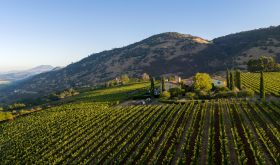
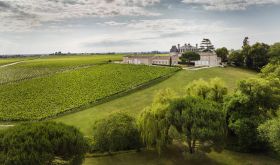
Midwinter is a fine time of year to consider the rich, robust wines of the southern Rhône valley with such resonant names as Châteauneuf-du-Pape, Gigondas and Vacqueyras. These wines, generally made from Grenache grapes grown on low vine stumps blended variously with Syrah, Mourvèdre and Cinsault plus the occasional dash of Counoise, Picpoul Noir, Terret, Vaccarèse or Muscardin, are the wine equivalent of a thick daube – complex, herby, often spicy, powerful and definitively warming.
Towards the end of last year I set off for Avignon to taste my way through the latest vintage to be offered for sale, 2004 – assessing hundreds of wines blind, supplementing other (non-blind) tastings in London. The low winter sunshine gave the city’s papal stonework a roseate glow and the surrounding vineyards were still gilded with vineleaves in the colours of autumn. It all looked crisp and alluring and my first look at the vintage, organised on a Sunday afternoon in the Hotel Mirande a stone’s throw from the Palais des Papes, was in the most beautiful indoor setting for a wine tasting I have ever encountered.
I was shown down a stone spiral staircase into the bowels of this carefully restored hotel particulier with a 700-year history and led through various stone chambers until I found myself in the most stunning old kitchen, lined with an ancient range and shelves stacked with plates, jugs and coffee pots of varying sizes, warm lights catching the copper pans. The room was dominated by a vast scrubbed deal worktable on which were lined up dozens of numbered bottles disguised by knitted wine-coloured tubes, some top quality glasses, and various folders in which, after tasting, I was to find details on every wine.
The hotel’s head sommelier had apparently arranged this perfect tasting, completed by easy access to (discreet) sockets for my laptop and rush-seated chairs at just the right level for the table. I was in heaven, although deeply suspicious of something so visually perfect. Surely it was just a set for upmarket food photography? In the middle of the table was such a carefully arranged still life of orange pumpkins and artfully torn pomegranates on an old wooden board that I assumed they were all made of wax or pottery. I was thrilled to discover they were real – and all the more so when young chefs came in every now and then to collect a dish or stack of plates. Yes this was a real kitchen where, as I discovered afterwards, the Mirande runs a cooking school.
But what of the wines, the more impatient of you will ask. And yes, it’s true that if they had been a disappointment I would not have left the kitchen so elated. But in general the 2004 reds of the southern Rhône, including many relatively inexpensive Côtes du Rhône and Côtes du Rhône Villages are very attractive wines.
They are in general juicier and less obviously concentrated than the 2003s made in the heatwave summer (which tended to produce rather less extreme wines in this relatively hot wine region than in more northerly ones). The phenolics, notably the tannins, had a chance to ripen fully (unlike some 2003s) resulting in much more supple wines. Although summer temperatures were rather more moderate than in 2003, drought conditions persisted with five or six months without any precipitation at all, until some rain in late August. This prejudiced the ripening and health of the Syrah grapes whose ripening process had already been slowed by the drought and whose relatively thin skins made them a target for rot. Crop-thinning was needed to achieve any sort of decent ripeness and even so tannins tend to be pretty dry in such Syrah as has been included in these southern Rhône wines – especially those grown on light, sandy soils such as much of Lirac. (In the northern Rhône where Syrah dominates, the wines are noticeably less successful than in the south in 2004.)
But 2004 produced a reasonable, though not generous, quantity of typical Grenache, limited by some poor fruit set back in June, and Mourvèdre and Cinsault were particularly successful. Cool nights in September helped to keep the wines reasonably refreshing.
After the exceptionally rain-plagued 2002 and the exceptionally hot 2003 seasons, growers were relieved to be able to call 2004 “almost a normal year whose wines will be much more interesting than the 2003s” according to Thierry Usseglio who is in charge of promoting the Fédération, one of the two warring groups of producers of Châteauneuf-du-Pape who sometimes seem to be doing their best to limit the progress of this exciting and extremely varied appellation.
In the best wines there is lots of fresh fruit, attractive but not dominant acidity and an almost burgundian balance of sap and vigour. But those considering investing in this attractive vintage should be aware that many growers are even more enthusiastic about their 2005s which they report are more aromatic and more concentrated by the drying mistral of early autumn.
I found a recurrent ripe black cherry character in many of the wines. Alcohol levels are always high in the southern Rhône, often as much as 14.5 per cent or even more in Châteauneuf-du-Pape, but I found obvious heat and a lack of balance through excess alcohol relatively rare in the wines I tasted. In each appellation there would be one or two examples of wines that seemed to be made to an international formula of overripe, jammy fruit and/excess oak rather than expressing any inherent local character but these, fortunately, were relatively rare.
One of the more useful conclusions I reached was that many wines carrying the Gigondas, Vacqueyras and, especially Côtes-du-Rhône Villages appellations were excellent value, and better than many Châteauneuf-du-Papes which generally carry a much higher price tag.
There really is a step up from straight Côtes du Rhône to Côte du Rhône Villages which must come from certain specified superior villages, or areas, within the region to which four new ones have just been added – Comte de Signargues, Massif d’Uchaux, Puymeras and Plan de Dieu – to more familiar names such as Vinsobres and Rasteau, both of which are seeking appellations in their own right for their robust dry reds – status already accorded to Gigondas, Vacqueyras and, very recently, Beaumes-de-Venise.
Many of the Côtes du Rhône and Côtes du Rhône Villages are already bottled but most of the Châteauneufs will not be bottled until early summer so my notes have to be read in that context. There are doubtless many great wines I have not had a chance to taste – Rayas and Henri Bonneau’s spring immediately to mind – but the wines listed were those that particularly stood out for me. Domaine la Roquète is a new domaine owned by the Bruniers of Vieux Télégraphe.
A real revelation was how good the 2004 southern Rhône whites are, but that is a subject for another day.
For detailed tasting notes on 220 wines of all three colours see purple pages.
FAVOURITE 2004 SOUTHERN RHÔNE REDS
Ch de Beaucastel (Perrin) 2004 Châteauneuf-du-Pape
Clos du Caillou, Les Quartz 2004 Châteauneuf-du-Pape
Dom Paul Autard, Côte Ronde 2004 Châteauneuf-du-Pape
Dom Duclaux (Jérome Quiot) 2004 Châteauneuf-du-Pape
Dom Grand Veneur, Les Origines (Alain Jaume) 2004 Châteauneuf-du-Pape
Dom de la Janasse, Vieilles Vignes 2004 Châteauneuf-du-Pape
Dom la Roquète, L’Accent 2004 Châteauneuf-du-Pape
Dom St Préfert, Collection Charles Giraud 2004 Châteauneuf-du-Pape
Isabel Ferrando, Colombis 2004 Châteauneuf-du-Pape
Perrin, Vieilles Vignes Pre-Phylloxerique 2004 Gigondas
Dom du Pourra 2004 Gigondas
Dom Santa Duc, Les Hautes Garrigues 2004 Gigondas
Dom Santa Duc 2004 Gigondas