
The group of bordeaux specialist wine merchants and commentators with whom I taste a complete set of the top wines of one or two vintages at the beginning of each year are a curmudgeonly lot. The merchants particularly, because they don’t have to publish their notes and ratings, so some of them are downright rude in their comments and miserly in the extreme with their scores.
They’re all men and British so a certain amount of sardonic superiority is expressed. But the other day they were all struck dumb, for the first time in the many years I’ve been tasting with them, by the sheer magnificence of what man and Nature had achieved in the best reds of the 2009 vintage.
In the case of the ripe 2009 vintage, man was involved rather more than usual because of the unusual weather pattern. A nice cold winter and a relatively wet spring had left the vines healthy and the underground reserves of water plentiful. Then came a blissfully settled but not extreme, warm, dry summer that led some producers to call 2009 ‘a deckchair vintage’, one in which they didn’t have to work combating damp and disease in the vineyard.
The grapes matured steadily, with so little rain to swell them that the skin-to-juice ratio was high leading to wines chock-full of colour, tannin and flavour. On lighter soils with little water-retaining capacity some vines were so stressed by the drought that the ripening process stopped for a while, but some light rains in mid September helped, and then, the key to man’s role, was the exceptional fine, warm autumn that allowed everyone to decide exactly when they were going to pick. Some of the earlier-ripening Merlots had already been harvested in order to preserve acidity but producers on the left bank (Médoc and Graves), all of whom depend much more heavily on Cabernet Sauvignon, had the unusual luxury of watching their already concentrated grapes steadily concentrate and ripen even more in the late September and early October heatwave. With no rain or plummeting temperatures threatened, they really could decide exactly when to harvest.
The 2009 crop was also generous enough that the most ambitious producers had the ability as well as the will to do everything they could to maximise the quality of their main wine, the so-called grand vin, by selecting only the finest lots of wine to go into it. This was the first vintage that the new wave of Chinese speculators were seriously interested in, so it was worth, went the theory, going all out for high scores from the critics to justify maximum prestige and really high prices. The first growths also started to work even harder on the quality of their second and even third wines.
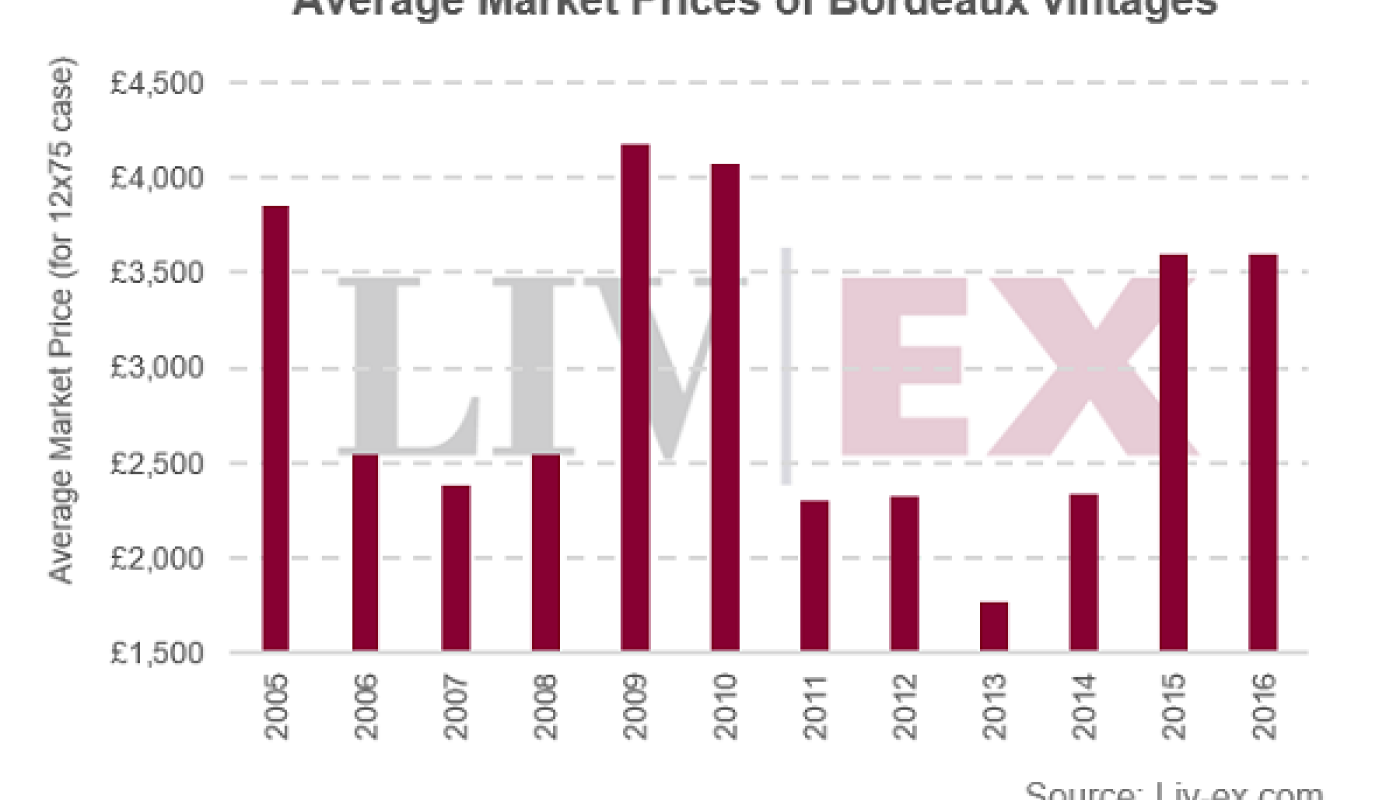
Largely thanks to Asian demand, as well as the obvious quality, the embryonic wines were offered the following spring at record prices ‘en primeur’. Much to the chagrin of these new investors, it would be many years before anyone made any money on them, and the vintage is still the most expensive on the market (see Liv-ex's chart below). The first growths are in general selling at considerably lower prices today than they were released at in 2010!

Top red bordeaux may have firmly put itself into the luxury bracket with the 2009 vintage but, to judge from how the best wines are currently tasting, I have reluctantly to admit that perhaps they deserve it. (My natural inclination as a wine lover rather than wine investor is to want first growths to be affordable by all.)
That said, the 2009s are not uniformly great. As a general rule, the heavier and damper the soil, the better chance the vines had of withstanding the long summer drought (not as severe as in 2005) and heat (not as severe as 2003). But at some addresses, the grapes clearly lacked freshness. Some may have been picked too late when they had started to raisin. Usually when we taste this number of bordeaux the main problem with the bottles is cork taint. With the 2009s, of which we tasted well over 150, the main problem was oxidation, particularly but not exclusively in Pomerol and St-Émilion on the right bank, suggesting that the wines have evolved far quicker than the general rule of thumb for fine bordeaux, that it should be ready to start to drink at around 10 years old.
It did seem as though on the right bank, with the exception of sui generis Petrus, famous for its water-retaining clay underpinning, the blends with a bit of Cabernet Franc to add freshness to their Merlot performed best.
In the Graves, the first growth Haut-Brion and its superstar stablemate La Mission Haut-Brion were both stunning, the former, for once, more reserved than the latter on this recent showing.
On the lighter soils of the southern Médoc, such as among the lesser wines of Margaux, there were probably more disappointments than further north. That said, there was lots of pleasure to be had from Margaux’s best wines, and the first growth Château Margaux was completely sumptuous, helped perhaps by the launch of a third wine in 2009 that soaked up almost a quarter of the crop.
But it was the damp soils of St-Estèphe that produced some evidently great combinations of the ripeness of the vintage and the fresh, slight austerity of the appellation. Some of the best bargains of the vintage are the less well-known names from around here, whether classed as St-Estèphe or Haut-Médoc, many of them classified as Crus Bourgeois, below the rank of the wines in our recent tasting. Among Crus Classés, both of the big names Montrose and Cos d’Estournel, which was initially thought to have been picked too ripe, showed very well – but Montrose’s often underrated neighbours Meyney, Ormes de Pez and Phélan Ségur, all of them costing £40 to £50 a bottle instead of seven times that, were also very impressive and unusually youthful for this vintage.
The St-Juliens also seemed if anything rather more youthful than the Pauillacs, but then they included the stately wines of the Bartons and the other two Léovilles as well as a particularly ambitious vintage of Ducru Beaucaillou. The sister properties of St-Pierre and Gloria showed particularly well and were more accessible.
The best of the Pauillacs were spell-binding, with both Latour and its second wine Les Forts de Latour outstanding (as the market has recognised), but Lafite and Mouton were truly thrilling too – as well they might be at around £700 a bottle. Silly prices. Better value but still steep would be Pichon Baron at under £200 or, especially, Grand Puy Lacoste which, at around £100 a bottle, one has grudgingly to describe as a relative bargain for a Pauillac 2009.
BETTER BUYS AMONG GLAMOROUS 2009s
Bear in mind this was Bordeaux’s overpriced vintage initially and most of the lesser names are no longer commercially available. But if you bought, for example, Ch Capbern Gasqueton 2009 St-Estèphe en primeur on my recommendation, I don’t think you will regret it. See this thread on 2009 bordeaux on our forum.
Bernadotte, Haut-Médoc
£23.95 Uncorked and elsewhere
Grand Puy Lacoste, Pauillac
£100 Tanners
Pichon Baron, Pauillac
£133 C A Rookes (more like £200 elsewhere)
Meyney, St-Estèphe
£42.60 Lay & Wheeler
Les Ormes de Pez, St-Estèphe
£25.85 plus tax Davy’s Fine Wine Broking List
Other stockists via wine-searcher.com. Tasting articles with notes, scores and suggested drinking dates on 168 bordeaux 2009s recently re-tasted, most of them blind, can be found via this guide to 2009 bordeaux coverage on JancisRobinson.com.













