Wines of the New South Africa – Tradition and Revolution
Tim James
University of California Press
£27.95/$39.95
In the wake of the end of the Mandela era, and into what is fast becoming the post-revolutionary phase, 20-odd years after the dismantling of apartheid, the South African wine industry faces a number of problems that James, a freelance wine writer, eloquently puts across in this honest, clearly written and intense study of what has happened and is happening in the Cape.
Beginning with an overview of the current issues affecting the region's wine industry, James juxtaposes the challenges facing contemporary winemakers with what was allowed to happen prior to 1994. James's analysis includes, for example, the influence of such institutions as the Koöperatieve Wijnbouwers Vereniging van Zuid-Afrika Beperkt – Cooperative Winegrowers' Association of South Africa Ltd – (KWV) and the fallout from the legislative control over the production, sale and export of South Africa's wine and spirits that the co-operative enjoyed from the early 1920s until the fall of apartheid in the early 1990s. This fundamental control of how the industry was set up was responsible, for instance, for a strategy that maximised quantity over quality, a lack of research that would have allowed the industry to make better choices when it came to matching the right varieties and clones to the right site, and no great emphasis on making fine wine.
James also takes a wry look at the knock-on effects of the apartheid years that, for instance, saw the illegal importation and subsequent propagation of Chardonnay cuttings – the only problem being that the cuttings turned out to be Auxerrois, which, while sharing some ancestry with Chardonnay, is definitely not Chardonnay.
There is also reference to the 'tot system' with the implication that the problem hasn't gone away. The 'tot system' (or 'dop system'), whereby farmworkers were paid in kind with a daily supply of cheap wine, was once widespread in South African vineyards. The system allowed the vineyard owner to offload cheap, poor-quality, unwanted surplus wine while at the same time holding the workers captive in a net of addiction. James touches on this problem along with the current long-term affects of alcoholism, one of the by-products of the system's success that continues to affect communities around the Cape's vineyard regions.
Looking to the future, James goes into detail examining such topics as the recent implementation of improvements in viticultural techniques; the lack of irrigation potential; the decline in vineyard area; the movement away from Chenin Blanc (which, while still the leading grape variety in South Africa, has declined nearly 13 per cent since 1996); the side-stepping of provincialism (a by-product of the isolationism that preceded the revolution); the limited choice of clonal material; and the restricted availability of less mainstream, more high-quality grape varieties; the lack of vineyard diversity in a climate that, while similar, does not rival that of Italy and Portugal; and the obsession with and pride in blending, among many other others.
Aside from that, James also has an extensive analysis of grape varieties, wine styles, legislation, labels and terroir before a thorough region-by-region study together with profiles of more than 150 of the country's best producers. Overall, this is a really fine, well-written book that is easy-to-follow, hugely informative, acerbic in its judgements, and a book you just won't want to put down – as well as being one of the best reads of the year.
Chile Wine Brief
Peter Richards
Self published on www.susieandpeter.com
£15*/$25 (53-page PDF)
*See this special offer for Purple Pagers
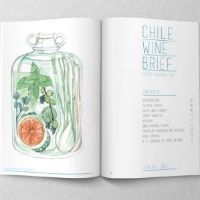
 It's a little surprising there are not more books written about Chile, considering the country's climatic diversity and the popularity of its wines. This pamphlet-like production, therefore, is a welcome addition and, in Richard's own words, is 'bang up to date'. It is, in essence, a 53-page booklet that investigates the current trends in Chile under a number of chapter headings that include talking points, grape varieties, regions, the 2013 vintage, producers, and of course wines.
Richards, who has been writing on Chile for a number of years, and who previously wrote The Wines of Chile (published in 2006 by Mitchell Beazley, which remains a sturdy comprehensive analysis of the region) provides on this occasion a report card that maintains Chile just needs to do better with its wonderful natural resources. In the opening segment, Richards raises a number of fundamental issues such as the reasons vine longevity is a problem bearing in mind that, in order to make great wines, mature vines are de rigueur; the continually rising alcohol levels when the market has long moved to a leaner requirement; the need for big companies to give younger winemakers the leeway to develop different styles or even mini-brands; the need to change the Chilean denomination system; the nonsense of parochial rivalry among winemakers; the government and winegrowers' obligation to get its water policy in order and to instigate investment in what is going to be such a valuable resource in the years ahead; and a justification for better consultants.
After that, there is a succinct overview of the facts and figures, grape varieties, the current vintage and the regions, written in a punchy, no-nonsense style that is refreshing and not afraid to say it as it is, highlighting local characteristics, star producers, and why one grape variety works better than another. Richards also offers his insights into the 10 best producers to watch, the 10 best-value producers, and star winemakers to keep an eye on. In the A-Z section on the producers, there are short, snappy appraisals followed by tasting notes for the best wines he has tasted. In essence, this is as comprehensive a study as you'll get in a short, well-packaged, uncomplicated pamphlet.
James Halliday Australian Wine Companion, 2014 Edition
James Halliday
Hardie Grant
£22.99/$40
This is another fine encyclopaedic instalment from James Halliday, following a formula that has worked well in previous years. Beginning with a relatively short introduction – which includes some interesting data on Australia's wine trade with China – and notes on how to use his book, Halliday turns on the juices with his snapshot of 2013; his winery and wine of the year; best of the best wines; best of the best by variety; best wineries of the region; 10 of the best new wineries; and 10 dark horses. After that, there are smaller pieces on Australia's geographical indications, its varietal wine styles and regions, and vintage charts.
The main body of the book, as in the past, focuses on the wineries and wines themselves with a winery-by-winery analysis and assessment that includes addresses, phone numbers, regions, winemakers, when established, opening hours, biographical background, vineyard acreage, and tasting notes for a representative amount of each winery's best wines. The 4,000+ tasting notes written by Halliday and two more team members, Ben Edwards and Tyson Stelzer, seem to be mainly in the 94 points range and are printed in red, as opposed to those below that standard which are printed in black. Overall, it ticks most of the boxes as you'd expect in what is a colossal body of work.