At the Peggy Guggenheim Collection in Venice there are 13 Pollocks: 11 by Jackson and two by his brother Charles. But did you know that when displayed adjacently, one Pollock always hangs lower than the other? (Apologies if that makes sense only to male readers.)
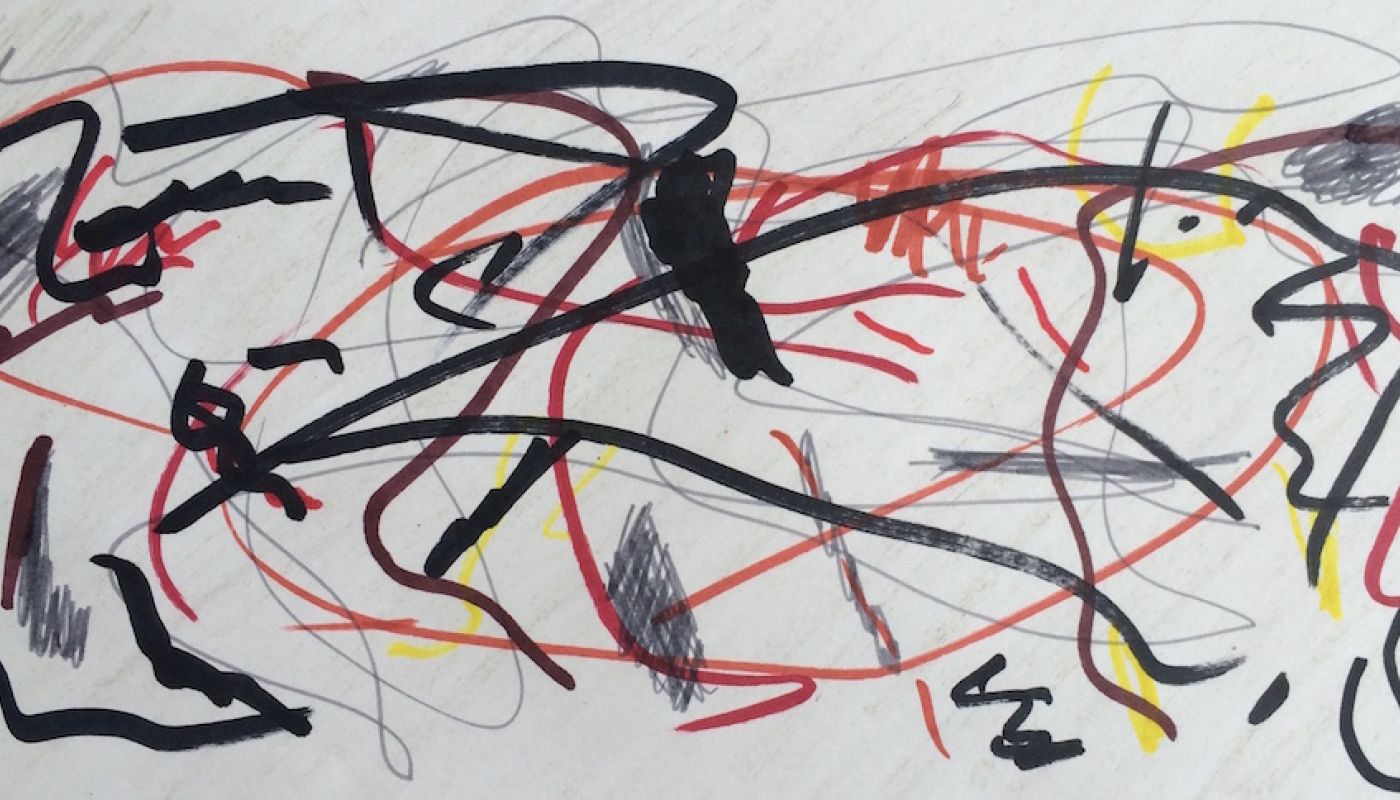
Several years ago, this museum provided me with my first encounter with an original Jackson Pollock. The piece was his 1947 painting Alchemy (you can see the original here). As an art ignoramus, my first reaction was the predictable one: what’s the big deal? Layers of different coloured paint sprawl randomly over a rectangular canvas. Alchemy schmalchemy. I certainly didn’t think that ‘it restates the negativeness of the universe'.
To the side of the canvas was a small explanation of the painting, part of which said ‘In Pollock’s classic poured paintings [...] line no longer serves to describe shape or enclose form, but exists as an autonomous event, charting the movements of the artist’s body'.
Armed with this titbit of knowledge, the painting now made sense. For most observers the true value of Alchemy is only revealed when you know that the image isn’t supposed to reproduce something tangible, but instead records the act of painting itself. It’s a concept which is much more skilful than it at first sounds. After all, if I just tapped the first keys my fingers came to then lsdimssdp k sofsofs er.s.
Just as with art, the appreciation of wine can be undeniably enhanced by increased understanding. Some knowledge is technical, such as appreciating that the unpalatable tannins of great young Bordeaux or Barolo will soften over time. Other knowledge is more romanticised – for example, Madeira’s distinctive rancio style originating from prolonged heat exposure in barrel on sea voyages, which these days is replicated within the winery.
Learning these facts explains why wines taste as they do, and that knowledge increases the pleasure derived from consuming it. But does it therefore follow that someone without this knowledge is less able to enjoy wine?
After all, it would be unlikely for someone to be able to fully appreciate Alchemy on its superficial appearance alone. Most uninitiated reactions range between puzzled and disdainful. I can imagine the same reaction being provoked by many types of wine. Indeed, I remember the first mature Riesling Auslese I tasted from the Mosel, on my second day as a green employee of Majestic Wine. I was given a bottle to taste overnight – an immediate perk of the job! The following day I returned it with a grimace, convinced that this sweet yellow linctus that stank of petrol was off. [I'm tempted to add a link to my views on Majestic's historic German wine range here – JR]

Shmalchemy, Richard Hemming, 2016.
One of the most enduring stories in wine is the Damascene conversion. In such scenarios, the intrinsic quality of the liquid is supposed to provide an epiphany, a sudden moment of clarity that reveals the wonder of wine to the unsuspecting drinker. Jancis wrote this of her revelatory experience with Chambolle Musigny, Les Amoureuses 1959 : ‘I knew nothing about wine at the time, but in that glass I could perceive not only a huge amount of sensual pleasure but the sense that in this glass was history, geography and the human hand in some form. The beauty in that wine lit the flame for a lifetime's fascination with wine for me.’

Label image courtesy of vivino.com
There seems to be a dichotomy here: on the one hand, wine evidently contains inherent qualities that speak for themselves, but on the other hand education is essential to unlocking a proper appreciation of wine.
The truth lies somewhere in between, of course: yes, it’s entirely possible to appreciate a wine with scant understanding of the subject. But it’s also true that increasing knowledge of the subject is fundamental to achieving a more profound enjoyment of wine. And what price could be put on such a lifelong benefit? (Merely £8.50 per month, folks.)
Returning to Alchemy, it’s interesting to consider that the value of this artwork relies on method of production over what it depicts. Rather than representing something, it primarily reflects its own creation. Perhaps the vinous equivalent is natural wine, where unconventional winemaking creates a style which expresses methodology above origin or ingredients.
Natural wine devotees relish the extremes of flavour which are conjured from these methods, but to the wine neophyte these flavours can be hard to swallow. Does that mean they should be educated until they learn to enjoy natural wine? That sounds rather too much like the disturbing 'aversion therapy' scene from A Clockwork Orange Wine.
It would be unfortunate indeed if wine could be enjoyed only by those able to devote time (and money) to it, yet as with any complicated subject an increased understanding of wine will confer an increased pleasure. Ultimately, it is the choice of the individual. We are all entirely free to choose whether we see a roomful of groundbreaking modern art or just a load of old Pollocks.