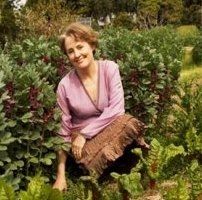
Alice Waters, the founder of Chez Panisse restaurant in Berkeley, California in 1971 and the passionate campaigner for local, sustainable and seasonal food, will be made a Chevalier du Legion d’Honneur by the French Consul General in San Francisco this Friday. It will be a quiet ceremony followed by what she described as a ‘more raucous party’.
The last American woman to receive this honour in this field was the writer, Julia Child, whose towering presence and booming voice have been so accurately captured by Meryl Streep in the recent film, Julia and Julie.
Both physically and politically (they used to disagree vociferously), these two women could not be more different. Waters is slight of frame but as elegantly dressed as one of her colourful plates, wearing when we met a short black satin kimono over a purple dress, both designed by her friend, Christina Kim.
A flawless complexion belies her 67 years and while there is no doubting the strength of her convictions, the voice that conveys them is almost febrile in tone. As we sat across the booth from one another in the café on the first floor of her restaurant I had to lean across, closer to any woman’s face other than my wife’s, to ensure that I didn’t miss a word.
What is perhaps most remarkable about Waters is that she has achieved so much from one single restaurant in which, most unusually, she has been as successfully in charge in both the kitchen and the dining room. Had there been any role models, I asked?
‘No,’ she replied with the first of many charming smiles. ‘I had always loved to cook and to serve. When I first went to Paris in 1965 I fell in love with the small, family owned restaurants that existed everywhere then, as well as the markets and the French obsession with buying fresh food, often twice a day. When I came back all I wanted to do here was to create a little corner of Paris.’
On the counter of the open kitchen are a wicker tray of artichokes and radicchio; a tier of lemons, dates and tangerines; loaves of sourdough bread and slices of just-made chocolate tart. These, and the walls covered in French film posters, bear witness to the fact that this homely but professional approach has not changed after 38 years.
‘But I do think women can pull these two roles off more effortlessly than men. Judy Rodgers does it at Zuni Café in San Francisco, Sally Clarke in London and, of course, the late and lovely Rose Gray at the River Café. When male chefs walk into their restaurant it tends to turn into a parade. This is my house and above all I want to make my customers feel welcome here’ she added.
This philosophy was underlined from the very outset by a pricing policy that offered a less expensive dinner menu at the beginning of the week rising, as demand did, to higher prices on a Friday and Saturday (dinner was originally $4.50 for three courses on a Monday, US$6 on a Saturday). ‘I did this,’ Waters explained emphatically ‘because I always wanted my friends to be able to afford to eat here.’ This admirable, and highly effective, practice continues today.
The biggest, but perhaps most significant, change remains hidden from public view, however. What Waters came to realize from working on both sides of the kitchen door, is that it was asking too much of any one chef to be responsible for the two sets of menus, in the restaurant and café, that would continually reflect her passion for the most seasonal produce.
Both kitchens now work to these same goals but under a different rhythm. There are two Head Chefs in the restaurant who, while paid for the year, only work six months and then can travel, learn and eat elsewhere. In the café their equivalents work three days on and two days off, an approach that Waters now realizes generates healthy competition and teams working in collaboration. Menus are not, she emphasized, generated from the top down.
It was time to eat, she decided, and having quizzed Sam White, a young waiter, she ordered some Hog Island oysters with sausages, a dish that for her always takes her back to eating out in Paris, sardine toasts with,salad, and a chicken breast stuffed with spinach under the skin with new season onions for us to share.
‘Waiters like Sam,’ she continued after he had turned to the kitchen, ‘are one reason I am so optimistic today. He’s the son of customers who’ve been coming here for years and who first brought him in as a baby. Now he’s in the restaurant business and there are a lot like him across the country and just as many going into farming. That has to be good.’
But Waters is under no doubt as to the enormous risks the planet faces unless and until it can put its whole food system back on a more healthy and sustainable basis. She is fully aware that this is going to be an expensive process but passionately believes it will be much less costly if we do it before the system is completely broken than if we wait until it completely broken.
For the past 15 years Waters has devoted her time, energy and the proceeds from the Chez Panisse Foundation to the Edible Schoolyard. This programme now encompasses over 1,000 schools across the US and teaches children to grow and cook their own food and take pleasure in nutritious, seasonal ingredients and in sitting around the table talking to one another.
When I try to interject and ask what impact this emphasis purely on local, seasonal ingredients will have on farmers and producers in the developing world who depend for their livelihoods on their exports, she seems ready for me. ‘Well, I think that they have to develop their own, local markets too. I realize that there will always be exceptions, luxuries like coffee, oranges or chocolate but what’s going on with food shipped all around the world is deeply wrong. We need to change this to sew our communities back together.’
Waters claims no originality for these goals. The idea for the schools project was somebody else while it is a return to eating seasonally and locally not a new beginning. ‘We’re hardwired to eat this way,’ she added, ‘it’s just that over the last 50 years we’ve simply forgotten how to do it.’
Although delighted with the French honour, Waters fully appreciates the irony of it, too. A French restaurant reviewer dismissed Chez Panisse 20 years ago saying it was ‘more about shopping than cooking’ and while she has had the last laugh in that so many chefs now follow her example this comment obviously still rankles.
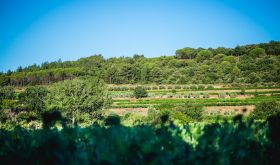
But, more pertinently, Waters rarely goes to France now to eat other than to visit her heroine, the 92 year old Lulu Peyraud, at Domaine du Tempier in Bandol, Provence. ‘The whole French food system as I knew it has been ambushed,’ she explained, as though speaking of a former lover, ‘it’s very sad.’
Her culinary heart now lies in Italy since she first fell in love with Tuscan food fifteen years ago and where for the past eight years she has been Vice President of the Slow Food Movement. The current manifestation of this empathy is her transformation of the food at the American Academy in Rome but what draws her to Slow Food is not just shared principles but her desire to preserve the knowledge of those who understand food to ensure that this is passed on to the next generation. ‘The food genes of today’s farmers, growers and chefs are vital and we need to preserve them.’
As a thin apple tart with prune and Armagnac ice cream, a quintessential French dessert, was served, I couldn’t help but notice that Waters’ hands, which had been moving rapidly whenever she spoke, now seemed to be flying in every direction. The explanation was further grounds for optimism.
‘I believe we’re finally having an impact across the US. Doors are beginning to open even into the Department of Agriculture. We’re getting support from those with the political astuteness I may lack but I now know is essential in Washington DC and Michelle Obama’s encouragement is invaluable, of course. It’s very exciting.’