11 October 2008 This is a longer version of an article also published in the Financial Times.
It is difficult to exaggerate how much Argentine wines have changed in the last few years. But perhaps that is not so surprising considering that the world’s fifth most important wine producer has been exporting its wines seriously for hardly more than a decade.
Until quite recently a typical Argentine wine was a full-throttle red of almost monstrous proportions – the perfect foil, it was frequently said, for Argentina’s massive steaks. They could even handle the highly spiced chimichurri sauce served alongside. There is still no shortage of fibrillation-strength reds, but a recent tasting of almost a hundred of the country’s finer wines suggested that even in Argentina, where – most unusually – there is no shortage of either sunshine or water, many of the most ambitious winemakers are consciously seeking more finesse in their wines.
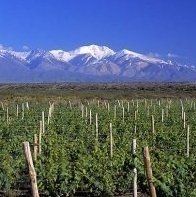
The key to this has been a noticeable trend to planting vines ever higher up in the Andean foothills, and further and further south, away from the equator. In the south of the country, Argentine Patagonia with its subregion Río Negro is now a serious wine producer in its own right. And a significant proportion of Argentine vineyards are now at more than 1,000 metres above sea level (in Europe’s much feebler sunshine, 500 metres is popularly regarded as an effective upper limit for successful grape ripening). In the northern province of Salta, there are even some vineyards higher than 3,000 metres. Donald Hess, Swiss-born owner of the eponymous Napa Valley winery as well as Peter Lehmann in South Australia and Glen Carlou in South Africa, has some of the world’s highest vines near his Colomé estate.
As Nicolás Catena, arguably the most prominent Argentine wine producer on the world stage, put it to me recently, the key to maximising Argentina’s special qualities as they pertain to wine lies in the measurement of, believe it or not (and photochemists will easily), microeinsteins per square metre. It is all about harnessing the extraordinary intensity of sunlight in Argentina to micro-manage phenolics and produce the optimum quality of wine. His team’s current research is focusing on the effect on the resultant wine of tiny changes to exactly how vines are shaded and which bits of the ultraviolet spectrum are favoured. I need hardly tell you that this is a man driven by the spirit of scientific enquiry. In fact he can hardly believe that so many non-Argentines have come to settle in his native country expressly to produce wine when he feels that the Argentine wine industry is nowhere near its ideal of having vines that are not only planted at the correct high altitudes for top quality wine, but are also mature enough to produce interesting fruit.
The Malbec grape, so disappointing elsewhere, is now the acknowledged king of the Argentine wine scene. Catena may now pride himself on persuading his joint venture partner Baron Eric de Rothschild of Ch Lafite of its merits, but it was only very recently that Catena himself was favouring the Cabernet Sauvignon of Bordeaux over Malbec, more readily associated with Cahors in France. For most of the 1980s and 1990s the ubiquitous Malbec was scorned in favour of the supposedly more sophisticated Cabernet, but now it is properly valued as offering a uniquely vibrant yet haunting expression of Argentine sunshine.
Malbec also, usefully, matures in bottle much faster than Cabernet Sauvignon – it is much lower in tough tannins, even though it is much higher in colouring matter. In the old days, Argentine Malbec was typically made in the image of Bordeaux, or of a Spanish or Italian red with an emphasis on mass and chew. Today, more and more winemakers are aiming for something a bit more burgundian, scented and sensual, often with much more judicious use of new oak. Mendel’s regular Malbec 2006 is a fine example at a fair price. Retailing at around £14 (as opposed to £21 for the more oak-dominated Mendel Unus bottling), it has a wonderfully rich, sumptuous nose, then a fine fragrance, a strong suggestion of crushed brambles, excellent refreshing acidity, less than 14 per cent alcohol, and the promise of voluptuous drinking over the next three years or so. What’s not to like?
For what it’s worth, I gave that particularly emblematic wine 17 points out of 20 but I ended up giving 17.5 out of 20 to all of 16 wines, and a score of 18 out of 20, which for me is a very high score indeed, to seven wines, those in the box. A significant proportion of the fruit that went into these wines was grown on vines that are at least 50 years old, and therefore capable of producing extremely concentrated, interesting juice. But as the vines in the newer, cooler wine regions mature, they are expected to produce even finer wine than the old timers in the traditional warmer regions’ lower altitudes.
With the sole exception of Nicolás Catena Zapata, which is based on Cabernet Sauvignon, all of my 18 pointers happen to be Malbecs, but of course Argentina is not just Malbec. Indeed it is not just red wine. It has its own headily perfumed white wine grape Torrontés, the crossing of Muscat of Alexandria and Criolla Chica/Pais/Mission, which, in its finest incarnations such as Colomé Torrontés 2007 Salta, would make a great-value substitute for a smart Condrieu from the northern Rhône Valley.
Then there is Argentine Chardonnay, which can be uncannily fine. California winemaker Paul Hobbs, whose own American Chardonnays fetch extremely impressive prices, is an old Argentina hand, and argues that although the precise origins of Argentina’s Chardonnay cuttings remain obscure, it is the stoniness of the soils in its most successful sites that imbue it with real class. His ex-employer Nicolás Catena maintains that altitude is the key to Chardonnay quality in Argentina.
There is still much to be discovered in South America’s dominant wine producing country – which is presumably part of its charm for all those French, Spanish, Italian and Austrian wine producers who have moved there. Head of the generic body, Susana Balbo of Dominio del Plata winery, has been concerned at the number of new winery owners who leave the business altogether after less than five years. “Part of the reason is that their business plan was flawed in the first place, but also we find that they were making the wrong style of wine. Too much extraction, wines too rustic. Argentina’s growth is in mid-priced wines with real balance.”
ARGENTINE TOP SCORERS
Achaval Ferrer, Finca Mirador 2006 Mendoza
Nicolás Catena Zapata 2005 Mendoza
Catena Zapata, Malbec Argentino 2005 Mendoza
Noemia, J Alberto 2007 Rio Negro
Noemia 2006 Rio Negro
Doña Paula, Micro Terroir Malbec 2006 Mendoza
Poesia 2006 Luján de Cuyo, Mendoza
See my full tasting notes on nearly 100 Argentine wines.