'I believe that climate change is the cause/amplifier of the two weather phenomena described below but I don’t have evidence. I do know that they are largely directly responsible for the very dry, hot conditions and precocious fire season on our continent, because the Bureau of Meteorology has told us so, since June last year. I wish that our politicians had listened to them.'
31 January 2020 See this current message on smoke taint from Wine Australia.
30 January 2020 We are making this article free so as to correct some impressions of the likely quality of the Australian 2020 vintage more generally.
28 January 2020 Australian wine luminary Brian Croser sends a timely update on the extent to which the bushfires are likely to affect the country's 2020 vintage (provided there are no more disasters).
Understandably, Australia has been in the headlines around the globe for the past month, as the continent-wide catastrophe of fire and smoke unfolded. Within the national saga of human emotional suffering, lost lives and injuries, destruction of homes, livelihoods, farms, farm animals, national parks, wildlife and infrastructure on a scale that is unprecedented, vineyards and wineries are relatively unscathed.
That’s not to diminish the pain and suffering of my vigneron colleagues in the Adelaide Hills, Gippsland and the highlands of eastern Australia who have suffered damage or complete loss of assets and business. Max Allen wrote here on Christmas Eve of the Catastrophic bushfires in the Adelaide Hills, where I live, and acutely portrayed some of the victims including the plight of my lifelong friend Geoff Weaver. He and the other affected vignerons in the Adelaide Hills will rebound with a little help from their friends and because Australian vignerons are conditioned to adversity. Adversity is a natural condition of the game that ever-variable vintages play with our vineyards and us.
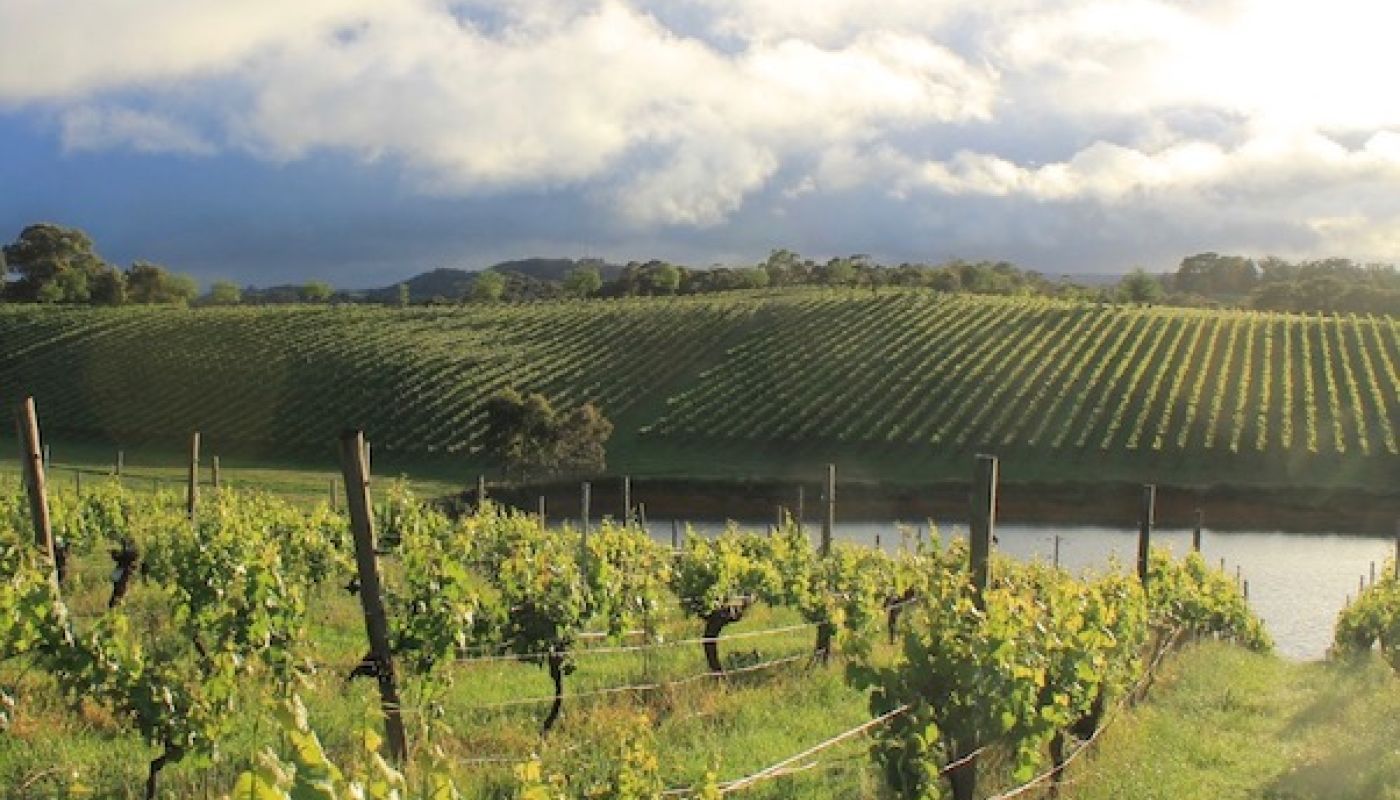
The image above shows some of Geoff's vines before the fires, none of which were affected by them. The picture below was taken after the fires. Geoff comments: 'The vines are affected by heat but not burnt. It is clear [from the foreground of the picture] how far the heat penetrated by the leaf scorching. All the vines will survive but the scorched vines won’t have a crop in 2020 or 2021, I think, but the fact is that we have 60% of our vines unscathed.'
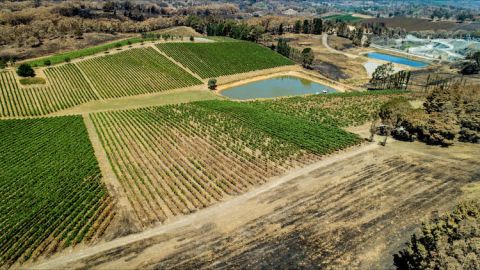
What wasn’t known when Max wrote his article was the extent of the damage in the Adelaide Hills vineyards, and a loss of one third to one half of all Adelaide Hills vineyards was widely reported. The established truth is that only 20% of the Hills vineyards were in the fire zone and of those only about half or less of the vineyard area was affected directly by fire. The region’s wine production will suffer to a much greater extent not because of the fires but as a result of the late September frost and the poor flowering conditions in November, a month in which only nine of 30 days were above the average temperature. 2020 is the second year in a row that flowering has failed in our usually very reliable region.
The exaggeration of the extent of fire damage to our vineyards is not the only catastrophist pall shrouding our imminent 2020 vintage. There is near-hysteria levels of concern about the potential effect of smoke on the quality of Australia’s 2020 vintage. While our AWRI are the pioneer researchers of smoke taint, they like the rest of the world do not know what if any effect smoke exposure will have so early in the season, well before the grapes have started the ripening process (veraison), nor what intensity and duration of smoke exposure is a prerequisite to taint. What we do know is that only a small proportion of Australia’s vineyards have been exposed to intense smoke and even less for any extensive period. (See Assessing smoke tasting and fermentation issues and Fire and smoke – unwelcome but increasing written in the wake of Sonoma’s bushfires in late 2017.)
As an example with which I have direct experience, none of the central (including the Piccadilly Valley) and southern Adelaide Hills was affected, nor was the Fleurieu Peninsula across the Backstairs Passage from Kangaroo Island. The winds blew the smoke away from the vineyard areas.
What is certain is that Australian vignerons are well served by their own vigilance and the incomparable taint-testing abilities of the Australian Wine Research Institute. Thanks to this, the very small proportion of potentially smoke-affected grapes will be detected and left on the vine and any tainted wine inadvertently made will be recognised and dealt with appropriately.
We live in uncertain times. It is going to get hotter and drier around the globe. However, climate change is not the direct cause of what Australia has just experienced.
Two unprecedented meteorological events dried the Australian continent to a crisp over the past year, creating the conditions that burnt rainforests in Queensland and the lush ancient ecologies in the wettest and coldest part of Australia, north-west Tasmania. The oily sclerophyll forests of eastern Australia didn’t stand a chance. They at least have the evolutionary advantage of natural adaptation to the Australian fire cycle and will largely regenerate at an astonishing rate.
The first of the two blameworthy meteorological events was the 2019 winter establishment of the strongest Indian Ocean dipole ever recorded, meaning the biggest differential of surface water temperature between the eastern (Australian) side of the Indian Ocean and the western (African) side. The unusually cold ocean and dry atmospheric conditions of the north-west of Australia (think Broome) have led to a particularly delayed southern monsoon season and have had a very drying effect on the Australian continent. And as if one unprecedented event were not enough, the Antarctic vortex experienced a rare and sudden stratospheric warming exceeding that of 2002.
The net effect has been the shift of the Southern Ocean westerly winds towards the equator, and for the east coast of Australia this means reduced rainfall, clearer skies and higher temperatures. Spring temperatures increased, rainfall decreased and heatwaves and fire risk rose. If one of these two events provided the kindling, the other produced the fuel of our national misery.
What does this mean for the 2020 vision of the harvest of the vineyards of the cool south-east of Australia?
Having done their worst work, those two unprecedented events have now dissipated and we are back in the grips of the habitual Southern Ocean pressure systems that bring our weather. The battle line is between the searing inland temperatures of the Australian continent and the cool air of the Great Southern Ocean. That margin advances and retreats, orchestrated by the direction of the winds and the duration of the heat event. For the 2020 vintage the battle is a stalemate. We have experienced short intermittent heatwaves, bracketed by extensive very cool periods. For the first four months of the growing season to the end of January for my Foggy Hill vineyard in Fleurieu Peninsula, 58% of days and 66% of nights have been cooler than average and the heat summation for the season so far is a mere 6.6% above average. Foggy Hill has received 74% of normal growing season rainfall.
Here then, 2020 vision is for a smaller-than-normal, smoke-free crop, harvested two weeks later than usual in the cool, dry conditions of mid autumn. Couldn’t be better – always allowing that it could be worse.