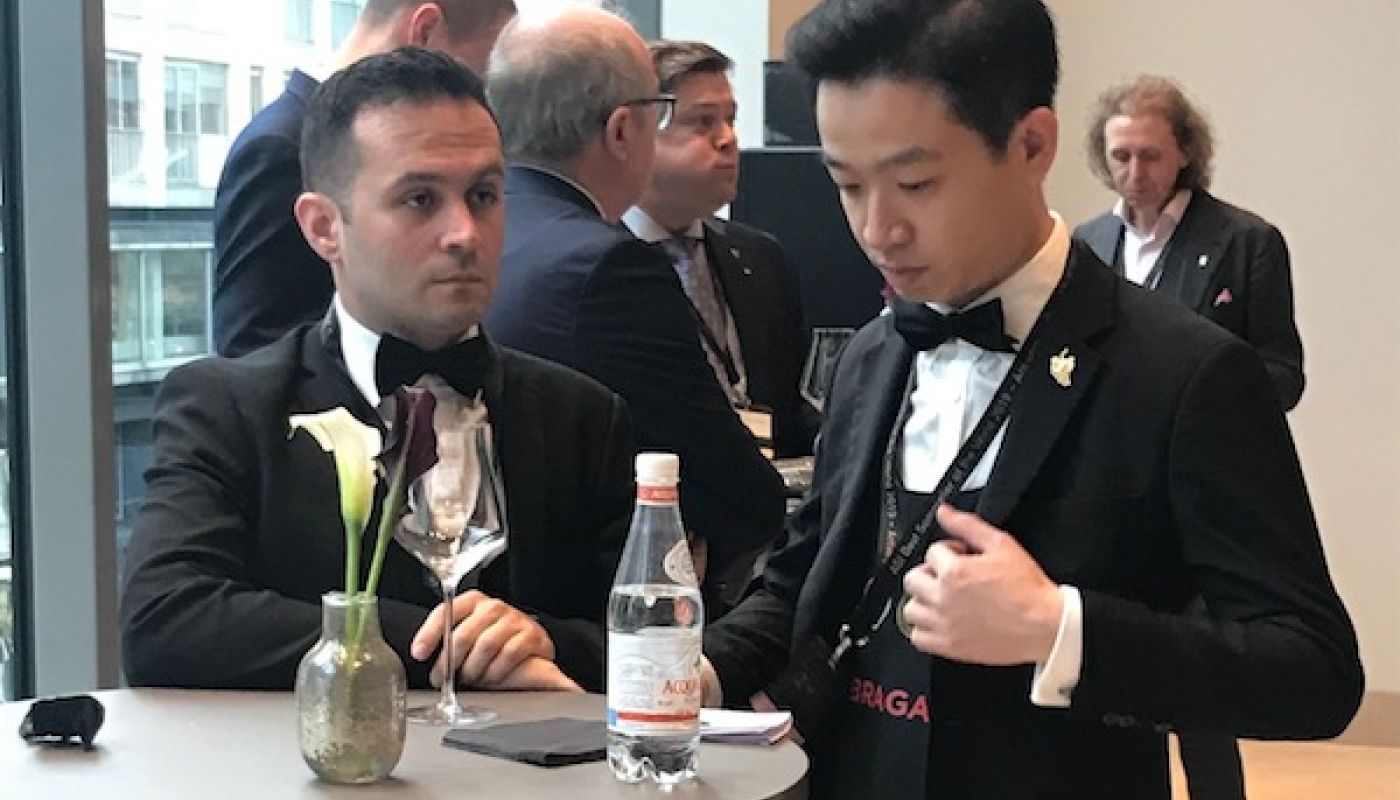
If you had told me I would find myself gripped by whether a young Danish woman would manage to pour a magnum of pink Italian sparkling wine into equal portions in 16 different glasses I would not have believed you. But I found the World’s Best Sommelier championship in Antwerp two weeks ago as enthralling as the finest thriller.
It doesn’t really matter, I kept telling myself as I watched the finalists being taunted by impossible tasks. But of course it does matter enormously to the eventual winner who can parlay their title into a fortune, and a life of being idolised by anyone who has ever wielded a corkscrew professionally.
This particularly arcane competition is now held every three years and local sommelier associations vie with each other for the right to host an international event which seems to draw a massive crowd to judge by the number of seats occupied in Antwerp’s three-tier concert hall in the Elisabeth Centre. The Belgian sommelier association were cock-a-hoop to have wrested the 2019 competition from their counterparts in Bordeaux when the various bids were assessed by the Association de la Sommellerie Internationale. (The name may be French, but the event’s official language is now English.)
The knockout competition had begun on the Monday when 66 entrants, the best wine waiter in their respective countries, had been tested on blind tasting and written theory. There were representatives from all the obvious European and American countries but also, for instance, from Iceland, Kazakhstan (whose Dayana Nassyrova told me there were about 80 professional sommeliers in her country), Albania, Morocco, Mauritius, Venezuela, most wine-drinking Asian countries, and a big posse from the Baltic nations, encouraged by the fact that Raimonds Tomsons of Latvia is the current European champion. He was a favourite to do well in this global test.
By Wednesday the 66 had been whittled down to 19 semi-finalists, who were left to stew for a whole day as Thursday is a rest day, when the organisers desperately tried to get all the wines and trials in place for the final on stage in front of a breathless crowd. (The hall was only just beginning to fill up when I took this picture. There was a sea of black and white in the front rows to which all contestants were assigned.)

At the beginning of proceedings to decide the winner on Friday, every single previous winner, the 15 wine waiters who had been promoted to superhuman, global glory, lined the stage, including 81-year-old Armand Melkonian – except for the only British winner. Gerard Basset, hugely popular among fellow somms, was born French but, after a long and glorious career in the UK which included passing both the gruelling Master of Wine and Master Sommelier exams and co-founding the Hotel du Vin group, when on his sixth attempt in Chile in 2010 he was finally crowned Best Sommelier in the World, he chose to drape the Union Jack around his shoulders. After a year-long battle with cancer of the oesophagus, during which he wrote his memoirs, to be published later this year, he died in January at the age of 61. It was not surprising that we were treated to a film tribute to him. His widow Nina and son Romy spoke positively about him from the stage. (Apparently it had been Gerard who had suggested that Nick and I should be invited to act as judges in Antwerp.)
Then all the semi-finalists were called to the stage, an army of black and white. One by one, those who had not reached the final were ignominiously dismissed. Just seven of the original 66 entrants were women, but three of them made it into the 19 semi-finalists. At one point there were just two men and two women left on the stage and it looked as though Ireland’s hotly tipped candidate Julie Dupouy Young would go through, but no. The three finalists were the 38-year-old Latvian European champion, 26-year-old Nina Højgaard Jensen from Denmark and 27-year-old Marc Almert representing Germany but currently working in the Pavillon restaurant of the Hotel Baur au Lac in Zurich. They are seen below awaiting the final result, Tomsons on the left.

Still a bit dazed by their achievement, they drew lots for the order in which they would tackle the seven tasks ahead of them. The young Danish woman went first, the men being sent to a room where they had no clue what awaited them. The tasks were brutal. One of the three of which I was a judge required them to identify four of the most obscure wines in the world – an amphora-aged, skin-contact Malvazija from Istria, Alicante Bouschet-based Mouchão from Portugal, a flor-aged Château-Chalon from Jura that they all took to be a sherry and, if you please, a 30-year-old sweet German Pinot Noir Beerenauslese – and suggest food matches for them. In just three minutes.

Another task devised by my particular fellow judges, winners in 2001 and 2007, required the contestants to identify as closely as possible 10 water-white ‘beverages’ in three minutes. There was a gin, but it was grape-based and from France. The rice-based one from Japan was not fermented sake but a distillate. The aniseed-based spirit came from Lebanon. And so on.
Several past winners and ASI officials play-acted as customers. One task involved serving a Sauternes when in the available ice bucket there was only the dry wine from Ch d’Yquem (strictly a Bordeaux not a Sauternes) and a South African sweet wine, Vin de Constance. Points were given to those who handled this best – as they were for the reaction to a request for ice cubes in the sweet wine. (I was told by my fellow judges that the correct protocol is to allow the customer to add their own ice.) The Latvian lost points for dithering.
Apart from the announcement of the winner, the greatest drama came when a stage manager, trying to compensate for a less-than-perfect sound system, pranced with a hand-held mike in front of the young Danish contestant when she was carrying a tray of eight glasses during the decanting task – with predictable results. The first part of the task was declared null and void while the organisers wielded dustpan and brush. Nina from Denmark, quite remarkably, kept her cool. She must have been on autopilot.
The last contestant, Marc from Zurich, looked about 14 to me, but was another who managed to be both brisk and efficient. Amazingly, he managed to get a laugh from the audience, even under this extreme pressure, by confessing to his excitement at being able to try Unico Reserva Especial, a rare blend from Spanish icon Vega Sicilia in one exercise. I was told that there are judges stationed in the audience to supplement those of us with specific briefs on the stage. Their important task is to mark the candidates for general demeanour and language skills. Apparently it is the requirement that all entrants speak at least two languages fluently that restricts the number of potential American candidates.
I must say that at the end, when all three candidates simultaneously had to try their hand at the 16-glass fizz trick, I was none too sure who would win. As a member of the sisterhood, I was rooting for the Dane. But I could also see that the German was extraordinarily dedicated and charming, even if he lost a few points matching various (other) obscure wines to the wrong grape varieties on a magnetic board for all to see.
There had been clusters of miniature flags (especially Japanese and Swedish) in the audience. And, awaiting the result, the heads of sommelier organisations in Latvia and Germany hovered in the wings with giant versions of their own country’s flags.
The (Argentine) chairman of the ASI eventually came on stage with various rather bemused Antwerp luminaries to announce that the third prize went to the Latvian and – drum roll – the winner was young Marc Almert, only the second-ever German winner. He looked suitably modest as apparently it had been a very close-run thing, but it will presumably be only a matter of time before he is acting like a world champion.
Here he is decanting that Vega Sicilia, particularly keenly watched by past winner Philippe Faure Brac.

WORLD’S BEST SOMMS – PAST WINNERS
2016 Jon Arvid Rosengren of Sweden, in Mendoza
2013 Paulo Basso of Switzerland, in Tokyo
2010 Gerard Basset of the UK, in Santiago de Chile
2007 Andreas Larsson of Sweden, in Rhodes
2004 Enrico Bernardo of Italy, in Athens
2000 Olivier Poussier of France, in Montreal
1998 Markus Del Monego of Germany, in Vienna
1995 Shinya Tasaki of Japan, in Tokyo
1992 Philippe Faure Brac of France, in Rio de Janeiro
1989 Serge Dubs of France, in Paris
1986 Jean-Claude Jambon of France, in Venice
1983 Jean-Luc Pouteau of France, in Brussels
1978 Giuseppe Vaccarini of Italy, in Estoril
1971 Piero Sattanino of Italy, in Milan
1969 Armand Melkonian of France, in Brussels