There's a sense of cautious optimism as the last of the red grapes are harvested in Bordeaux. While 2014 isn't a great year, it could prove to be a really good one for many châteaux. An excellent flowering in June, a mixed summer, then a gorgeous September and first few days of October, all give the impression of a 'bookend' season that started and ended well.
On the face of it, the timing of the harvest and the size of the crop is almost a return to normal, if there is such a thing. The dry whites were picked in September and the reds in late September and first half of October, producing a decent yield of healthy grapes.
Yet it hasn't simply been a case of harvesting as and when convenient, as some Bordelais like to boast in great years like 2005, 2009 and 2010. I've been lucky enough to drop in to see the harvest being handled at scores of leading châteaux over the last few weeks and here are some observations.
Five glorious weeks
I caught up with Christian Moueix in St-Émilion at the beginning of October, before they picked at Ch Bélair Monange. 'It's a good vintage – very good in fact', he said, speaking mainly of his Pomerols. 'And a miracle compared to what we thought at the end of August.'
After a fairly lacklustre summer, we’ve had the best September and start to October that I can recall in 16 harvests here.
The good weather lasted for more than just September. After the August veraison (when the grapes changed colour), Bordeaux enjoyed a 38- to 40-day sunny spell for the crucial ripening period in the build up to the harvest. For example, Léognan, to the south of the city of Bordeaux, saw a consistent level of rain in May, June, July and August: 69 mm, 71 mm, 67 mm and 73 mm respectively. In 38 days from 29 August to 5 October, however, just 14 mm of rain fell there.
'September and the start of October have completely transformed the vintage', according to Jean-René Matignon, who celebrates the end of his 30th vintage at Ch Pichon Baron today as they pick the last of the Cabernet Sauvignon and the Petit Verdot.

Denis Durantou gets stuck in at Église-Clinet
The picking order for the reds can be quite predictable across Bordeaux yet it seemed more variable this year. Traditionally, the earlier ripening Merlot vineyards of Pessac and Pomerol are the first to come in. Then St-Émilion and the left-bank estates pick their Merlots, before the Médoc concentrates on Cabernet Sauvignon, and the right bank on the later-ripening Merlots and Cabernet Franc. This year, however, it has been more random, partly as a result of the varying levels of rainfall in September but also because châteaux could afford to wait while the sun was still shining.
Many of the great estates of the Médoc began harvesting their Merlots in bright sunshine in the last week of September, including Chx Lafite-Rothschild, Mouton-Rothschild, Palmer, Montrose and many others. Some, like Léoville Poyferré, started harvesting Merlot the following week on 1 October, the same day that Lafite and Mouton started their Cabernet Sauvignon.
On the right bank, Pomerol picked earlier than St-Émilion as usual, starting mainly in the last week of September. Petrus picked on 3 and 4 October, at the same time as Église-Clinet, with Le Pin on 2 October.
The sunshine and blue skies sadly departed on Monday 6 October, yet most of the forecasted rain stayed away until Thursday 9 October, giving a great many châteaux on the left bank and in St-Émilion a chance to harvest in overcast but dry conditions. Some Médoc estates such as Chx Lafite and Léoville Barton wrapped up on Wednesday 8 October while others such as Ch Cos d’Estournel, finished on the Friday. Several châteaux in both St-Émilion and in the Médoc have carried on into this week.
There was almost zero botrytis on the grapes at the umpteen vineyards I visited from the last week of September to 10 October. It was rot-free from St-Émilion to St-Estèphe, from Pomerol to Pauillac. This is in contrast to 2011, 2012 and especially 2013 when there was often a compromise between waiting to pick ripe fruit and having to sort and remove any rot-affected bunches. With less risk of rot, growers have had the chance in 2014 to push for the best level of ripeness until there was nothing more to be gained. Bearing in mind, though, the early start to the growing season in April, it was no surprise that some vines were visibly flagging by the end.

Jean-Michel Comme is delighted with the Cabernet Sauvignon at Ch Pontet-Canet.
'It was un autre monde 30 years ago', remarked Jean-René Matignon, referring to his first vintage at Ch Pichon Baron in 1985. The extraordinary array of sophisticated sorting equipment in use today demonstrates this; most harvest reception areas at the top estates have changed completely in the last 10 years alone. And it doesn't stop there. ’Come and see my yeast booster’, said Thomas Duroux of Ch Palmer excitedly, while at Ch Cos d’Estournel, access to the floor above the spectacular vat room was restricted. 'Not even our consultants are allowed up there – we have 35 separate patents on the kit we designed’, Aymeric de Gironde pointed out intriguingly. (It was good to see, by the way, Cos owner Michel Reybier joining in the harvest lunch with their team of 80 Spanish pickers.)
After three years of declining yields, 2014 production levels are a cause for mild celebration. 'Les cuves sont pleines', Denis Durantou of Ch L’Église Clinet was happy to report. Most Bordeaux appellations are restricted by law to making around 55 hl/ha, and many crus classés are talking about 'normal' yields of 40-48 hl/ha. Not all though – both Thomas Duroux of Ch Palmer in Margaux and Jean-Michel Comme of Ch Pontet-Canet in Pauillac estimate they'll produce only about 32 hl/ha. (Coincidentally, both vineyards are biodynamic, and the vines looked remarkably vibrant and healthy last week given the pressure of downy mildew faced by châteaux in Bordeaux from late July onwards.)
One unusual aspect of this year is the widespread occurrence of flétrissement (withering) of the skins of Merlot grapes in some parcels. There are several schools of thought as to what caused this, from the heat spike in July, the hydric stress in September, to a deficiency of magnesium and dry stems as a result of climatic conditions in the spring across the Gironde. These relatively unripe and shrivelled grapes were often the principal target of the tables de tri and sorting machines, for those who have such luxuries.

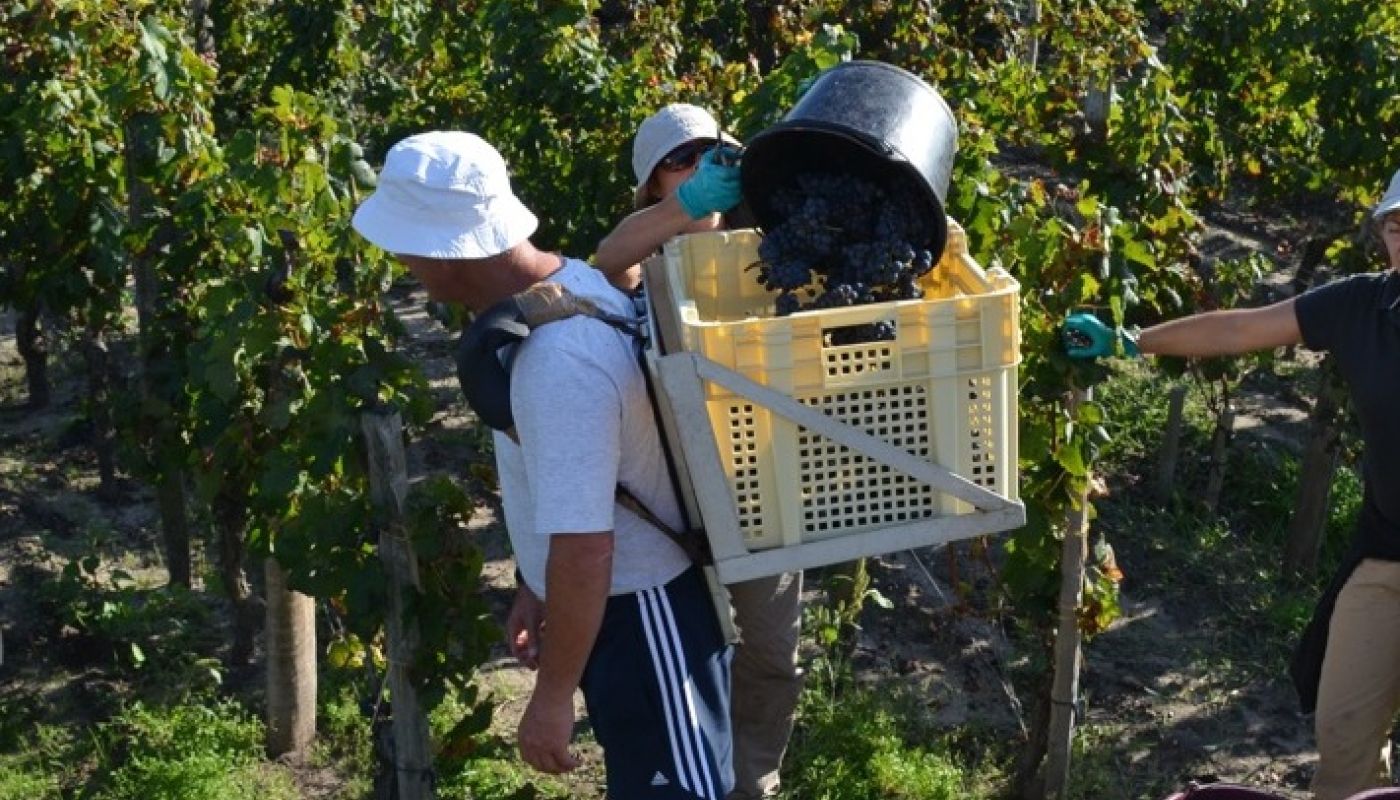
Hand-harvesting at Ch Cos d'Estournel.
One positive aspect of the vintage, depending on your point of view, is that it is not a uniform one. If the joy of wine is in its diversity then perhaps, despite all the modern technology employed today in Bordeaux, we will find wines of markedly different characters in 2014. The varying patterns of rainfall and the negative impact of downy mildew in some vineyards will have made a significant difference.
Compare St-Émilion to St-Estèphe for example. Vincent Millet of Ch Calon-Ségur in St-Estèphe highlighted that, with all the talk of a damp summer, they'd had just 30 mm of rain each month in July, August and September. In St-Émilion on the other hand, rainfall was 85 mm, 87 mm and 60 mm respectively in the same period (we had a whopping 125 mm in July at my vineyard in the Entre-Deux-Mers, mainly thanks to a freak storm on 25 July).
Even then, most of that September rain on the right bank fell on 17 and 18 September, providing useful refreshment to the vines some three weeks before the harvest began. In Margaux, meanwhile, there was no rain on 17/18 September but localised showers on 7 September. These factors all make a difference, and tasting the first vats of Merlot reveals there are clear regional characteristics to the wines.
Jean-Claude Berrouet’s first vintage at Petrus was 1964. He was there during this year’s harvest, joking that he is better known these days, since his retirement, for being the father of the current winemaker, Olivier. 'Every year has been different. No two years have been the same but I do think this year will produce elegant, classical wines. They should suit the British.'
Let's hope so.