
The 6,500 growers in Bordeaux had to submit their 2017 harvest declarations in December and the numbers have now been counted up. While Bordeaux enjoyed the largest crop for over a decade in 2016, 2017 was 40% down on the previous year and 33% lower than the 10-year average. And with Bordeaux, 40% is a lot of wine – the equivalent of over 300 million fewer bottles from one year to the next.

The figures also confirm that 2017 was a year of incredibly mixed fortunes for those viticulteurs, and this was chiefly down to the varying levels of impact of the late spring frost at the end of April 2017. In an article entitled Epic crop fail made it a bad year for bulk wine, the Financial Times picked up on a counter-comment from my harvest and weather report last autumn: 'For enthusiasts, buyers and collectors of fine wine, it’s first worth noting that 80% of the top 150 châteaux enjoyed a good harvest; there was minimal (frost) damage to the plots which provide the grapes for their first wine or grand vin. So, at the top end, there should be reasonable volumes, and good quality, from many of the blue chip names.'
In fact, the three leading appellations of the northern Médoc, Pauillac, St-Estèphe and St-Julien, actually had a larger crop in 2017 than the average of the five preceding vintages:

They were the lucky ones. The appellations above escaped intact thanks to the beneficial impact of the Gironde estuary during the late April frost. This was evident soon afterwards, as can be seen on my frost map of Bordeaux from last May – see the foot of this article.
Further south, many vineyards in Margaux and Pessac-Léognan were not so fortunate, although some were hardly hit, but overall figures in St-Émilion and Pomerol on the right bank were fairly devastating. Here are the yields, expressed in hectolitres (100 litres) per hectare, over the last 12 years for the most prestigious appellations (all red):
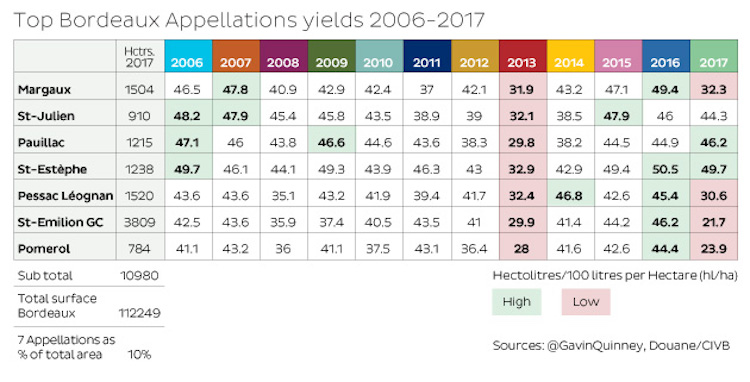
I’ve highlighted the years with the highest yields in green and the lowest in red. With the exception of those northern Médoc appellations, 2013 and 2017 are the standout weaker vintages in terms of volume. Note that these more expensive appellations, which are home to the vast majority of famous and sought-after wines that are sold en primeur, make up just 10% of the total Bordeaux vineyard. Here’s the broader picture for Bordeaux, bringing together the appellations into manageable groups:

The huge gap between 2016 and 2017 can be seen in the yield averages. A relatively strong run of three vintages, 2014, 2015 and 2016, are bookended by two much smaller crops in 2013 and 2017. What’s also noticeable is how the recent five-year stretch of ‘down-up-up-up-down’ contrasts with the strong nine-year run from 2004 to 2012 in terms of volume (barring, arguably, 2008).
The drop from 2016 to 2017 is even more stark when we look at the amount of wine produced in different parts of Bordeaux. Again, I’ve separated out all the ‘named’ appellations and grouped them into logical chunks, leaving out the huge, generic Bordeaux rouge appellations for now as they dwarf the scale:

We can really see how badly some areas were hit by the frost. The pretty St-Émilion ‘satellite’ appellations, covering close to 4,000 hectares (9,885 acres), were nearly two thirds down on 2016. St-Émilion itself comprises two large appellations, St-Émilion Grand Cru and St-Émilion. Combined, they were down 56% on the generous 2016 – from around 34 million bottles to fewer than 15 million. By contrast, the four major left-bank appellations of Margaux, St-Julien, Pauillac and St-Estèphe saw a fall of just 12% and that was largely due to those parts of Margaux that were hit by the frost. Along with those leading lights in the northern part of the Haut-Médoc, the huge Médoc appellation further north suffered less than other areas. Some inland parts of the Médoc appellation were hit but not those closer to the estuary. It was a similar story across the Gironde in the Côtes de Bourg, and parts of Blaye.
Here are those worst-hit areas in a little more detail, comparing the volumes in 2017 with the average of the previous five vintages:

In actual fact, the small area of Côtes de Francs saw the lowest yield of all the red appellations at 13.9 hl/ha but as it comprises ‘only’ 369 hectares of vInes, I’ve left it out. Lalande-de-Pomerol saw the lowest yield of the more prestigious, sizeable red appellations at just 17.1 hl/ha – just a third of the 51 hl/ha it managed the year before. Although the right bank was much more widely impacted by the frost, some parts of the left bank were similarly affected. Moulis in the Haut-Médoc was seriously affected; and far to the south of Bordeaux, the lovely sweet white appellation of Barsac saw a very small crop – even by their standards – with just half the five-year average.

The generic Bordeaux red wine appellations, including Bordeaux Supérieur, and rosé make up about half the annual production, with Bordeaux Blanc in addition. These wines, mostly from the Entre-Deux-Mers, and the Merlot-dominant right-bank reds, dwarf the wines from the left bank in volume terms. Note that the Bordeaux vineyard area has remained pretty stable (at 112,249 hectares/277,373 acres in 2017) for the last seven years, after a reduction of almost 10,000 hectares from 2006 (121,496 ha) to 2011/2012.

Bordeaux Rouge and Bordeaux Supérieur red were considerably down, by 42% and 43% respectively, in 2017 after a large crop in 2016. White was down by a similar percentage and prices for bulk wines have inevitably gone up. Part of the reason why the rosé decrease is lower is that a higher proportion of rosé was made compared with red: 500 hectares that made red in 2016 were declared as rosé in 2017.
To help with the geography and many of the names mentioned above, here’s the frost map of Bordeaux from an article I put together last May after driving around the region. Meanwhile, I’ll get back to bottling our half-measures of 2017 white and rosé.
















