There’s a long way to go before the autumn harvest, and the grapes have yet to change colour, let alone ripen, but the end of July seems a reasonable moment to take stock of how the growing season is progressing. Most of the hands-on chores in the vines have been done, and vineyard managers can take their annual August holiday before the harvest preparations begin in earnest.
Speaking of stock, the flowering took place in June and the grapes and bunches evolved in the ensuing weeks, so we have a clue as to how the volumes might look, all being well. This month, in fact, the French Ministry of Agriculture released its estimates of the size of the 2019 crop across France based on conditions to date. AOP wine production (what most of us still know as Appellation Contrôlée) in 2019 is forecast to be between 0 and 8% below the five-year average of 2,100 million litres. Bordeaux accounts for around a quarter of that figure and as the largest contributor, the numbers from here can have quite an impact.
Bordeaux 2019 latest
In short, a few days of rain and a brief chill in early June took the edge off the flowering, which had begun so well, while, in contrast, two days of heavy rain on 26–27 July proved a godsend after the prolonged dry and hot patch between mid June and late July, with peaks close to 40 ˚C (104 °F) at the end of June and indeed exceeding 40 ˚C on 23 July. It’s all to play for, still. Marks so far? 7/10.
Mixed flowering points to an uneven year
After the homogeneous and successful 2016 vintage, Bordeaux had a mixed year in 2017, thanks to the late-spring frost, which caused widespread losses in a multitude of vineyards but spared others. Volumes overall were well down, except in the key northern Haut-Médoc appellations. 2018 was also uneven, thanks to the mildew that dramatically reduced the size of the crop for many growers in what was otherwise an excellent year.
It’s far, far less of a blight than the frost damage in 2017 or the intermittent losses from mildew in 2018, but the mixed flowering across the region, resulting in some uneven bunches and poor fruit set – while neighbouring rows reveal no such issues – points towards 2019 being the third uneven or heterogeneous vintage in a row.
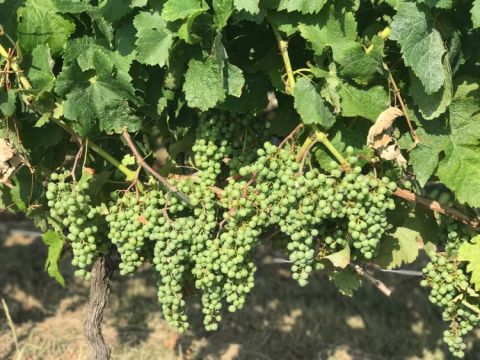
There is every chance for most châteaux to make excellent wine, if all goes well in August, September and early October, yet it’s hard to see how 2019 could become a great vintage for Bordeaux as a whole. At the time I thought the flowering for Bordeaux 2019 seemed higgledy piggledy, and I’m still looking for a better expression.
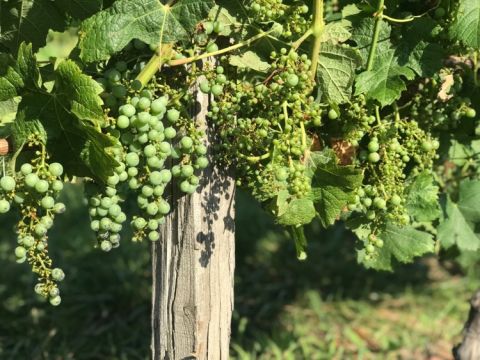
The photos above were taken just yards apart, in the Entre-Deux-Mers near Lignan.
The uneven fruit set across many sectors simply leads to uneven ripening within the bunch. One thing seems sure – those newish and sophisticated grape-sorting systems at several leading châteaux will have a chance to prove their worth.
The Bordeaux 2019 growing season so far
As a backdrop, autumn and winter 2018–2019 was fairly mild, with the exception of a cold January. The region had, quite significantly, a rainfall deficit between October 2018 and March 2019, with on average about 100 mm (4 in) less rain than the norm (530 mm/21 in). There was though a 250-mm difference between one area and another, with some zones receiving markedly unequal amounts of rain. 2018–2019 saw a much drier October–March period than in 2017–2018 but it was not as dry as the same six-month stretch in 2016–2017.
In general, 2018–2019 autumn and winter rainfall was about average in November, December and January, but it was pretty dry in February and, though regions vary, in March. Budbreak was in early April and that month was considerably wetter and slightly chillier than the norm in most regions, though with about average rainfall in St-Émilion. There was also a frost alert in mid April, with some localised damage, but nothing on the scale of the damage caused in late April 2017.
Despite the heat, a slow burner
Temperature wise, until the late June and July heat surges, it’s actually been relatively cool. February and March – when the vines are still taking their winter break – were less cold than the 10-year average, but April, May and June have all been cooler than the average and than the previous two vintages.
Our vineyard consultant uses a helpful temperature analysis as a guide for determining the progress of the vines in each vintage. By adding up the daily average temperatures since the 1 January but removing any daily average temperatures below 10 ˚C (50 °F), here is how the recent vintages compare at this stage of the growing season. (For more on Degree Days, see the Oxford Companion entry on climate classification.)
|
Vintage |
2011 |
2012 |
2013 |
2014 |
2015 |
2016 |
2017 |
2018 |
2019 |
|
Total 25/07 |
1019 |
857 |
778 |
899 |
965 |
813 |
1003 |
984 |
885 |
|
Total 800°C |
2/7 |
20/7 |
27/7 |
17/7 |
12/7 |
24/7 |
7/7 |
10/7 |
20/7 |
'Total 25/07' is the number of Degree Days reached by 25 July and the final row shows the date when the Degree Days reached 800. The figures do seem to tally. 2011 was an early-ripening year, and 2013 late. 2019 is more on a par, timing wise, with 2016 or 2012 than with either 2017 or 2018.
Rainfall figures
Here are the rainfall figures for the growing season so far. They’re important, if only because Bordeaux growers, like those in other appellations, are not allowed to irrigate their vineyards (except young vines which are not yet in production).
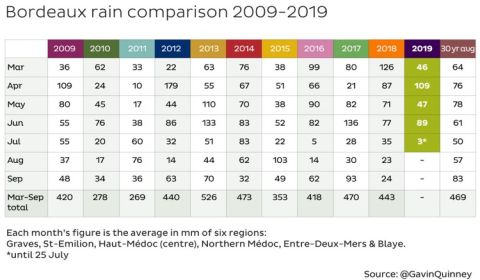
I’ve cheekily included just the rainfall figure up until 25 July. Temperatures had exceeded 40 ˚C (104 °F) across Bordeaux on 23 July, after a long, dry spell since mid June, and until Friday 26 July it was fair to say – looking at the numbers alone – that July 2019 was the fifth consecutive dry July. Mercifully, the heavens opened on Friday and my provisional figure in the table, with almost no rain in the month to that point, has been blown out of the water. With varying amounts of rainfall reported across the region for Friday and Saturday, I’d expect the July 2019 ‘average’ now to be between 60 mm and 90 mm (2.5–3.5 in).
Early June and the flowering
These screenshots of the weather forecasts in June don’t accurately portray what happened each day but they help to paint the picture.
The all-important flowering, or floraison, began in precocious Merlot vineyards towards the end of May, with sunny weather at the end of the month and a lovely weekend at the start of June, with the flowering in full flow.
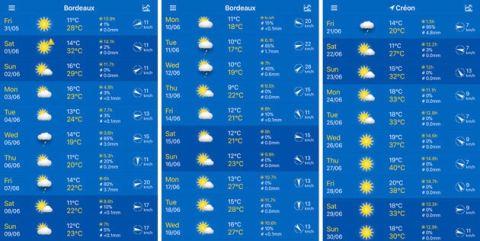
Had the sunshine continued uninterrupted, I’m sure we’d have had a beautiful and consistent flowering in Bordeaux 2019. Those parcels that were complete by 4 June are in excellent shape, but then rain came on Wednesday the 5th – and it was much heavier than the earlier forecasts in some areas. Overall, we had as much or more rain in just over a week, from the 5th onwards, as the 30-year average for the whole month of June (63 mm/2.5 in). After that it was pretty clear.
There’s nothing unusual about having most of a month’s rain in the space of a few days in Bordeaux (like 26–27 July 2019, above) but for a month’s worth to come down right in the middle of the flowering was unfortunate.
Let me tell you about the flowering
Coulure and millerandage aren’t up there with hail, frost or mildew but they can have an impact on quantity and quality. They come about with unhelpful conditions such as rain or cold during the floraison, when the vines can’t self-pollinate properly. Other factors such as vine vigour, the age of the vine and so on, can play a part.
What should happen is that the tiny calyptra, a flower cap of fused petals, falls off the weeny grape flower, releasing the little male spikes called stamens, which produce pollen, and in turn the female part – a moist pistil with an ovary in the centre – is pollinated, leading to the creation of a berry. Ahh.
The trouble comes with rain and cold, when those little fused petals don’t fall off as planned. Merlot is by far the most widely planted vine in Bordeaux, making up two-thirds of the red in Bordeaux, which is 89% red. And although it grows well in most places here, it is vulnerable to poor conditions and poor fruit set during flowering. (Our Sauvignon Blanc isn’t affected in anything like the same way.)
Coulure – more often than not due to wet weather – is when a grape isn’t formed and there are large gaps in the bunch as a result. There’s more of an impact on quantity here than on quality, for fairly obvious reasons – there are fewer grapes. Millerandage is often caused by cold weather, in tandem with rain, and with this you end up with various sizes of smaller berries. It’s been called ‘hen and chicken’ although hen and chick seems more logical to my mind. Millerandage can certainly have an impact on quality, as well as on volume, as the grapes ripen in different ways in the same bunch.
Leading or ambitious châteaux will have all sorts of sophisticated sorting equipment to get rid of the smaller, potentially more acidic and less ripe berries when they are brought into the cellar, or on more sophisticated machines in the vineyard.
Late June and late July – a scorcher
After the flowering, we’ve had hot and sunny weather on the whole since mid June, running through the whole of July until the rainstorms of the 26th. Holiday makers have had a great time, although the joys of temperatures above 35 ˚C (95 °F) are limited. I certainly can’t recall seeing 40 ˚C mentioned in consecutive months like this.
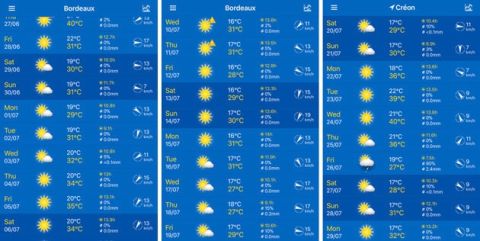
To 25 July, the average temperature for July 2019 has been 3 ºC (5 °F) hotter than the 30-year average – 24.3 ºC compared with 21.3 ºC.
The vines have stood up well to the canicules in late June and late July, although younger vines on drier ground have suffered. Many vines seemed to close down, not unexpectedly, in the late-July heatwave, so the rain soon afterwards was crucial to reinvigorate them before veraison, or colour change, in August.
The heatwave at the end of June took place when there was actually much more work to be done in the vines, such as lifting the branches between the training wires, and the working day had to be shifted to a very early start. That’s normal practice.
Here at Ch Bauduc a few willing students who had applied to work here couldn’t cope with the heat, and they packed it in – one could hardly blame them. At short notice we brought in a team of a dozen locally based Moroccans, who had no such issues – their boss used to work for us full time a few years ago – and we managed to complete the tasks.
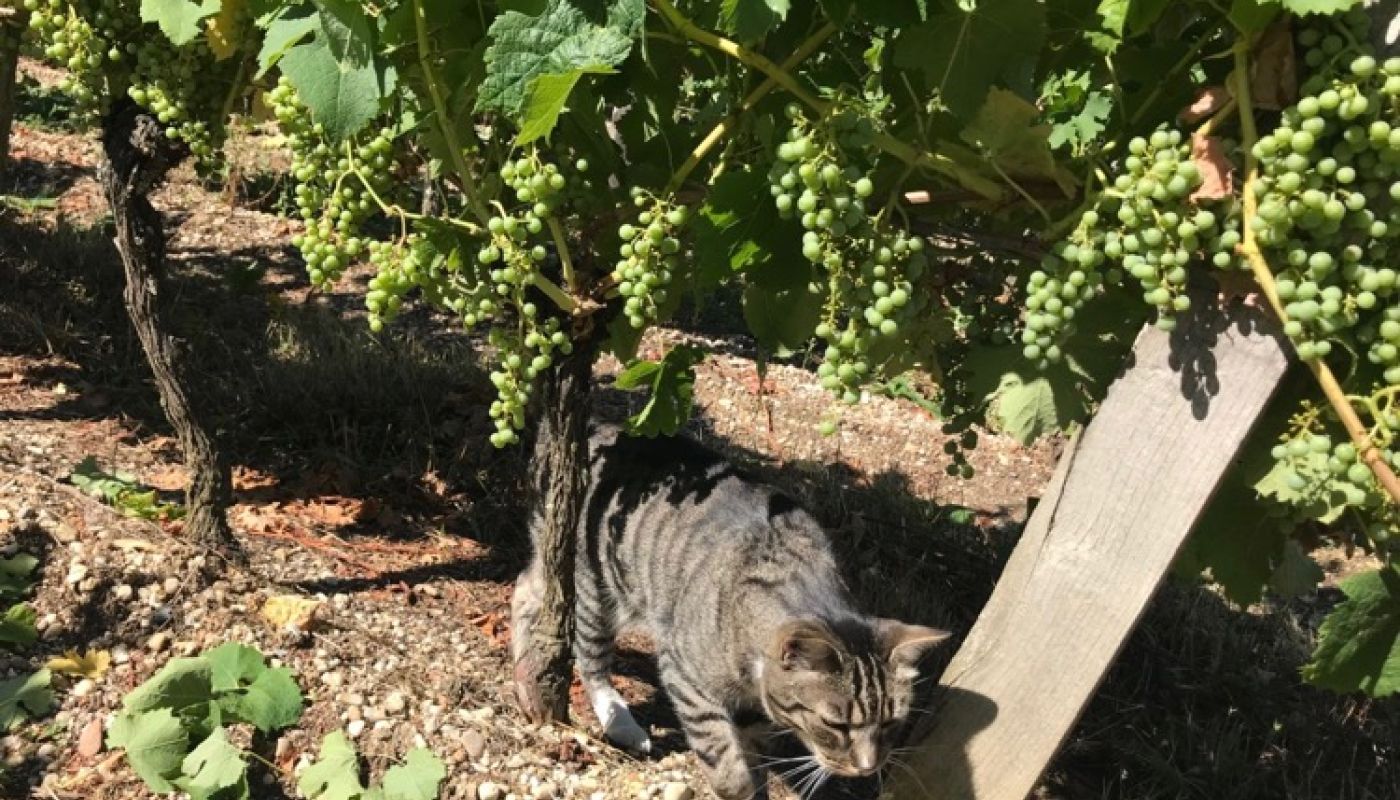
The photo top right stars Gavin's cat.
















