Bordeaux 2018 will be remembered as an exceptional year, with no shortage of outstanding wines from this extraordinary vintage. The weather too has been exceptional, with a glorious summer extending long into the September and early-October harvest, but the vintage had begun with a bizarrely challenging first half of the growing season. It has ended up, not for the first time, as a year of mixed fortunes.
I’ll try to explain the impact of the weather on yields and quality using – as ever in these vintage reports – a few graphs and statistics.
A dozen highlights of the out-of-the-ordinary 2018 vintage
- A wet winter, followed by a seriously soggy spring.
- The threat of downy mildew, from spring onwards, was the strongest for decades.
- Hailstorms in May and July caused damage in some unlucky areas.
- The flowering in May and June was largely successful.
- A glorious summer, preceded by just enough rain in late June and early July.
- To have three complete months of sunny, dry weather from early July thorough to early October is rare.
- Optimal harvest conditions: stress-free with no risk of rot.
- A vintage of great potential, with outstanding reds and some very good whites.
- Balance will be key as alcohol levels are generally quite high.
- The fourth very good to excellent vintage in a row for 75% of the leading châteaux.
- Plentiful yields for most growers but low for those hit by mildew or hail.
- Overall Bordeaux volumes are, at a guess, close to the 10-year average.
The growing season
Here then is the story of the vintage, using daily statistics that I’ve compiled from six different weather stations around Bordeaux.

The amount of rain can differ considerably from one area to another, and even from one commune to another, but this gives a pretty good impression of how the growing season panned out. For a comparison of 2018 with the last two vintages – and they are quite different – see the appendix below.
A game of two halves
At the end of July – the month in which France won the football World Cup – I wrote that Bordeaux 2018 was ‘a game of two halves’. I have to admit I was taking a punt on the weather staying fine for August and September. As it happened, it stayed fine right into early October. It’s extraordinary how the weather stayed so sunny and dry after such a wet start.
The stark contrast in the amount of rain for the period from March to June, compared with July, August and September, and how this compares with other vintages, can be seen in this grid showing rainfall each month over the last ten vintages.
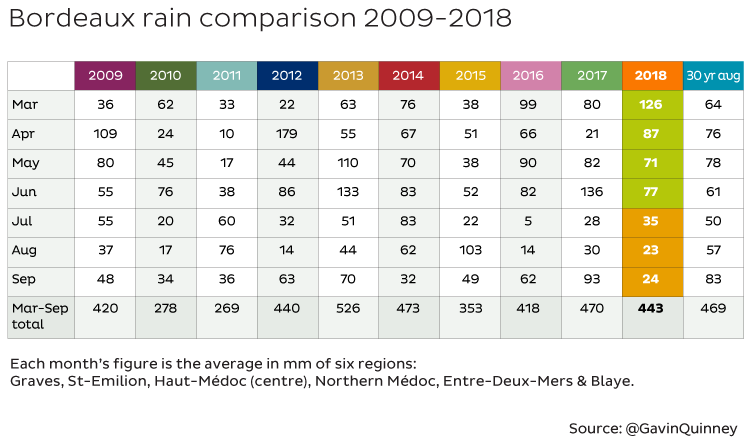
An important backdrop to these rainfall figures during the growing season (budbreak, when the vineyard appears to wake up after the winter recess, wasn’t until early April) was the amount of rain beforehand. As you can see, March 2018 was wet and, while February’s 66 mm (2.6 in) was close to the 30-year average of 72 mm, December and January both saw 155 mm (6.1 in), against the 30-year average of 106 mm and 87 mm respectively. So we went into the growing season with no shortage of water underfoot.
Although the spring was wet, the rain actually wasn’t too heavy in April, May and June compared with the norm. But because it had followed on from a very wet December, January and March, it felt like a fairly miserable start to the season.
Worse still, there was a real threat of mildew. After a long, mild start to the winter, and then heavy rain, the risk of contamination became severe from mid April onwards. The pattern of rainfall in the spring coincided with the spread of mildew (unless it was brought under control). Many organic and biodynamic vineyards were hit badly and those conventionally farmed vineyards that missed vital sprayings also suffered considerable losses. Spraying a day or two late, in some cases, was to prove expensive – mildew can affect bunches as well as the canopy. As much as a third of Bordeaux vineyards were affected by mildew to a greater or lesser extent, although this is an estimate based on what I’ve been told by viticultural experts.
The flowering in late May and June, though, went well and the weather picked up from mid June. After rain and storms at the end of the month and around 4 July, the sun shone throughout July, August and September. In 20 harvests here at Ch Bauduc, I cannot recall such a consistently sunny three-month period at the end of the season like this – 2010 came quite close – nor such a stress-free harvest time in Bordeaux.
One reason for focusing on rain – and most people outside the trade aren’t aware of this – is that under appellation rules we’re not allowed to irrigate the vines, so the amount that nature gives us, depending on our terroir, can have quite an impact. Something these charts cannot show is the considerable variation in rainfall among the different regions, and among different sectors within the same area. For example, St-Émilion had 70 mm (2.75 in) of rain right at the end of May, yet Léognan had just 5 mm in the same period. Margaux had 75 mm of rain at the end of June and the start of July, while here in the Entre-Deux-Mers we had 30 mm. On 5 and 6 September, St-Émilion had 34 mm of rain as a refresher just before the harvest (and it was different from commune to commune there too), while there was less than 1 mm in Margaux.
Monthly temperatures
After a mild end to 2017 and mild January 2018, the really cold patch we had in February was welcome so that the vines could have a proper winter break. March was a degree chillier than the average, as well as wet, but after this it wasn’t cold overall however rainy it was.
Here are the monthly temperatures with the 2018 average of the six regions, followed by the 30-year Bordeaux average in brackets.
- March 9°C (10.2°C)
- April 13.8°C (12.4°C)
- May 16.1°C (16.1°C)
- June 20.3° (19.3°C)
- July 22.5°C (21.3°C)
- August 22.1°C (21.4°C)
- September 19.2° (18.5°C)
It is significant that June, July, August and September were all considerably warmer in 2018 than the average. The height of the summer was to be challenging for some vines, especially younger ones with shallower roots on dry ground. Five days on the trot in early August with maximum temperatures over 35 °C (95 ºF) proved too much for some vines. Between the two French national holidays on the 14 July and 15 August, France Météo reported that the average temperature in France was 23.6 °C (74.5 ºF), compared with the 30-year average of 21 °C, with 19 days over 23 °C average and none under 19 °C. That’s the second hottest ‘high season’ since 1947, just slightly cooler than the ridiculously hot summer of 2003.
The harvest
With the warm summer, it was little wonder that the harvest kicked off early for the whites, with several blocks of Sauvignon Blanc being picked as early as 21 August. The precocious vineyards of Pessac-Léognan began harvesting their whites in late August, with the Graves and the Entre-Deux-Mers starting, on the whole, in early September. It’s strange to think that as I write on 31 October, they’re still picking their sweet whites in Sauternes – as they hold out for botrytis of the noble kind – more than two months after their neighbours started picking for their dry whites.
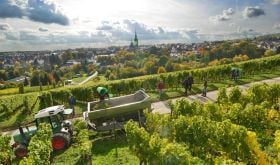
For the reds, if there’s one vintage this century that growers can, hand-on-heart, say that they could pick and choose their harvest dates ‘à la carte’, it’s 2018. I was at Ch Troplong Mondot in St-Émilion (pictured above right) as they harvested their Merlot on 10 September. Four miles down the road at Ch Fleur Cardinale, they completed their red harvest on 24 October.
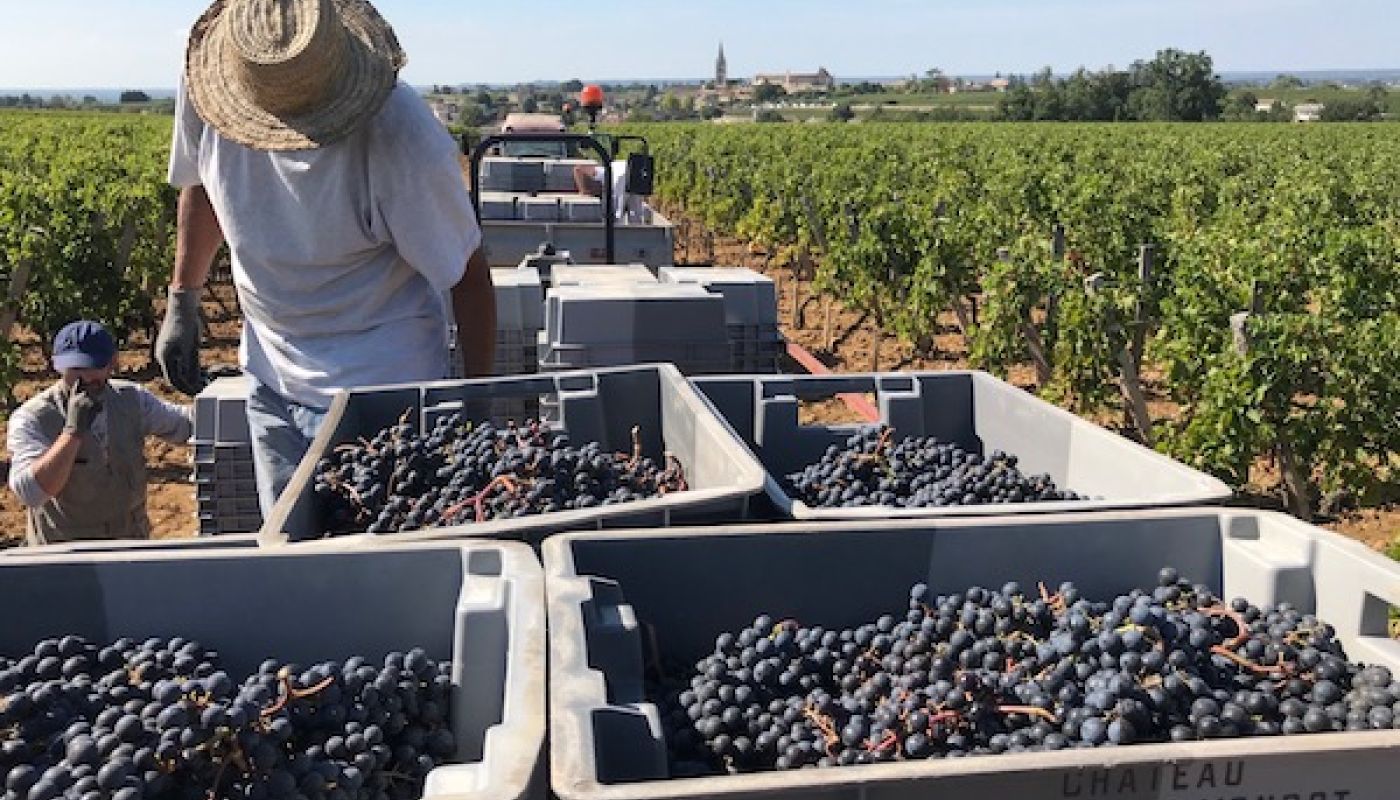
There are exceptions, naturally, but the busiest time for harvesting the Merlots and the Cabernets was during the second half of September and the start of October. The bunches were, unsurprisingly, as clean as a whistle, and I saw no rot whatsoever. Below is the Cabernet Sauvignon picked at Ch Lafite.

There’s little doubt, for the majority of growers, Bordeaux 2018 is an excellent vintage. We can expect some terrific quality from those châteaux that managed to stave off the threat of mildew earlier in the season, and whose vines had access to just enough sustenance from the subsoils during the prolonged periods of drought and sunshine. Those properties that were unlucky enough to be right in the hail zone, below, have been far less fortunate.
Yields were generally good for Merlot (two thirds of all the red planted), with lower yields on the whole from the smaller berry size of Cabernet Sauvignon.
With the weather forecast in September and early October throwing up no harvesting deadlines, it’s really a question of terroir, varieties, decision-making, resources and preferences over style. Alcohol levels – especially with Merlot – were always going to be on the high side, unless the grapes were picked before reaching maturity.
What will matter is balance, and ensuring that the wine has refreshment value. Today, thankfully, there are far fewer producers trying to extract the living daylights out of the wine for extra body and structure; the mood in Bordeaux these days is certainly not to turn the screw.
Stylistically, it seems – again, for those estates for which everything went well – that we’ve got something close to 2015 and 2016 on the right bank, and a blend of 2016 and 2010, plus a dash of 2009, on the left bank. Overall, it’s a bit like '2016 plus plus' – 2016 with knobs on – not that everyone will want the 'plus plus' part. It’s early days and I could certainly be wrong about this. 2016, like 2018, also saw a long summer drought, though it wasn't as hot throughout the summer and we had a fresher harvest period that year. (See the chart below.)
I’ve really talked about red bordeaux here, as Bordeaux is almost 90% red. For the dry whites, much depends on retaining the aromas, the acidity and vivacity in such a sunny vintage. (I’m a little biased here but I’ve been pleasantly surprised, as has my oenologist.)
In Sauternes, they’ve been waiting patiently for botrytis to kick in late on, as it’s been so sunny and dry. I was last down in Sauternes in early October and there were few signs of the precious rot. Conditions though have been far more favourable since.
Volumes
All producers have to submit their harvest declarations by late November and we’ll know the full results in February 2019. It’s a difficult season to judge, as most growers had good yields, while others were hit by losses from mildew, and from isolated hailstorms. (More on that below.)

After the huge losses in 2017 as a result of the late spring frost, my impression is that Bordeaux 2018 will bounce back in terms of volumes, with production a little over the 10-year average of 507 million litres. (The 10-year average has, of course, been lowered of late by the two small crops of 2013 and 2017.)
I had thought we’d see a higher crop overall in 2018 – at Ch Bauduc we had a record production in 2018 as we’ve more hectares in production than we had in 2016, another good crop. But friends have convinced me that the general losses to mildew (and to hail) are higher than I originally thought.
Hail damage
As I reported back in July, hailstorms in late May and on 15 July, the day of the World Cup final, caused considerable damage to specific areas of Bordeaux. In late May, a storm moved up from south of Bordeaux in Pessac-Léognan, through the city and on towards the southern end of the Haut-Médoc, before causing significant damage in the vineyards of Bourg and Blaye. Several thousand hectares were affected. In July, hailstorms damaged vineyards in Sauternes and, again, the southern end of the Haut-Médoc.

Appendix – 2017 and 2016 for comparison with 2018