On Saturday, in Glass dimissed?, I put forward the case for revising our opinions about wine packaging, continuing the observations made in Carbon footprints, wine and the consumer by Dr Richard Smart.
We argue that since glass-bottle production and transport represent by a margin wine’s greatest carbon emissions, it is time to consider the alternative, more planet-friendly containers for wine outlined in my article – at least for the massive proportion of all wine sold that is destined to be drunk within a few months of purchase.
Glass comes into its own for wines that are designed for extended ageing, such as most of the wines we write about on JancisRobinson.com, but is unnecessary for the far greater volume of wine sold to be drunk immediately.
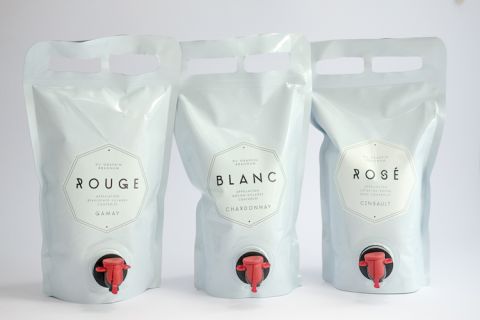
If more consumers realised there was nothing wrong with wine in kegs, pouches, recycled plastic bottles, cans and cartons, sales of glass wine bottles for what Andrew Nielsen, pioneer of the bagnum pictured below, calls ‘drink-now wines’ would be likely to decline.
What about corks?
Glass bottles need stoppers. Although a good proportion of those stoppers nowadays are either screwcaps or technical corks rather than natural corks, the cork industry would inevitably be adversely affected by any decline in demand for glass wine bottles. A good 70% of their business is represented by wine corks.
I was not surprised therefore to see Amorim, the world’s largest cork supplier, recently presenting the results of a study they commissioned that argues that the carbon captured in a wine cork can help to offset the carbon emissions associated with a standard 75-cl glass wine bottle.
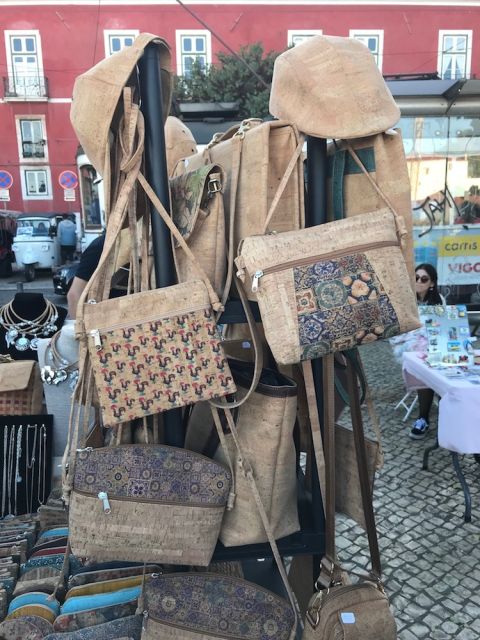
The cork industry has long, justifiably, drawn attention to the special qualities of the ecosystem of the world’s cork forests around the Mediterranean. Remember the cork producers’ clever use of the potential extinction of local birds in their fight against screwcaps? And I’m certainly not arguing that these forests be abandoned (although perhaps the cork industry might look a little more proactively at alternative uses for cork – tourist souvenirs such as the bags and caps on offer in Lisbon and Oporto are definitely not enough).
But I would argue that offsetting is beside the point. We urgently need not to offset but to reduce overall our carbon emissions. I’m not suggesting that glass bottles and corks are abandoned entirely by wine producers. In my ideal (idealistic?) world, there will still be demand from producers of premium wines for the sort of top-quality, trustworthy corks that are presumably most profitable for the cork industry. Demand for the most basic cork stoppers might decline if the switch to alternative wine packaging really took off, but the cork industry has already ceded much of that market to the blessed screwcap.
Bodybuilder bottles
In my article on Saturday I continued a campaign I initiated as long ago as 2006 against unnecessarily heavy bottles. Their carbon footprint, in terms of both production and transport, is particularly excessive. They do nothing for the wine itself, can be dangerously heavy for those who have to lift cases of them, and inconveniently disguise how much wine is left in an opened bottle.
South American producers seem particularly fond of very heavy bottles. Perhaps it’s because their chief export market is North America where consumers, or at least distributors, still seem to revere them as marketing tools. On the way to a week in Argentina recently I considered refusing to review wines that came in what we at JancisRobinson.com abbreviate to an NHB (naughty heavy bottle). In the event, had I done that, I would have had to decline perhaps three-quarters of all the wines presented in my (fascinating and very educational) tastings.
The travel conundrum
I mused on this on Twitter and at least one tweet quite rightly drew attention to the hypocrisy of my position, dreamt up when I was 33,000 feet up on a heavily carbon-emitting transatlantic flight. It was suggested that I would have been allowed to make my observations only if I had travelled to Buenos Aires by canoe (though presumably a Greta Thunberg-style sailboat would also have been permitted).
I do feel very guilty that my job involves so much air travel but I can’t really see a way round it. We are fortunate that we live very close to the Eurostar terminal so we do go to European destinations by train when it makes sense. But living on an island necessarily limits the extent to which one can travel without resorting to the air. It is not surprising that travelling by plane is – usually – much faster than travelling by train but, as I pointed out in my new year’s resolutions, it is truly shocking how much cheaper air travel within Europe is than rail.
We have not had a car for at least the last seven years (and didn’t have one for many years while our children were too young to drive). We recycle like mad. I take the carbon offset option when booking flights and we also try to offset our carbon emissions via a hefty, monthly contribution to the Swiss-based ClimeWorks. But I really can’t see how I could do my job of trying to keep abreast of developments in vineyards and cellars around the world without air travel.
Yes, I could taste the wines of the world at home in London. As I argued in London, capital for wine, no other city offers such a busy and tempting roster of tasting opportunities and in theory it would be quite possible to churn out columns about wine without ever leaving London. I could communicate with wine producers by phone and online. I could pore over images of vines and barrels. I could read what other local wine commentators wrote.
But I couldn’t sit, as I am doing now (I wrote this on Sunday morning, a few hours before setting off for home in London), watching the Pacific fog that determines wine quality in the Napa Valley, listening to the birds that are increasingly encouraged to control vine pests and retain biodiversity here, knowing that in a couple of hours’ time I will be able to look a particularly fascinating, and ecology-conscious, local wine producer in the eye, observe his quirks, learn about his plans for a revolution in sustainable vineyard management, and enjoy a proper one-to-one encounter with him in situ.
IWCA reminder
May I remind any wine producers reading this of the International Wineries for Climate Action initiative founded by Familia Torres and Jackson Family Wines to encourage reductions in carbon emissions by the wine industry? They have recently been joined by Spottswoode of Napa Valley, Symington Family Estates of Portugal, VSPT Wine Group of Chile and Yealands Wine Group of New Zealand, and can provide really practical help and suggestions – although these wine producers have already adopted many admirable measures (see Symingtons join B Corps, for instance.)