
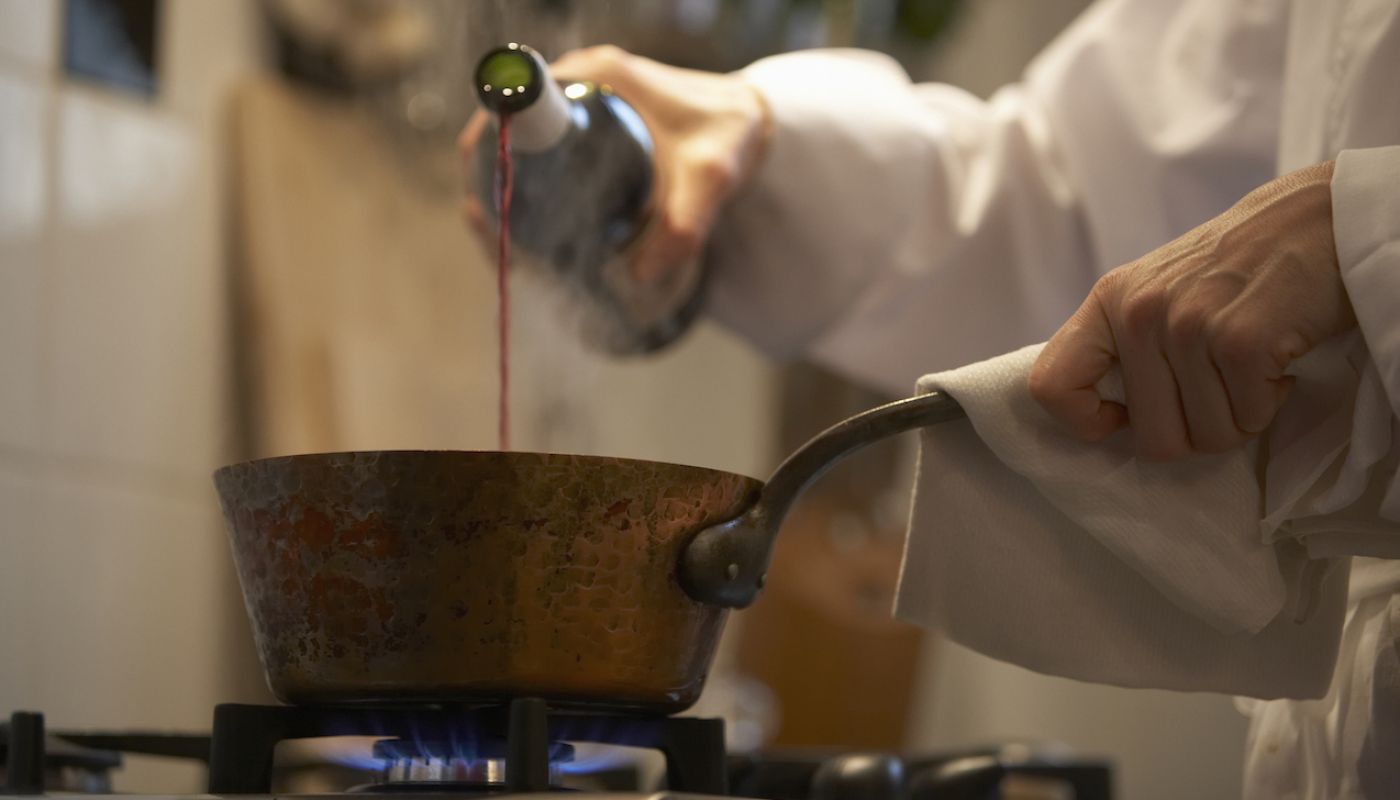
‘Whatever its colour, the wine must be clean and without a harsh, aggressive taste. Very cheap table wine sometimes does not react well in cooking, and it is better to use something superior in quality, although this does not have to be a great wine.’ So says Larousse Gastronomique. My mother, who spent most of her cooking years in Zimbabwe and used wine in many dishes, may not have complied with this advice, as anyone who has tasted Zimbabwean wine would attest. Choices were limited (severely, one might add). But her food was always delicious. Which brings us to a question that has divided chefs, cooks and wine lovers since time immemorial. Literally. Which wine should you use for cooking?
Cooking with wine as an ingredient (as opposed to the all-important cooking with wine by your side; in a glass; sipped for inspiration, energy and motivation; a vital component to preparing almost any meal) is a long and very old tradition. De Re Coquinaria, one of the earliest (and oldest) known cookbooks, collated, it is thought, by the Roman Caelius Apicius in the fifth century AD, contained numerous recipes which called for wine as an ingredient. For centuries, wine has been a key ingredient in many classical and traditional recipes, peasant and refined, particularly in Europe. Coq au vin, boeuf bourguignon, moules marinière, oeufs en meurette, cacciatore, chorizo al vino tinto… the list is endless and sweeps around the Mediterranean with rich infusion. Like stock, wine adds flavour; like vinegar or citrus, it adds acidity; it can also add sweetness.
French chef Marie-Antoine Carême codified the four ‘mother sauces’ in the early 19th century, but it was Auguste Escoffier who introduced the ‘daughter sauces’ with their wine components, which brought wine, officially, not only into the haute-cuisine lexicon but made it a structural element of classical cooking. Even without this stamp of approval from the Cerberus of classical cuisine, wine always has played, and continues to play, an integral role in cooking in myriad ways: it marinates, macerates, and adds piquancy splashed on the finish. It’s used to poach, boil, stew, braise, steam and blanche. Reduced, or used to deglaze, it becomes a defining component of sauces, jus and glazes.
I was commissioned to update the ‘Cooking with wine’ entry in the forthcoming fifth edition of The Oxford Companion to Wine. I was somewhat stunned to realise how little scientific research has been applied to the subject. Basically none – even scanning through online academic libraries for articles and papers revealed nothing. My own research revealed a lot of advice. A lot of ‘rules’. Cook with cheap wine. Cook with good wine. Cook with leftover wine. Never cook with leftover wine. Cook with tannic wine. Cook with wine without tannins. Cook with fruity wine. Cook with dry wine. Cook with red wine. Don’t cook with red wine. Cook with wine you like to drink. Cook with wine you don’t want to drink. The advice out there is plentiful but contradictory. Basically, choose your myth and wing it.
So, I set out to do some empirical research of my own, based on a half-baked idea that I launched into with much application and little thought. ‘Empirical research’ being a glamorous description of the unstructured, unscientific kitchen-chaos scenario that ensued. If I learnt anything at the end of it, apart from the lesson that one doesn’t undertake an exercise like this without a full team of kitchen porters, it was that proper, scientific experimental trials would be expensive, take a great deal more planning, and require more equipment than a home kitchen could possibly support.
Nonetheless, with careless enthusiasm, I threw myself into what I considered to be the world’s most pioneering investigation into which wines one should cook with. I scribbled a scrap-paper plan (if you must know, I used the back of a customs invoice attached to a box of wine samples) encompassing all the different wine styles and quality levels espoused by the various experts. The first hitch proved to be cost. Even with buying all the vinous variables at the cheapest local supermarket, my grand plan was starting to push my budget well over £500, and that was without the food. The second hitch was the sheer range of variables that should be investigated. Did I really want to taste test a couple dozen versions of mushroom sauce? Or mussels? Or chicken chasseur or boeuf bourguignon? What about turbot poached in different types of sparkling wine? Suddenly, the hitches started stockpiling at an alarming rate. The task I’d set myself, I realised, should be undertaken in lab conditions.
I had the luxury of neither laboratory nor the budget for endless variables. I had an entry to write for one of the world’s most beloved wine reference book, and my elderly parents had already signed up as willing sous chefs. Their energy levels and levels of commitment to the idiocies of their middle-aged daughter are now strictly limited. My other sous chef, aka husband, wanted to go on a long bike ride. He gave me a choice of dates and, within that, time frames. There was no option but to plough on. Give me enough wine, and I will plough on.
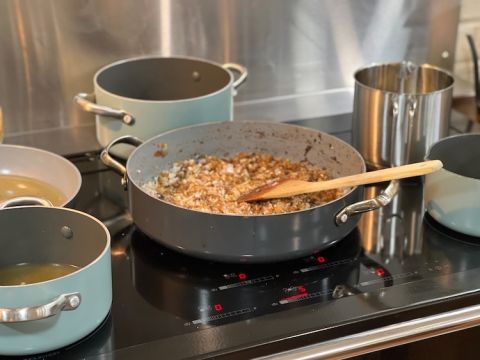
To keep the application as broad as possible, including the interests of vegetarian and vegan diets, I decided to cook a very simple base dish of mushrooms and onions without dairy, use that as a foundation and finish it with different wines. In a perfect world, one would consider the variables of different ingredients (proteins; dairy; oils; savoury elements such as tamari, soy, beef stock and salt; sweet elements; acidity in the form of vinegar or citrus; veg components; herbs and spices) as well as the impact of adding the wines at different times during the cooking process, heating it to different temperatures and cooking it for different lengths of time. Once you start to think about it, the permutations are overwhelming. This could be the work of a lifetime. I had one Saturday.
We cooked like crazy people. I did mise en place. I aproned my SWAT team, lined them up, lined up the ingredients, turned up the Top Gun soundtrack, and with military precision we chopped and chopped, sautéed and stirred, measured, reduced and gossiped over the relentless hum of the extractor fan. Unlike Top Gun, the kitchen looked nothing like the surgically neat landing strip of an aircraft carrier by the time we finished. A paintball fight in a mushroom-soup factory might have been closer to reality. How is it possible to get sauce on ceiling beams? I can’t answer the how, but it is possible. I can attest to that.

Job done, we lined up small plates – which makes it sound like an elegant tapas restaurant but don’t get ideas… The stove top looked as though a flock of pigeons had taken residence three feet above. We’d tested the recipe with a number of wines from cheap to expensive, fruity to oaky, low to high acid, dry to sweet. Considering the (enormous) limitations of the exercise, the results were strikingly simple and clear-cut. Acidity and sweetness had the most impact on the finished dish, and, in combination, proved to have the most profound, positive influence. ‘Fruitiness’, as opposed to sweetness, was the third contributing component.
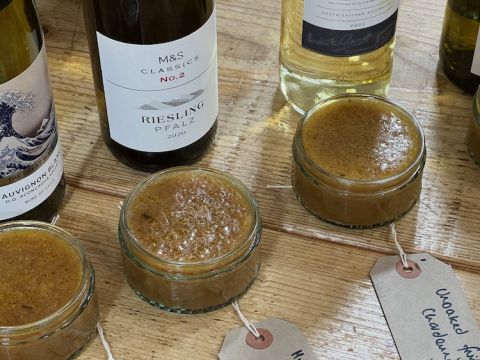
Sweet wines with high acid, such as medium-dry Riesling, and fortified wines, dry or sweet, such as madeira, sherry, marsala and port, were by far and away the best wines to cook with. Dry wines, red or white, disappeared, sometimes leaving dishes needing a bit more acidity. They didn’t seem to add much depth of flavour, no matter how simple or complex they were. The expensive wines made no more impact and added no more depth than the cheap wines. Tannic wines and oaked wines left a bitterness in the aftertaste of the dishes. Fruit matters – the wines with real juiciness of fruit added more to the dish than wines that were more on the savoury spectrum.

I didn’t try cooking with a faulty wine, so I can’t support or refute the theory that wine faults become exaggerated when used for cooking.
It is, of course, the crudest of experiments and I appeal to culinary institutes around the world to lean in with some proper investment in scientific research in this field. But in the meantime, all I can say is, whatever you’re cooking, you can’t go wrong with madeira. It covers all bases and if you don’t use it all up, it will last until the next time you need it. It also tastes delicious. In fact, you won’t have any left for next time.
Recommended wines to cook with (in your glass and in your pan)
Schloss Lieser, Wehlener Sonnenuhr Riesling Kabinett 2021 Mosel 7.5%
£16.68 (2020) Justerini & Brooks
Abundant, bright fruit with racy acidity – perfect in a garlicky, creamy coq au Riesling.
Eugenio Collavini, T Friulano 2020 Collio 12.5%
£18.95 Alivini
An almondy, herby wine that goes beautifully with asparagus and in a spring-green asparagus risotto.
Giant Steps, Pinot Noir 2020 Yarra Valley 13.5%
£23 (2021) VINVM, £24.99 Wine Delivered
Full of juicy charm – the wine to add to thyme-infused puy lentil and bacon braise.
Marion, Borgo 2019 Valpolicella 12.5%
£19.49 Bancroft Wines
Supple, red-fruited and sappy – slosh it generously into your ‘saucy’ spaghetti alla puttanesca.
Barbeito, 5 Year Old Rainwater Reserva NV Madeira 18%
£17 Theatre of Wine
Tastes of apricot jam and bitter orange – deglaze the pan you’ve seared your venison in and make a velvety sauce.
Barbadillo, Solear Manzanilla NV Sherry 15%
£15.95 per half The Wine Society
Lightly smoky, nutty and tangy – made for mushroom soup.
Harveys, Signature 12 Year Old Cream Sherry 19%
£13.99 Waitrose
Candied citrus peel, walnuts, medium sweet – slug a whole bottle over lamb shoulder, cook for hours.
Taylor's, Late Bottled Vintage 2015 Port 20%
£13 Marks & Spencer, £17.50 Hard to Find Wines
Be daring – make peixe Oporto, baked fish in a sumptuously rich port-wine sauce.
Tasting notes in our >220,000-strong database. International stockists on Wine-Searcher.com.
Credit for the photo above belongs to Ted Levine via Getty Images.