Almost half of all the wine produced in Europe is made not by individuals or families but by co-operatives. Spain alone has almost 1,000 of them, France nearly 700. They were typically formed in the aftermath of the Depression or the second world war when farmers needed to band together to survive. They did reasonably well throughout the mid twentieth century when the watchword was quantity, but now that the market imperative is quality, and the EU has dramatically reduced the subsidies that used to be available, wine co-operatives are having to re-model themselves or die.
Anyone who spends any time in Languedoc-Roussillon, where wine co-operatives have been particularly important, would be forgiven for having a rather jaundiced view of them. For years it seemed as though those who ran them were more interested in maximising the flow of funds from Brussels than the quality of what was in their tanks. The region is dotted with abandoned reminders of 1930s architecture that have been mothballed as co-ops coagulate into larger and larger groups.
The other big threat to the co-ops, apart from the drying up of financial props from the EU, has been a decline in members, or adhérents as they are known in France. The average number of vignerons delivering their grape crop to the local co-op each year has halved since the 1960s. This is partly because, in order to drain the European wine lake, the EU has taken positive steps to encourage those farming the wrong varieties of grapes and/or the least propitious vineyard sites to give up vine-growing altogether. But it is also because so many younger vine growers, now that wine production has acquired social respectability, have decided to make and sell wines themselves rather than see their grapes disappear into one big communal blend.
Not before time there is a growing realisation among those who run wine co-ops that to survive, they need to make wines that people actively want to drink. Particularly tangible evidence of this is the formation of Marques & Co-op (marquesandcoop.com), an association of 12 co-ops, or groups of co-ops, from all over France who have united to pool technical knowledge, buying power, the odd bit of gossip about export markets and promotional activity.
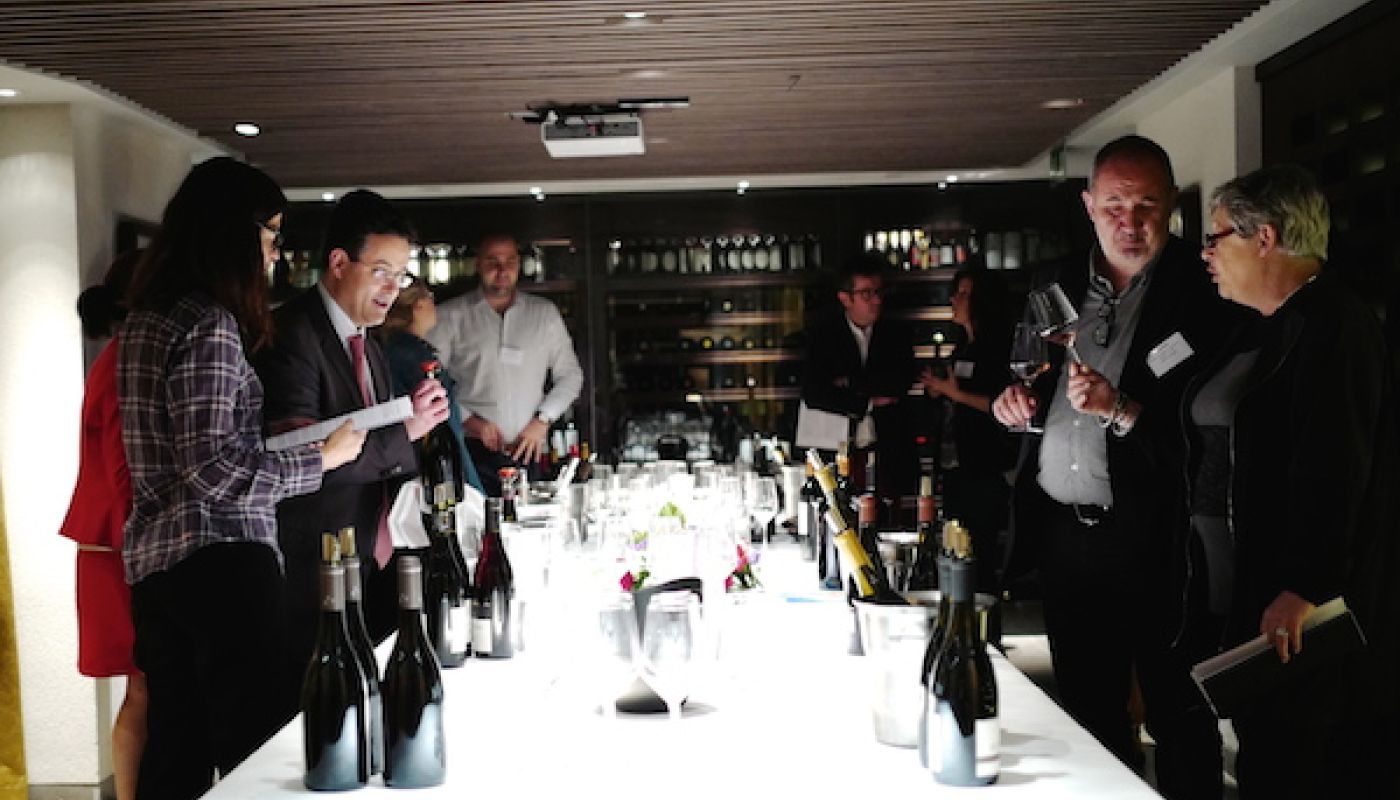
Representatives of these co-ops came over to London recently, each of them showing off two of the wines of which they are currently most proud. My expectations may not have been particularly high, but I found several wines I thought exciting on any basis. (The picture shows some of the co-operateurs at the tasting at Quilon Indian restaurant in the Taj Hotel.)
In the past, those co-ops with a successful export business tended to concentrate on large orders from the big retailers of northern Europe, often buyers’ own brands that did nothing for the reputation of co-ops and a decreasing amount for their bottom line. Most co-op wine was sold in bulk rather than bottle.
But the general manager of Cellier des Princes, one of the best-known co-ops in the southern Rhône, explained how eight years ago they had taken a conscious long-term decision to go for the much more profitable course of selling wines in bottle rather than in bulk to the négociant likes of Guigal and Meffre. At the meeting to present this new policy to his members he encountered a great deal of resistance, particularly from a couple of them. He proudly reported that this very pair had recently upbraided him for being too slow to move into the bottled wine business. For him the secret of success for a co-op is that the general manager and president (the Grand Poohbah of all the members) get on well and move in the same direction.
But the running of a co-op can hinge on intensely local issues, and we have ample evidence that the French are no sheep when it comes to proposed changes.
A particular pleasure in this tasting was the clear regional identity demonstrated by each member of the group. The co-operative grouping from the south west, for example, has been named Vinovalie, the oval reflecting this part of the world’s obsession with rugby. This was just one of several groupings of individual co-ops that has been created relatively recently by amalgamating co-ops with their own reputation (Rabastens, Técou, Fronton and Olt in this case). Olivier Cabirol from Vinovalie was glowing with pride that his Astrolabe 2014 Cahors had been voted best northern hemisphere Malbec at the recent Vinexpo in Hong Kong.
Another massive amalgamation has taken place in the Loire Valley. Here the co-ops previously known as the Cave de la Loire, La Confrérie des Vignerons de Oisly et Thésée, Les Caves des Vins de Rabelais and Les Vignerons du Pallet have got together under the (surely slightly misleading?) name Loire Propriétés. Their 250 members farm a total of 5,000 ha (12,360 ha) of vines and sell about €50 million worth of wine a year. But both wines they showed in London were exceptionally good by any measure: a long-matured Muscadet from Le Pallet subregion currently on sale at Majestic stores in the UK for a very fair £11.99 a bottle and a Chinon that tasted as though it had been made by a team entirely equipped with kid gloves.
Agamy was the anagrammatic name chosen last year for the amalgamation of the leading co-ops devoted to the Gamay grape of Beaujolais, whose best-known brand is Louis Tête, supplier of Marks & Spencer’s 2015 Brouilly. Within only a few months they were rewarded with a gold and a silver in the Decanter World Wine Awards. Their slogan? ‘Your idea of wine is going to change’ (and its French equivalent).
Jérôme Degonde, export manager of Estandon Vignerons of Brignoles, Var, the single biggest wine producer in Provence (most of these co-ops are the biggest producers in their region) could hardly contain his (fully justified) excitement at the ‘specificity’ of the four-year-old, oak-aged rosé he was showing.
Of course these small-production wines represent the icing on the co-operative cake, and I’m sure there is no shortage of distinctly ordinary sliced bread still lurking in France’s co-operative cellars. But being excited about genuine quality in wine is a great start, and it would presumably be a positive step to recruit more members into the Marques & Co-op fold: superior operations such as La Chablisienne, Union Champagne, the Caves de Tain, Turckheim, Ribeauvillé and St-Verny and more co-operative over-achievers.
Now they need to master the even more difficult art of selling and exporting wine successfully.
RECOMMENDED CO-OPERATIVE WINES
Not all of these, listed by colour and then roughly from north to south clockwise, are made by members of Marques & Co-op.
WHITES
Loire Propriétés, Jubilation, Le Pallet 2012 Muscadet Sèvre & Maine (£11.99 Majestic in the UK)
Union des Viticulteurs de Chablis 2014 Petit Chablis (£13 M&S)
Cave de Turckheim, Riesling Vieilles Vignes 2012 Alsace
PINKS
Chassenay d’Arce, Confidences Rosé Brut 2009 Champagne
Estandon, Légende Rosé 2012 Côtes de Provence
REDS
Les Caves de la Loire, Le Fauteuil Rouge 2012 Chinon
Louis Tête, Memoria Vieilles Vignes 2013 Beaujolais
Cave de Tain, Cuvée 88/77 2014 Cornas
Cave St-Verny Pinot Noir 2014 Puy de Dôme (£9-11 £9-11 RRP Lea & Sandeman, Booths, The Sampler, Quaff Fine Wine Merchants, South Down Cellars, The Wright Wine Company)
Ortas, Ico(o)n 2010 Rasteau
Cellier des Princes, Les Hauts des Coteaux 2012 Châteauneuf-du-Pape
Vinovalie, Astrolabe Malbec 2014 Cahors (not yet bottled)