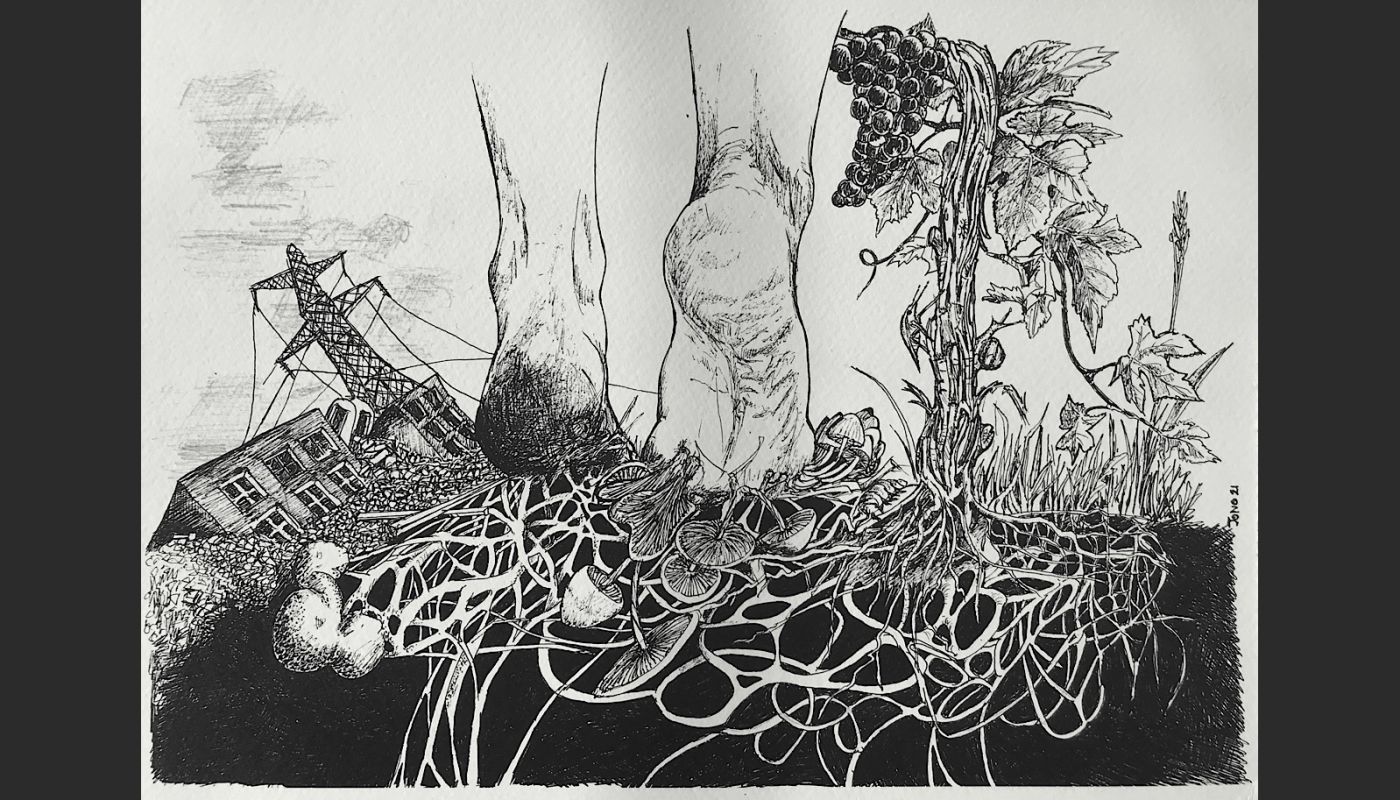
Chris writes Glad to hear the harvest is going well so far. Sorry for my delayed response – been a bit touch and go lately. I’m very impressed, flattered and feeling slightly guilty that amidst all the work to do in this critical, culminating moment you engaged with my chapter on that level. I thought you might look at it once your ferments were finished and your wine put to rest for the winter. Clearly, your mind is as busy as your hands!
How wonderful you sensed the connections between those intersecting lines of inquiry, from indigenous multinaturalism, posthuman anthropology, phenomenology and winegrowing. Indeed, it can all send the mind spinning, but reassembling the modern relationship with nature is deeply important. Our discourse (in the Foucauldian sense of knowledge–power structures) and engagements with matter (Barad and the new materialists) must change in tandem. Even seemingly subtle linguistic shifts can make a difference in how we think and act. For example, what happens when we turn from surviving to ‘subviving’, as the Brazilian anthropologist Eduardo Viveiros de Castro suggested in a recent book.
The very notion of ‘survival’, even when used to emphasise the magnitude of catastrophic environmental change, contains a hidden presupposition. The usage of the prefix ‘sur’, which denotes the capacity to transcend, rise above, etc… expresses that very macho sense of omnipotence over nature that got us where we are in the first place. Hence, the usage of this ‘sur’ appears inadequate, though ‘vive’ we certainly must. Given all that’s stacked against us, it will be miraculous if we manage to subvive! The prefix ‘sub’ not only suggests being ‘under’ but also the capacity to be content with imperfection and minimalism. Subiving calls for paying attention to overlooked relations, such as the vital role of mycelium in soil ecologies that we depend on for food (and wine).
We might even say that today there’s a battle between subvivalists and survivalists – those who still believe in a modern, Promethean overcoming of ‘nature’ v those who are prepared to negotiate a minimal deal with the earth to safeguard our continued coexistence. I found this dialectic perfectly encapsulated in that old vineyard I wrote about, Evangelho. The juxtaposition of the old vines, with their gnarled arms and deep roots, subviving under the power lines and urban sprawl (symbols of ‘modern progress’ and ‘survival’). I do understand your reservations about Tsing’s ominous focus on capitalist ruination. It all sounds hopeless, but I think she’s advocating subvivalism by showing that even in damaged landscapes, life goes on. On a brighter note, I think biodynamic vineyards/farms such as your San Polino can be inspiring symbols of the liveable collaborations we need to emphasise. Becoming attuned to how vineyards think … what a wonderful topic to explore!
Before signing off, here are my thoughts on those ‘two other things’:
1. I think you’re quite right that the conceptual power of ‘natural wine’ may reside in its oxymoronic signification. That’s actually rather clever except, as you said, most adherents probably miss the irony. If it hasn’t already happened, someone should really host a symposium where the wine world can properly get to grips with natural wine. I’m sure it would be well attended and very juicy.
2. On the matter of Stone Age wine, it’s difficult/impossible to pinpoint when and where it went down, but the first human encounters with grapes would have occurred somewhere between 60,000 and 100,000 years ago, probably in the area of modern Lebanon. This is the southernmost point where wild grapevines have grown for the last 100,000 years, which our ancestors would have encountered when they ventured out of Africa. For now, the Palaeolithic hypothesis is just that – an educated guess. It’s impossible to prove since there isn’t any ancient wine to exhume from the earth and the organic baskets are also long gone. There is solid evidence (via seed morphology), however, for identifying the transition from wild to domesticated grapes, which coincides with the shift from the Palaeolithic hunter-gatherers to Neolithic farmers around 6,000 BCE in the region between the Black and Caspian seas.
Wishing you a bountiful harvest and looking forward to further correspondence downstream.
Katia writes My turn now to forgive my late reply. The day before yesterday we finished harvest! At 6 pm we snipped off the last bunch, and while to many that would seem to be the end, for us it is the beginning. So we are up at all hours managing the fermentations, but luckily all seems to be smooth. One vat has already more or less finished and has been closed with its glass stopper (colmatura, I don’t know in English, the glass thing that rattles and tinkles as the gasses escape) … beautiful smells, colour, the thought of all those little Saccharomyces getting on with their busy days and busy schedules is such fun. I have sometimes made bread from the fermenting must, which worked on just a few occasions. Maybe try again.
Thank you for your reply. I love the idea of subvival. Never heard of it before, but yes, it is so, and is a very clever concept. Yet, then I thought how maybe it sounds once again somewhat binary and dramatic, and wondered whether an ‘en’ prefix might not be better, as in ‘envival’, which of course took me to the word ‘enliven’ … oh, aren’t words fun! So much to play with and so important.
Your idea of a new radical natural-wine symposium is great. So much to be said it would be hard to know where to stop! But we would be very restrained and only positive because it is only positive. In the meantime, we cross our fingers for COP26 … I saw this morning that the Queen herself was caught complaining that the leaders all talk yet do nothing. For once I find myself in agreement. The only thing we can do it seems is change what we can in our worlds and engage these changes with local politics. I am thinking of the Brunello Consorzio here in Montalcino. Once we are out of harvest it would be a good time to take a better look at what is happening.
I send you all my warmest regards and look forward to more enlivening thoughts … they do, on the ground, help change worlds.
…
Hi again, I just reread what I wrote and just to clarify … we started harvest on 30 September, that’s why one of the vats could finish, otherwise it could appear that they ferment only for a day!
Illustration by Jono Nussbaum.
















