
18 July 2016 Those who embark on the journey to becoming a wine geek soon encounter the Department of Viticulture and Enology at the University of California at Davis, an institution so well known in California and around the world that most people simply refer to it as Davis. Over the past few weeks I’ve been trying to recall the first time I learned about the establishment that many refer to as the Harvard of winemaking, and, as best I can tell, its name came up in the very first moments I decided that I didn’t want to just drink wine, I wanted to learn about it too.
Perhaps I noticed the association with the Aroma Wheel™, a graphic both enlightening and maddening to my early wine-drinking self (why is it round? why is it missing lychee and a bunch of other aromas?). Or maybe in my first readings of the Wine Spectator or Robert Parker’s Wine Advocate I noted how many times the phrase ‘UC Davis-trained winemaker’ seemed to appear.
Davis, I quickly learned, was a Big Deal – a hallowed institution that in no small part was responsible for the success of the California wine industry and hugely influential in the world of wine as a whole. But that was 20 years ago. After reading Julia's recent article Microbial terroir – Davis leads the way, I decided to find out how well the Harvard of winemaking is maintaining its reputation and what it is up to these days.
Davis sits in a small town with the same name about 15 minutes outside California’s capital city Sacramento. Its broad, tree-lined streets have gradually replaced more and more of the fields full of grain and cattle that speak to the agricultural heritage of the town. That heritage was strong enough to motivate the creation in 1905 of what was then known as the University Farm, essentially the state’s first agricultural education programme. In 1959, the school became the seventh major University of California campus. The school’s Department of Viticulture and Enology dates from 1935, shortly after the repeal of Prohibition. In its early years, Davis assisted with the herculean task of rebooting wine production in America (and California in particular), which had nearly disappeared during the 13 years of Prohibition.
Davis’ eight decades as an academic institution have been marked by the production of some of the wine world’s most enduring research and concepts. Eugene Hilgard’s pioneering work on rootstocks to combat phylloxera and Albert J Winkler’s climate classification using the concept of growing-degree days are two of the most famous. Under the leadership of Professor Harold Olmo, the university created dozens of clones of grapevine varieties that are among the most widely planted incarnations of Pinot Noir and Chardonnay in the world. According to some estimates, 75% of the Chardonnay in California is planted with Davis-bred vines.
Around 2000, research by Professor Susan Ebeler and some of her colleagues led to a significant improvement in TCA detection and removal by the cork industry. These days, one of the most exciting and important areas of the department’s research is being done by Professor Andrew Walker, who is painstakingly breeding rootstocks for resistance to problematic diseases and for significantly greater drought tolerance. The university maintains an exhaustive public database of grapevine cultivars and rootstocks available in the United States known as the National Grape Registry, as well as running an impressive nursery company selling virus-free versions of these vines, Foundation Plant Services. Known as FPS, this is the only dedicated grape importation facility in the country, which means that most vine material brought legally into the US goes through its doors. Davis also houses a research library that Hugh Johnson described as the ‘world’s greatest wine library’ before donating all his personal manuscripts and research notes to it last February.
 In many ways, Davis has always had a reputation that belied its size. The Department of Viticulture and Enology has always been a small part of the much larger agricultural university, producing about 60 graduates from its degree programmes each year, overseen by a faculty of 15 or so professors. For every person studying wine-related subjects, there are hundreds at the university studying botany, agronomics, biochemistry or geology.
California winemaker Randall Grahm attended Davis between 1978 and 1979 and I asked him to describe the department at that time. ‘It was extremely parochial', he laughs. ‘With the exception of [Maynard] Amerine and [James] Guymon, the faculty seemed largely incurious about the rest of the world. At the time I went, I felt the school had very little perspective on the world of wine. The facilities were pretty rinky dink. The wine lab, in particular, was dismal – think of a hobby chemistry set.’
Things had improved by the time Austin Peterson, winemaker at Ovid winery in Napa, received his enology degree in 2005. But he, too, wished that the facilities were better. ‘The worst thing about my time at Davis', he jokes, ‘Is that they built the whole winemaking centre right after I graduated.’

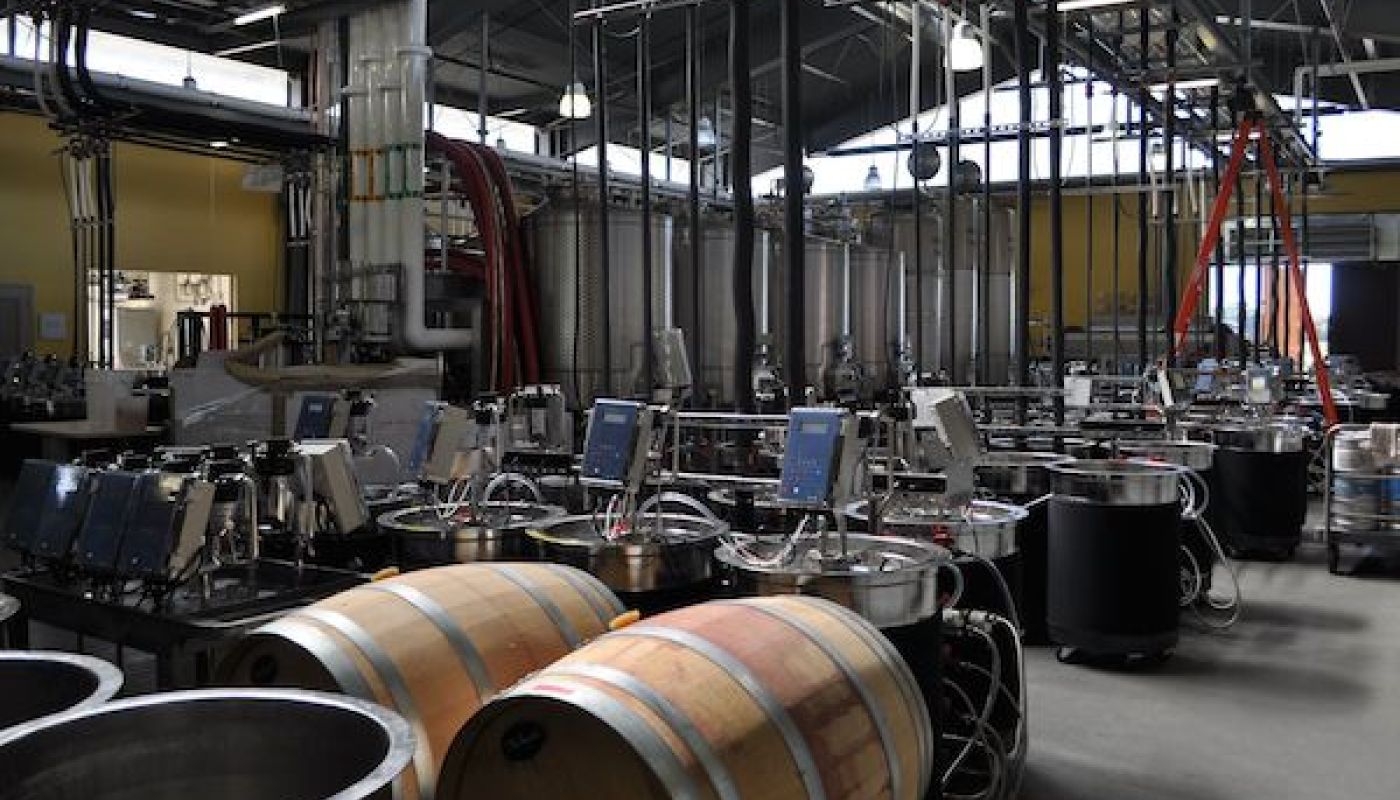
The late Robert Mondavi donated enough money to the College of Agricultural & Environmental Sciences to facilitate the creation of the Robert Mondavi Institute for Wine and Food Science, a complex opened in 2008 that now houses sensory classrooms and a very impressive teaching and research winery, a LEED Platinum-certified winery that the university claims with some credibility is the most sustainable winery in the world. The exterior of this teaching winery is shown above, the interior above right.
And that’s before the addition of the nearly complete Sustainable Winery Building. Not to be outdone, the late Jess Jackson and his wife Barbara Banke of Jackson Family Wines donated millions for the creation of this additional building that will house equipment designed to make the entire winemaking facility the first fully sustainable, zero-carbon-footprint teaching and research facility in the world.
 ‘In just a few years, we’ve gone from having not such good lab space to having the best in the world for what we’re doing', says Dr David Block, current Chair of the university’s Department of Viticulture and Enology. ‘It’s not just an incredible training tool for us, but also for the industry. We’re giving something like 200 tours a year for wine industry people from around the world – and we’re hearing back from people who are telling us they’re changing what they’re doing because of what they saw.’

Davis’ impact on and relationship to the wine industry is one that Block takes seriously. He tells me that he measures that impact in three ways: through their graduates; the interest in and usage of the university’s research by the broader industry; and through what Block calls Extension, a regular monthly programme of events put on by the school that industry members can attend to learn about the latest work done by Davis professors. In addition, the university employs an industry relations manager who, along with Block and other faculty members, visits different California wine regions five times a year. ‘When we go out, we make sure we always spend time listening', says Block. ‘We want to know what are the most important problems in that region. It helps us figure out what expertise to hire and how to change the curriculum to adjust to the problems that producers are facing.’
Despite what Block characterises as a particularly strong relationship with the industry, there are practical challenges. ‘If you go back 40 or 50 years', says Block, ‘our department was about the same size, but there were less than 100 wineries in California. Today there are something like 4,000 and it can be difficult for wineries to feel like they’re in touch with what’s going on here.’
In 2015, California sold $31.9 billion dollars worth of wine to the world. Despite the fact that this figure exceeds the GDP of almost half the countries in the world, Davis gets surprisingly little money from the wine industry. By my rough calculations and inferences based on what Block was willing to share, it’s somewhere in the order of single-digit millions per year.
‘What’s the diplomatic way of putting this?’ asks Block. ‘The amount of money we get to help fund our research from the industry is not huge. The industry will give us wine or grapes at the drop of a hat, but it would be nice if the number of companies that want to fund projects directly were higher.’
The university as a whole gets about 9% of its funding from the state, which according to Block is about enough to cover faculty salaries. Operating costs are covered through a combination of tuition and fees, a few small endowments, and some external sources such as the American Vineyard Foundation, which raises money to support wine research at many institutions around the country.
When I ask Gilian Handelman, Director of Wine Education at Jackson Family Wines, why there isn’t more financial support coming from the industry, she’s mystified. ‘Maybe it’s because things haven’t hit the fan enough in California. If you do a little digging you’ll see that Australia outspends California on academic wine research somewhere between 10 and 20 to 1.
‘But then again', added Handelman, ‘Australia was about to run out of water.’
Handelman goes on to describe Jackson Family’s latest research project in conjunction with Davis that involves separately fermenting and studying a single clone of Pinot Noir from the exact same plant material planted in 15 different separate vineyards. ‘We couldn’t have done this study without Davis, and Davis couldn’t have done this without us. It’s an immense collaboration.’
Only the biggest wineries are really in a position to fund a significant research project such as the one that Handelman describes. And, not surprisingly, smaller wineries’ relationships with Davis vary.
‘You know the old joke, right?’, asks Peterson, ‘Davis grads come out of school knowing everything there is to know about winemaking, but none of them can turn on a pump.’
I’ve certainly heard my share of grumbling about Davis over the years, primarily from winemakers at smaller wineries. The main complaint seems to be a sense that Davis churns out winemakers rigidly steeped in a dogmatic approach to winemaking. But most of those who level such complaints didn’t attend Davis and don’t employ Davis-trained staff.
‘Two thirds of our staff are Davis grads, and we hire interns from Davis every harvest', says John Conover, partner and general manager of CADE, Plumpjack, and Odette wineries in Napa. ‘In order to get into UC Davis now you have to be a straight A student. I don’t know how you know at 18 that you want to make wine, but most of them do, and they have straight As and this crazy resumé.’
Charlie Henschen didn’t know he wanted to make wine at the age of 18 but during his undergraduate years he studied in New Zealand and caught the wine bug. Instead of working in a neuroscience lab after graduating, he worked three harvests and then came back to Davis for his masters degree in enology, which he will receive in December, after a brief hiatus working a harvest in Burgundy and finishing his research thesis.
‘I learned a lot more at Davis because I knew what working in a winery is like, and I could apply the lessons to what I had experienced', says Henschen. ‘Professors are aware of the limitations of the classroom setting, and they don’t really teach you particular practices. They teach about the equipment, different techniques that can achieve different things, what tests to do that give you what numbers, and how to determine whether those numbers mean anything. You can’t learn to make wine without working in a winery, and the professors know that.'
‘Davis is in a tough position, where they have only two years to teach you a subject that has a broad spectrum', concurs Peterson. ‘It’s not Davis’ job to give you experience, or an introduction to various wine cultures. That’s your job to go out and get that experience, to see those different cultures.’
Conover agrees. ‘Their professors’ job is to teach them the fundamentals of grape growing and fermentation', he says. ‘Then they come to us and we build on the foundation that Davis has provided us. If you have a 22 year old right out of school, you’re not putting them into the winemaking and picking decisions. That comes from a decade of experience.’
That point of view certainly aligns with how Block thinks about the programme he’s in charge of. ‘In most fields people understand that you’re going to have to learn on the job and make that investment', he says. ‘That’s true of winemaking as well. When a student gets out of here, they have problem-solving skills, but they’ll have to learn on the job and use those skills to be creative. We’re giving them the tools so that, using their creativity, they can make any kind of wine they want to make.’
‘I’m not seeing any downside to the education or anything they have to unlearn', says Handelman, who doesn’t know just how many Davis graduates get hired each year by Jackson Family Wines, but assures me the number is significant. ‘If anything, the new graduates I’ve seen are more open-minded than some of these dinosaurs in the industry who are kicking and screaming about new grapes or natural winemaking. These kids coming out of Davis have been exposed to more, have done stages in different places, and their worlds are much more expansive than 20 years ago. They’re not entrenched in Cabernet and Syrah and Chardonnay.’
Davis, like many academic research institutions that aim to produce highly skilled professionals for a specialised industry, has to walk a fine line. It must continually push the boundaries of knowledge in its field, while at the same time teaching fundamental knowledge and practical skills that allow its students to compete and succeed in the marketplace.
By all accounts, after many decades, Davis is doing both with aplomb. A quick glance through the hundreds of its current research abstracts yields a treasure trove of topics seemingly highly relevant to the world of wine we’re living in today. Every current and past student I spoke with, every member of the wine industry I interviewed, feels that Davis is operating at the top of its game. And the world seems to agree. Davis graduates are increasingly finishing their degrees and heading off to Europe, South Africa, Australia or Chile to begin their careers. So much so that this is starting to be a problem in Napa.
‘They’re young and they want to explore the world', says Conover, ‘But as a Napa Valley vintner that makes me nervous.’
The competition for top talent never ends, it seems.
Campus images copyright by and courtesy of the University of California at Davis.













