
As it turns out, living in a time on which historians will be able to base entire careers is wholly unpleasant and acutely frustrating. Quite aside from feeling useless as COVID-19 cases climb (thank goodness for the healthcare workers, epidemiologists and virologists with the requisite skill set to fight for the rest of us) and being physically isolated from family and friends (a few of whom have the virus), I speculate that a lot of us in the wine industry are finding that the more enjoyable aspects of the careers we’ve chosen aren’t currently in play. Or perhaps I’m just projecting.
While there have been some interesting projects in the last two weeks, for the most part cellar work has been of the type that keeps my hands busy while my mind does anxious loops. Production jobs are in short supply on the west coast of the US and I’ve heard of more people being laid off due to reduced wine production (because of the fires) than I’ve seen job posts. My fellow intern is in the process of being interviewed for a cellar position at a rural winery in Missouri. Being rather partial to the west coast, I’ve taken the slightly less geographically drastic approach of applying for hospitality positions. But while the cellar learning lasts, let me share …
In addition to general cleaning (which truly never ends) we’ve been doing our best to assist the 2020 reds with finishing primary fermentation and malolactic conversion, have completed bench trials (see below), and begun racking 2019 blends.
In an ideal world, you would put your red fruit in tank; it would get most, or all, of the way through primary alcoholic fermentation; you could choose to conduct an extended maceration (fear of smoke taint kept us from doing this for the 2020 vintage); and then you’d drain and press it off. Some tanks will be completely sugar-dry when you drain and press, others will have a few grams of residual sugar, but the oxygen picked up during draining, pressing, racking the tank and barrelling down the wine will generally stir the yeast up enough to finish the primary fermentation. Add in our cosy warm room to keep the yeast happy and you should be golden …
However, sometimes entire lots of wine or a single barrel will be stubborn or slow to complete fermentation. If your wine isn’t sugar-dry and primary fermentation slows or stops, you may see a large spike in volatile acidity. Above 1.2 g/l VA is illegal and the only way to fix it is reverse osmosis, which is detrimental to wine quality. This spike can be caused by acetic acid bacteria, usually in the form of acetobacter, which metabolise ethanol into acetic acid; or gluconobacter, which metabolise glucose into acetic acid; or by lactic acid bacteria. Lactic acid bacteria can be beneficial and are responsible for converting malic into lactic acid but when they take hold before the end of primary fermentation they can convert glucose to acetic acid. In addition to causing off-aromas and undesirable flavours, acetic acid is toxic to Saccharomyces cerevisiae yeast. So, while some wineries will allow primary fermentation and malolactic conversion to take place simultaneously, the winery I’ve been working in finds it best to use either a low dose of sulphites to kill bacteria or the anti-microbial preparation Stab Micro M to reduce VA and microbial growth.
If you are unable to halt malolactic conversion before the completion of primary fermentation (sometimes the strain of bacteria is very strong, and you can’t use a high dose of sulphites or you’ll kill the yeast), you’ll likely have to restart fermentation. Fortunately, we haven’t had to do this yet (encouraging yeast growth gets ever more difficult the higher the alcohol, lower the sugar, and greater the amount of acetic acid present). Unfortunately, we will have to do it shortly. We have one barrel that has 11 g/l of residual sugar and is going through malolactic. Luckily, the winery encountered a viciously productive strain of yeast a couple of years ago which managed to restart many stuck fermentations. They sent a sample to a lab in order to isolate the strain and now have it stored so that they can call in and order a culture whenever they have a stuck fermentation.

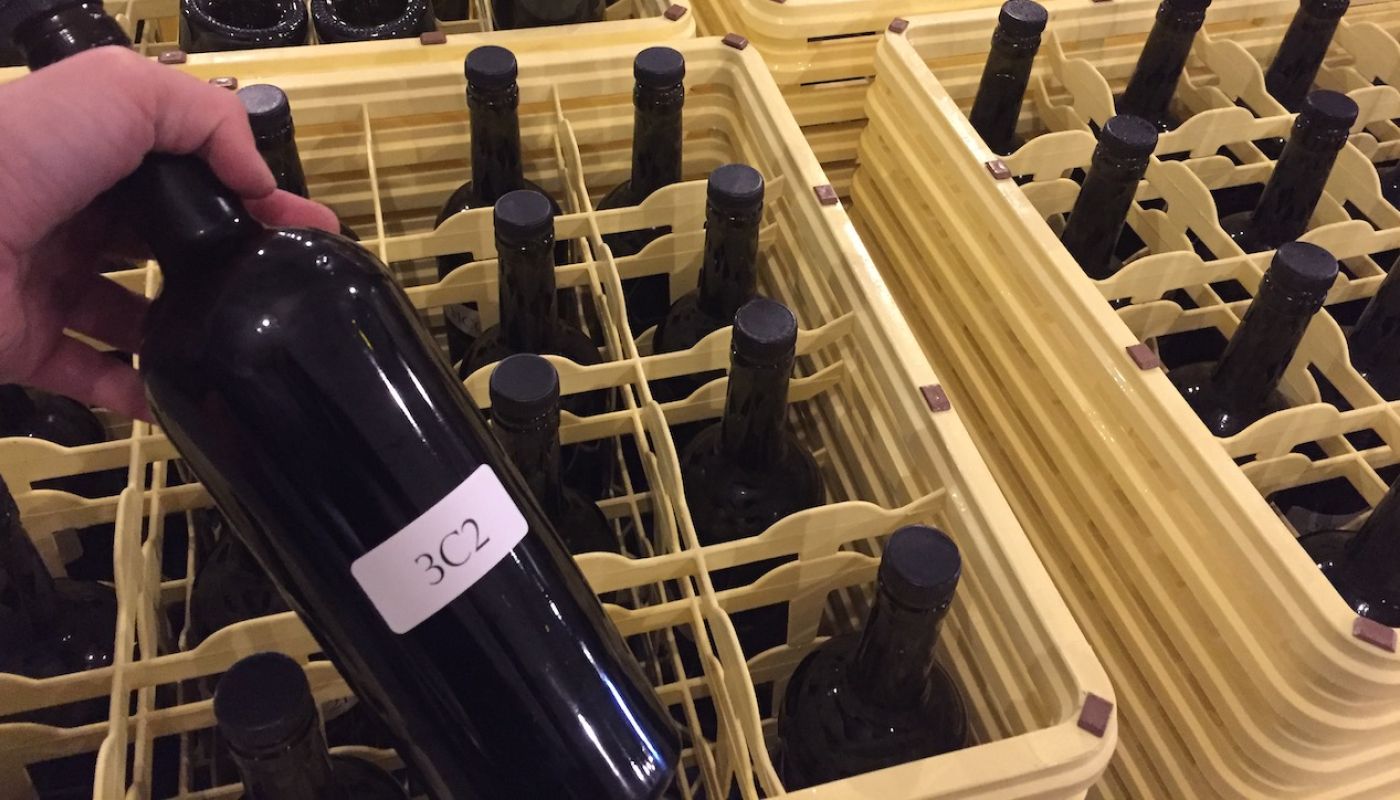
Bench trials started a week ago for the 2019 blends. This involved us pulling a massive number of composite samples of each lot and lining them up (apparently the barrel-by-barrel sampling I described in my last article was only to show us the difference in oak regimen and check for off-barrels). Our assistant winemaker then goes through and starts blending and tasting (with reference to prior years’ blends) and comes up with three iterations of each blend. Our head winemaker and our general manager will then go through and taste these blends to decide on their favourite.
Decisions having been made, we pull out the pumps, hoses and selected barrels, rack and blend the wines into a tank, wash the barrels, and put the blended wine back into barrel to rest for another year. What, I asked, was the point in blending a year before, putting the wine back to barrel, and then having to put it back up to tank a year later? Why not just do it once?
The answer that I was given was that the wine benefits from being racked off the lees, especially if it’s a bit reductive, and it results in a clearer wine without filtration. The micro-oxygenation that occurs when you move a wine (of course we’re still gassing all the lines and the tank) is beneficial in softening and stabilising colour and tannin. Finally, the component pieces of the wine have more time to ‘marry’. What the chemical explanation for the last one is, I couldn’t tell you.
As the end of cellar work for 2020 approaches, I’m thankful for the intellectual challenge and clarity that the last two vintages have provided me. It was made all the better by sharing it with JancisRobinson.com readers. To everyone who has emailed or messaged me on a forum post, your questions have encouraged me to ask more of myself in the cellar, pay closer attention, and do better research. You have been a joy and a boon. Thank you.













