
28 August Lebanon's rich winemaking heritage is no secret. It stretches back to the mists of time, back to the Phoenicians who brought their wines from Tyre and Byblos across the Mediterranean to Spain. If Gilgamesh were around today, he'd likely be sipping Lebanese. He's believed to have passed through snow-capped Mount Lebanon and encountered Siduri, 'the woman of the vine and maker of wine', on his way to the secret of eternal life. Good ole Gilgz, there he goes again!
It was in Baalbek in the Bekaa Valley that the Romans chose to build the Temple of Bacchus. And it was in Cana in southern Lebanon that, according to the Gospel of John, Jesus turned water into wine. The Bible's Hosea 14:7 states, 'People will dwell again in his shade; they will flourish like the grain, they will blossom like the vine – Israel's fame will be like the wine of Lebanon.' The legend and lore makes this wine Game of Thrones-worthy.
Lebanon, though, has long been overlooked and undervalued. Behind the veneer of deep history and shifting perceptions of Middle Eastern wine is a diverse, throbbing Beiruti modernity and taste for world-class wine that have taken root in the vineyard and winery. Lebanon's post-civil war identity is becoming ever clearer. Its wine has come into its own.
Michael Karam is the guru of Lebanese wine, author of Wines of Lebanon and Arak and Mezze: The Taste of Lebanon, contributor to the Oxford Companion to Wine and writer for Harpers Wine and Spirit and The National. He's light-hearted, warm and profoundly generous. His big, reverberating baritone is permanently switched on and, even when he's debating whether to add more milk to his coffee, he's speaking from somewhere deep. I suspect he, in many ways, embodies his country's wine.
I caught up with him to talk Lebanon, where it is today and where it's going. I asked him to ‘Gimme the full Leb’, so first we tasted – Domaine Wardy's Obaideh 2012, Domaine des Tourelles' 2015 blend of Chardonnay, Viognier and Muscat, IXSIR's Grande Reserve 2011 blend of Syrah and Cabernet Sauvignon and Ch de Marsyas B-Qa 2013 blend of Cabernet Sauvignon, Syrah and Mourvèdre. Also in the line-up was Domaine des Tourelles' Vieilles Vignes (70-year-old vines) Cinsault 2014, which Jancis reviewed in detail earlier this year. As Karam emphasised, this grouping of wines is an excellent barometer of Lebanon's potential (and street cred) today. I've added Ch Musar 2004, Ch Kefraya 2007 and Ch St Thomas 2001 to my wish-list to better understand Lebanese ageability. FYI, as of this writing, I frequently find myself in a daydream-trance navigating platters of lamb shish and mint, chicken and pistachio and cardamom, za'atar, tabouli, lemon and lentils, honey, halloumi, sumac, charred octopus, saffron potatoes and spiced yogurt alongside endless glasses of these Lebanese wines. Who among us hasn't debated ordering that extra plate of stuffed grape leaves? Clearly, Lebanon channels a deep collective unconscious.
Lebanese wines can be rich and fat just as they can be lean and elegant. For the reds, big, ripe, opulent tannins made up the common thread. Wine made from grapes grown on the valley floor differs greatly from wine from IXSIR's vineyards up at 1,800 m (5,906 ft) in elevation (the highest in the northern hemisphere). Lebanese wines, with their fairly limited availability, can be hard to catch in the act of greatness, though more adventurous consumers and sommeliers seeking interesting, eclectic wine lists are taking notice. For more, take a peek back at Lindsay Groves' detail on Lebanon's wine landscape and Team JR's 'Points East' tasting-note compilation.
Q&A with Michael Karam
Lebanon's production of roughly nine million bottles per year (up from two million in 1990) has played third fiddle to Turkey's 70 million bottles and Israel's 50 million bottles. How do you see Lebanon's place on the wine shelf and wine list today and tomorrow?
Don't forget the 35 or so million bottles that are produced on Cyprus that we don't really get a chance to see because they're mostly drunk locally. Thankfully the Lebanese don't drink that much wine – whisky and vodka still reign – so the world gets a chance to sample around half of what is produced. Still, it's a microscopic amount and Lebanon’s ambitions must be focused around developing a solid reputation as a boutique nation whose wines need to be sought out, either in the independents or the on-trade, where, incidentally, we need to see more listings in non-Lebanese restaurants.
Producers must also, where possible, be a bit braver about using what they unfairly perceive as lesser grapes – Cinsault, Carignan and Grenache in reds and the native Obaideh and Merweh in whites. These grapes speak most to our heritage and, let's face it, selling wine is about identity building.
Lebanon is surprisingly diverse and tolerant. How are wine-drinking habits of its unique population evolving?
Wine is catching on but we're a small country with, let's say, half the population teetotal. And, as I mentioned, spirits, including arak our national drink, are huge, as is beer. But what is important is that the Lebanese are waking up to the realisation that their wines are every bit as good as wines from rest of the world, including France, a country we tend to fawn over when it comes to all things taste and style.
Has Lebanon followed the French blueprint in introducing an appellation and classification system? How is this developing at the moment?
It hasn't. There are some plans in a file in a ministry somewhere but don't hold your breath. We’re lucky we have a functioning industry in a dysfunctional part of the world.
You coined the term 'Super Lebs' for Lebanon's high-octane Bordeaux and Rhône blends. Are these the exciting driving forces today? Or has the pendulum officially swung toward local varieties and lighter, fresher styles?
I coined 'Super Lebs' because we had a high percentage of international style wines – Cabernet, Merlot, Syrah, etc – that, while beautifully made, did nothing to advance our national wine identity. So I figured let's at least try to create an identity; a rationale, a sexiness – call it what you will – for them if that makes any sense. Listen, these wines are really good but are they ‘Lebanese’? I would argue that they aren't. This is something I'm passionate about but many people will disagree with me and I'm sure they can make a very good case that they are totally Lebanese and Karam is talking out of his bottom. That’s actually a good thing because it creates discussion around our wines and the wider issue of the so-called ‘international style'. But essentially, I believe wine has to have a sense of place and, maybe it's just me, but I only really get that feeling with the relatively lighter wines that are less extracted and not dressed in the most expensive new oak money can buy.
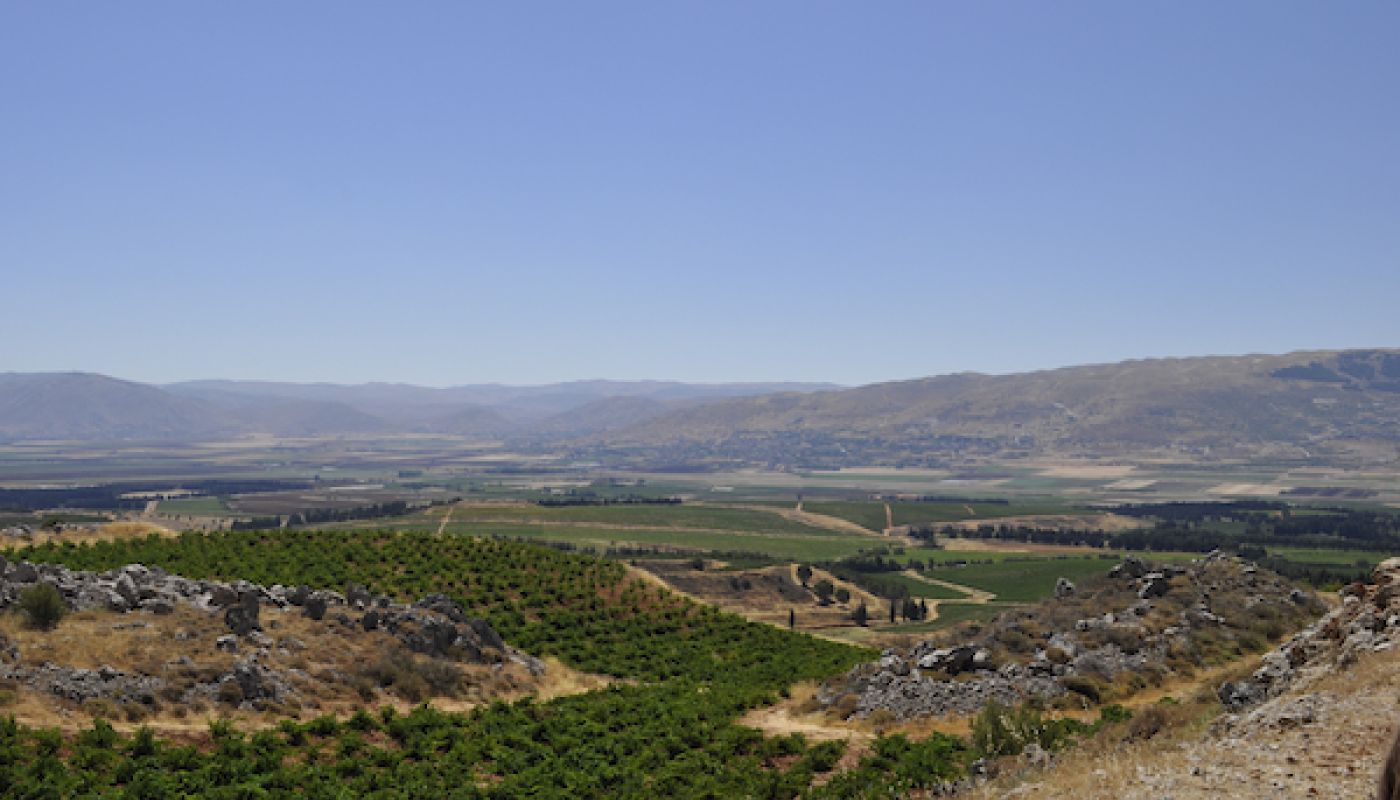
Cinsault is Lebanon's great grape. You plant it in the Bekaa (pictured above by Norbert Schiller) and it oozes the Bekaa. Carignan can do the same. We make great Chardonnay, but so does almost everyone else. Obaideh is a grape that can give a unique expression to our deeply profound terroir. I know this might sound a bit wanky but it's all about soul. Serge Hochar knew that and that's why his wines are among the most esoteric on earth. Was it coincidence he was Lebanese? I don't think so.
How would you introduce Lebanese wine to a wider audience? Do you believe Lebanon should emulate Italy's success with Montepulciano d'Abruzzo and Nero d'Avola in the on-trade (pizza wine)? Or do you believe this approach would pigeonhole Lebanese wine as ‘ethnic wine’?
No, no, no! Italy makes around four billion bottles. We can't go down that road. We have to make every bottle of Lebanese wine special, especially as the cheapest example retails for around a tenner.
Apart from Cabernet Sauvignon, Carignan, Cinsault, Grenache, Merlot, Mourvèdre, Syrah and Tempranillo, some producers like Ch Ksara and Ch Kefraya are experimenting with later-ripening, drought-resistant grapes such as Marselan (Cabernet Sauvignon x Grenache) and Arinarnoa (Tannat x Cabernet Sauvignon), though in small amounts. What new trends are you seeing with red varieties in Lebanon?
I predict more Cinsault-driven wines now that Faouzi Issa of Domaine des Tourelles took the plunge and produced a vieilles vignes Cinsault that has sold out everywhere. I never had any doubt it would work, by the way. In the absence of an indigenous red, Cinsault is our adopted child. It's not a box-office grape like Cabernet, but try building a reputation around Lebanese Cabernet. We make great Cabernet but it's everywhere on the planet and we need to be a bit different. Cinsault has a great story and it's been the workhorse in the Bekaa for 160 years, ever since the Jesuits at Ch Ksara introduced it into the Bekaa from Algeria.
Exceptional white wines from Chardonnay, Muscat, Sauvignon Blanc, Sémillon and Viognier are coming out of Lebanon today. Roughly what proportion of Lebanon's production is white? Are plantings of native grapes like Obaideh and Merweh increasing and do you see a bigger focus on these from producers and consumers?
30% of our wines are white and yes we're just at the beginning of an Obaideh and Merweh revolution that I hope will do for Lebanon what Assyrtiko did for Greece. I also truly believe that our whites are every bit, if not more so, interesting and diverse than our reds. And of course we have the altitude, which gives complexity and freshness rarely seen in such a hot country. Lebanese whites are the story at the moment.
Has the rosé craze hit Lebanese producers? How about sparkling and other styles?
Rosé is huge over here. The Lebanese drink it from the petrol pump. They inhale it at the beach and it has proven popular alongside our cuisine. Ch Ksara's Sunset is practically a national icon but there are many other stunning rosés. I've just come back to England from three weeks in Lebanon where I drank gallons of Ch Musar Jeune, which is 100% Cinsault-based rosé. They sell the 2014 in beautiful magnums over there.
Outside of Bekaa, which accounts for 80% of Lebanon's wine production, are other regions being explored and developed? Are big existing estates expanding in and new wineries popping up in northern Batroun, Mount Lebanon, the Chouf, and Lebanon's south?
The Bekaa is still the mothership and accounts for over 90% of the wines produced. Batroun with its Mediterranean climate (Bekaa is continental) is producing some really interesting wines, especially the natural-ish reds from Domaine Najem (I'm convinced Alice Feiring would go nuts over them) and reds and whites of Batroun Mountains. It's the only genuine other wine region in the country even if there are wineries in the areas you've mentioned. I can't wait to see more wineries in Mount Lebanon, but please no more Cabernet and Chardonnay! Think Southern France!
What has work in genetic identification of native varieties revealed?
Ch St Thomas, working with José Vouillamoz, recently proved definitively that Obaideh is Lebanese and not a synonym of Chardonnay as was previously thought. Jancis [and José and Julia – JR!] will have to reflect this in the next edition of Wine Grapes.
How has the sad passing of two giants Michel de Bustros, founder and CEO of Ch Kefraya, in late 2016 and Serge Hochar, the driving force behind Ch Musar to whom Jancis paid tribute, in late 2014 affected Lebanon's wine industry? Have we entered the next chapter of Lebanese wine with the new generation taking the reins?
Their passing was indeed very sad. But, truth be told, we're entering a new era with young owner-winemakers who are ready to take risks. They include Faouzi Issa at Domaine des Tourelles, Joe Touma at Ch St Thomas, Dargham Touma at Ch Heritage, Sebastien Khoury at Domaine des Baal, his cousin Jean Paul Khoury at Ch Khoury, Assad Hark at Batroun Mountains, Hiba Najem at Domaine Najem and Ramzi Ghosn at Massaya to name a few. It's very exciting. In the old days, the owners hired winemakers. In a small industry such as ours we need the owners to be hands-on or, at the very least, let the winemakers do the talking. There are exceptions. Tarek Saqr has kept the flag flying at Ch Musar in the wake of Serge Hochar’s tragic death, while James Palge at Ch Ksara, Fabrice Guiberteau at Ch Kefraya and Gaby Rivero at IXSIR ensure the wines from Lebanon's big wineries remain interesting, consistent and relevant.
With over a million Syrian migrants, Lebanon is the world's largest per-capita host of refugees. Moreover, the Bekaa Valley is just 70 km from the Syrian border – ISIS has taken advantage of this, holding fort in the town of Arsal. How has the Syrian conflict affected Lebanon and its wine industry?
So far so good, but it's always there in the back of our minds. That said, the Lebanese are masters of working under pressure.
Have above-average temperatures and drought-stress intensified due to climate change in recent years? What techniques have Bekaa producers used to manage these issues (eg higher elevation planting, earlier picking, canopy shading, clonal selection, irrigation)?
Climate change is undeniable despite what Mr Trump would like us to believe. Still, by and large, we don't irrigate and we don't acidify. We have altitude and the melting snow off the mountains still acts as a natural drip system. The first grapes in the Bekaa are picked in mid August and harvest goes on until early October in some cases. The Bekaa is a beautiful place to make wine.
With over 40 producers, Lebanon is well past the days when Ch Musar was the only game in town. What advice would you give to Lebanon's winemakers? What are your hopes and expectations?
We really need to improve how we market our wines, especially in a generic capacity, so I guess this should be aimed at the government and the Union Vinicole du Liban. We need a wine marketing board that would create a strategy for marketing our wines at home and abroad. To the producers I would say, ‘Be bold. Be different. Don't follow the Cabernet yellow brick road. Make wines that express who we are.’ What do I dream of? More wine. The whole Bekaa as a huge vineyard. We can make much more wine and wine is a messenger. Lebanon is a country of tradition, hospitality and generosity of spirit, qualities that are reflected in our wines.













