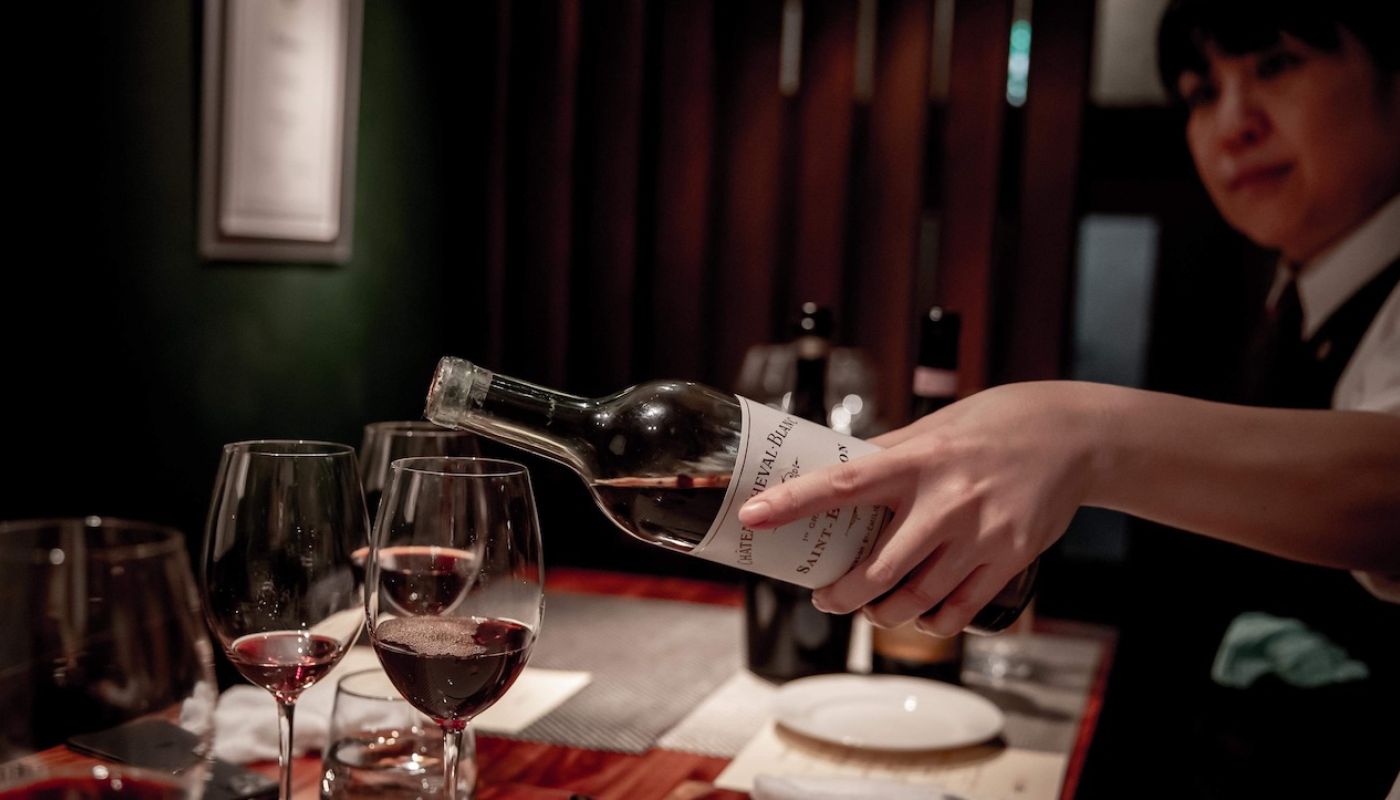
I was born in Shizuoka prefecture in central coastal Japan. This prefecture is well known for tea cultivation. Growing up in Shizuoka, I was always fascinated by the unique aroma of Japanese tea – fresh green tea (Sen-cha), roasted green tea (Houji-cha) etc. It elevated my sense of smell. As a beginner, I didnʼt have any problem detecting the characteristics of wine and I could take all the sommelier examinations in Japan. But as I study more, I think this was extremely intuitive. Now I feel that I need to reach conclusions more theoretically. The key is to follow the ‘deductive tasting format’.
I have already covered the Master Sommelier ‘List of examinable white and red wine grape varieties and regions’. My next step is to be more aware of and overcome my habits in blind tasting. For example, I have difficulty in catching the salinity of white wines like Albariño. It is probably because I grew up in a coastal area and my taste buds are too accustomed to salinity. In order to improve my tasting skills, I must be fully aware of my personal tendencies. I must put that aside and take an objective approach. This will make my tasting more theoretical and concrete. This skill is a must to prepare for the MS examinations.
Studying wine is similar to studying music. Since childhood, I have been learning classical music, like playing the piano and vocal training. When singing a song, it is important not only to understand the song well, but also to make it my own and express myself. Learning how to control my vocal chords is just a tool. I think it is the same with wine. I canʼt always call the correct answer in blind tasting – it is just one aspect of my study. The most important things are understanding viticulture and vinification, the winemakerʼs philosophy and sense of place, promoting the wine well, increasing sales, and making customers, owners and any stakeholders happy. On top of that, it is really wonderful if I can express myself.
Since 2015 I have been the co-owner of a French restaurant, Bistro Yoshimichi, in central Tokyo. I have been working not only as a sommelier but have also been responsible for overall restaurant management – from attending to the restaurant’s guests to making the menu and wine list, purchasing the wines, to accounting and all the administrative procedures. Having a licence in bookkeeping has been an advantage for me. With my business partner, the chef, I have been responsible for building the restaurant’s philosophy and business direction. One major decision was not to be on public media. We receive many requests from TV and magazines but we prefer to base our business on word of mouth. After all these years my business partner and I are convinced that we made the right decision.
Personal statement
Prior to my career in wine and gastronomy, I was an accountant in the IT industry. I was not the outgoing type, so I studied bookkeeping. To my disappointment, in my job I had to communicate with many people in different departments. Thanks to this experience, I gained interpersonal communication skills as well as analytical and time-management skills. One day, I happened to dine in a restaurant which led me to change my career to the restaurant business about 12 years ago. I gained management experience in brasseries before going on to manage my own restaurant.
As of now, there is no Master Sommelier resident in Japan. The biggest reasons are the language barrier and the fact that the exams are held abroad. However, the number of MS candidates in Japan is increasing now, so I began to be interested in becoming an internationally accredited sommelier. I started my preparation for the ASI exam, and I passed it at the beginning of 2018. In August 2018, to improve my sommelier and English skills, I took the Court of Master Sommeliers’ exam in Shanghai, and became a Certified Sommelier. Being the only Japanese there, I felt slightly anxious. However, the result led to subsequent challenges abroad: I was a semi-finalist in the Wines of South Africa Sommelier Cup (2019); finalist, Angelus Trophy (2019); semi-finalist, Japan Best Sommelier Competition (2020); and semi-finalist, Ruinart Sommelier Challenge (2021).
During the Advanced Sommelier exam preparation, Darius Allyn MS gave me wonderful advice. I was impressed with his generosity and, more than that, his deep knowledge and insight was an intellectual stimulation. Furthermore, he took the time to give me an online blind tasting lesson. All the MSs were very helpful, informative and inspiring and, most of all, VERY open. To be honest, there is no similarly open atmosphere in Japan yet. It was very comfortable, and I felt that I had finally found a world I want to be a part of.
I am a Japanese female, 44 years old. Sadly, in the 2021 gender gap rankings by country, Japan ranked 120th among 156 countries. Recently a high-ranking Japanese politician expressed his belief that there is no ‘value of being a woman’ in older age. I have been fortunate to be involved with the Japan Sommelier Association (JSA). Despite my gender and age, they give me fair opportunities to participate in competitions. But this is not the case in Japanese society as a whole. Discrimination in Japan is so deep-rooted. The biggest obstacle is women themselves. To be honest, my applying for this scholarship will not be understood by some Japanese women. The reason is women don’t take other women seriously.
I was diagnosed with cancer 10 years ago. After several years of treatment, I have fully recovered and since then, I feel more alive than ever and my vision of the world is greater than before. Now, nothing stops me from challenging myself. To take back the years I lost, I push myself, but in tune with my body, mind and spirit. I know how precious and fragile our one-time-only life is. Because I was given a second chance to live, I have a passion to share what I learn and to inspire as many people as possible – especially the younger generation, regardless of gender, in the food and beverage world where I belong now.
I have never hesitated to move to a new environment. Opportunity appears at the right time and I have always taken a chance, trusting my intuition. This scholarship opportunity appeared at the right time. My restaurant business has solidified and my business partner is able to operate it without me. I therefore believe I qualify to be a part of the Golden Vines Diversity Scholarship, Internship & Mentorship Programme and I assure you that I can fully give back what I gain through the Programme.
Discrimination continues
I studied classical music to become a music teacher until university. Since my high school was a preparatory school, most of the women went on to college or university, but most of my other friends got a job right after high school. At that time, in the 1990s, everyone in Japan pursued lifetime employment, where their position would be guaranteed based on the seniority system. So, in order to get a job, female students had to have the same hairstyle (short or put up), no dyed hair of course, and had to wear the same black suit. I wasn’t convinced that lifetime employment would really continue and I dropped out of the crowd.
My female friends who joined major companies were not given positions like their male co-workers, were not promoted, and left the company upon marriage. Even those who were given important positions faced a glass ceiling.
Even after 20 or 30 years, in a different environment, sexual discrimination exists. We are still in a world systematically distorted by male domination. For example, in 2019 there were cases of discrimination based on gender and age for an entrance exam of a medical university. There were the well-publicised sexist comments by the 2021 Tokyo Olympics and Paralympics former organising committee president, Yoshiro Mori.
In Japan, there are many female WSET candidates. Many women have qualified with the WSET Diploma. The registered members of the JSA include many women, but in truth that number includes a large percentage of female wine lovers – not sommeliers. The business of wine in Japan is still male-dominated. According JSA statistics, the total proportion of female sommeliers decreased by 3.86% between 2013 and 2020.
|
|
Total number of general sommelier qualification holders |
Number of women |
Percentage |
|
2013 |
19,047 |
8,794 |
46.17% |
|
2020 |
35,527 |
15,031 |
42.31% |
I have had the opportunity to receive training at the fine-dining restaurant Apicius in Tokyo. The chief sommelier, Mr Hiroyuki Seino (awarded Gault & Millau Best Sommelier 2019), continues to give me these great opportunities. However, as far as I know, sommeliers in Japan’s luxury hotels and Michelin-starred restaurants are mainly men. In spite of the large percentage of Japanese female sommeliers, my assumption is that they are mainly in local restaurants, cabin crew on airlines, wine shop staff and in teaching positions at wine schools.
Through my experience of watching and participating in competitions these past few years, I realised that discrimination in Japan is deep-rooted. For example, when I was watching the final of a competition, which I failed to reach, a lady sat down next to me. After we talked a little I told her that I wanted to win the competition next year. As she was leaving, she said to me, ‘You can’t do it anyway, but I wish you luck.’ I realised that the biggest obstacle is women themselves. I think the reality is that women think they can’t do anything anyway; thus, many women prefer to do simple service jobs and stay in subordinate positions. They subconsciously regard themselves as ‘incapable’ and accept the fact that they are ‘socially vulnerable’.
In the tenth edition of the Charities Aid Foundation Giving Index in 2019, Japan ranked 107th among 126 countries. Japan as a whole is simply not kind or open-hearted to the socially vulnerable. For example, mothers, orphans, non-Japanese, physically challenged, people who speak out – anyone who is ‘different’. Recently, a young female journalist (Ms Shiori Ito) spoke out about being raped by her boss. The shocking news is that the general public was very harsh towards her and she moved to London for safety. Not only victims of sexual assaults, but people with illness do not feel supported and, in fact, feel they a need to apologise for their illness. That is why all Japanese celebrities who have caught COVID-19 have been releasing public statements of apology. I realise that I have this mentality too and, therefore, I have not told anyone, especially business contacts, about my cancer.
I know discrimination cannot be ended as long as humans exist because it is human nature to construct hierarchical relationships based on educational background, salary, gender, race, age, etc. The most important thing is that a society respects the socially vulnerable. And, in order to be respected, the socially vulnerable need to appeal with confidence. This will spread and nurture confidence among others in similar situations. Only then can the socially vulnerable gain self-esteem. They will perceive they can do anything, and, in terms of employment, this will lead to taking on more responsible work.
I say with confidence that when you work hard, someone is definitely watching you. Without any guilty feeling, you should show off your own personality. It seems difficult at first but continuing with effort and getting results will guide you to the world where you would like to be. This is also a message to myself, because I haven’t broken the glass ceiling yet.
The key to changing this deep-rooted perception about women in Japan is to set a positive precedent, which I have to do through my contribution as a professional sommelier, and to spread this positive perception among Japanese women. Only then can we tackle other inequalities. To become a true member of the global wine community, this is a very important issue.
















