Makeovers, in which experts redesign other peoples' gardens, bedrooms and lounges, may be the current fad on television, but in the restaurant business they are a long established fact of business life.
For years failed sites have excited new blood, whether in the shape of established professionals or hopeful newcomers, with the prospect of immediate success where others have struggled. The late Peter Langan wove his magic on the closed Coq d'Or and it burst into life as Langan's Brasserie, whilst the combined talents of Jeremy King and Chris Corbin produced similar effects at the once down at heel Ivy, Le Caprice and J Sheekey.
The spread of restaurants outside the West End, their traditional London home, has seen openings in spectacular new locations thanks predominantly to the availability of two essential ingredients in the shape of far more readily available capital and modern technology and engineering. Harvey Nichols' restaurants atop its department stores in London, Leeds and Edinburgh (due to open in the autumn) are prime examples of this. Conran Restaurants' growth has been a mixture of the two, the reinvention of Quaglino's, once the place to eat, drink and be seen in the 1930's, alongside the opening up of Butler's Wharf and Zinc Bar and Grills in and outside London.
The frequency with which new restaurants spring phoenix-like from the ashes of old, highlights one of potentially the most misleading aspects of the business. There is a widespread belief that as long as restaurant columns are preoccupied with new openings the economy must be healthy, a sure indicator that a growing number of people are spending their money eating out. But this clashes forcibly with the hard truth, that in the dubious Premier League of annual business failures, restaurateurs come a close second only to the building trade, with whom, of course, they are closely interlinked whether in new sites or makeovers.
Nor is there any hard evidence that the market is growing. Overall, the restaurant trade has been sluggish for a year now and restaurateurs, missing the important American trade, are failing to draw in the 20-30 year olds who head instead for the more lively bars. One wine merchant recently confided to me that if all British wine suppliers were to call in their overdue accounts, the restaurant trade would face a severe liquidity crisis.
Four 'new' restaurants – Deca, Zuma, Sumosan and Racine – have recently opened in a seemingly overcrowded London restaurant scene. But whilst their ownership, names and menus may be new, their locations certainly are not. Deca used to be Firebird, the London branch of the New York Russian restaurant that just never took off over here; Zuma, now ultra-chic and Japanese in menu and design, was once home to the late Bob Peyton's Chicago Rib Shack; Sumosan, also Japanese, used to be Coast (and before that a car showroom); whilst Racine is a conversion of a former Cafe Balans. Despite the hype and the press releases, these openings do not in fact increase the total number of restaurants in London.
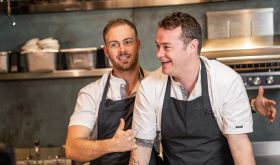
Two of these restaurants, Deca and Racine, are the respective creations of two of the capital's most experienced restaurant openers, Natasha Ladenis and Eric Garnier. Despite their relative youth, (both are in their late 30's) they have separately opened a total of almost 40 different locations albeit under very different circumstances.
Deca, as its name suggests, is the tenth Ladenis restaurant, taking in various Chez Nicos (in which Natasha began her working life as a waitress aged 16), Simply Nico, Nico Central and Icognico which was, before its conversion, offices belonging to Angel's, the theatrical costumiers. Garnier made his name opening Bank, once a National Westminster outpost, on the corner of the Aldwych before opening branches of Fish! around the UK. Racine is the first time he has opened something of his own in partnership with chef, Henry Harris.
My only professional experience, of refurbishing L'Escargot in 1980 which had been a restaurant since the 1920's, was of the obvious advantages of a makeover. The crucial factor, that the kitchen, lifts (so essential in London's tall, narrow buildings) and the essential entrances and fire exits are all in the right place seemed to me to vastly outweigh the cost of removing every vestige of the awful taste of the restaurant's former owners. Surely, I asked, Natasha, this inbuilt working structure must be a wonderful start.
'Not really,' she replied with the conviction that is her family trademark. 'More important than whatever you inherit in terms of equipment is the condition that it is in. If it has been abused then it is worthless and it costs you time and money before you realise this. The challenge of a conversion, as we did at Icognico, is that you have to visualize how the restaurant will work and plan everything meticulously before you start, down to the number of electrical plugs on the skirting boards so that you can ensure the waiting staff can get the Hoover into all the corners every morning.
'There are also inherent marketing problems in taking over another restaurant. One of the first things I insist on is changing the telephone number immediately because I don't want anyone to phone the old number and assume that they will get the former style of cooking or service. This is now a Nico restaurant with everything my parents stand for: crisp, white linen, mirrors, silver and lovely flowers as well as light, French food.' (And, I could not help but notice, still no salt or pepper on the tables!)
'And there is, of course, the only human tendency when you take over somewhere to think you can get away with not changing everything. I thought I could get away with the former restaurant's spot lights and dimmer switches but I now realise that was a false economy and eventually we will have to replace all of them. And although there was a kitchen in place, most of it was in the wrong layout and not powerful enough for what we wanted.'
Whilst she admitted that the cost of the kitchen conversion was probably less than a brand new fitout, the costs of the new Incognico and the madeover Deca are not that different. Whilst the former cost £1.2 million, the latter cost £950,000 with probably more to come as it settles down (both seat 80).
But whilst cost is obviously important, the great difference for Ladenis between what she refers to as old and new 'shops' is that if you can visualise, plan and build the new ones correctly, then running them is so much easier. 'On a blank canvas you can put all the controls where you want them,' she explained. 'At Icognico we designed the area by the reception so that I can change the lights, watch over the dining room, take a booking on the phone and see anyone at the front door all at the same time. At Deca, because it was somebody else's layout and the lighting panel is not in the dining room, all these jobs have to be done separately. That is infuriating.'
Eric Garnier shares Nataha Ladenis's passion for restaurants but a completely opposite view point – he is firmly in favour of makeovers.
'Cost is obviously the crucial factor, not only affecting what the restaurant will offer but the payback period, and in my experience starting from scratch costs four times more than a makeover. Today, just to convert a 2,000 sq ft corner site is going to cost £500,000 and closer to £1 million if you want anything special.'
Garnier has been able to convert Racine for far less, but before divulging exactly how he managed this he stressed one vital aspect for any new restaurant. 'The precise address is not that crucial but the area is. We looked at two or three sites a week for several months but I like the feel of Knightsbridge. That is important. And also, even if it is only a relatively small restaurant, you have to think big.'
He was only too aware that initial discussions with the landlords, the Wellcome Trust, would be tough. 'We had to pay a premium of £185,000 for an 11 year lease, put down a £50,000 rent deposit and pay three months rent in advance (the rent is £75,000 for 5 years). But because this had been a restaurant and because I felt confident that I could come under the budget of £130,000 for the conversion, I was reasonably confident it would work.'
Garnier has managed the transformation of Racine into an extermely comfortable neighbourhood restaurant, by carrying out a plethora of different roles himself. 'We didn't use architects or designers and there were no grand plans. I sourced and bought everything myself, chairs, crockery, glasses, cutlery, and by going directly to the suppliers I am sure I saved 50 per cent on cost. And we came to an arrangement with our kitchen suppliers, Hansens, whom I have known for a long, long time and who have extended very favourable terms as well as taking a small stake in the business.'
'This was critical when it came to a major stumbling block which is pretty common in all conversions or new sites and that is siting an air duct to extract hot air from the basement kitchen and introduce cold, fresh air. We needed 3.5 tons of scaffolding just for that job to ensure that it wouldn't vibrate, smell or be noisy and satisfy the landlords and the neighbours. It was tight,' he added with a smile.
Garnier's smile should get bigger. 'To cover our costs and overheads we need to serve 800 customers a week, 115 a day over seven days, that's approximately 30 at lunch and 85 at dinner, a weekly income of £14,000. In the first week we took £10,000 and during the second we should reach break even – we are completely full tonight – so I am optimistic.'
Ladenis and Garnier's enthusiasm is also the result of an intense period of activity for them both. Deca's conversion took six weeks, Racine's ten and whilst both were full of compliments for their builders (Deca's are based in Devon, Racine's near Birmingham) both agreed that their own continual presence on the building site was vital.
'We are building something here that has to last 25 years so everything has to be right,' Ladenis explained. 'The banquettes that run down the walls have to be the right height and width and of course correctly sprung. They were built in the workshop in Devon and I went down one day just to jump up and down on them to ensure that they will last long enough.'
Garnier never even considered travelling that far. 'I was on site for the entire period of the conversion from 8am to 5pm. And on the only two occasions I left the builders once to get a coffee once to buy a paper, something went wrong.'
If their new restaurants are to succeed in the present difficult trading conditions, then Garnier and Ladenis can look forward to as little time off while their restaurants are open as they enjoyed whilst they were being renovated.
Deca, 23 Conduit Street, London W1 (tel 020 7493 7070)
Racine, 239 Brompton Road, London SW7 (tel 020 7584 8549)
Sumosan, 26 Albermarle Street, London W1 (tel 020 7495-5999)
Zuma, 5 Raphael Street, London SW7 (tel 020 7584 1010)