
2 Dec 2014 A few months ago I wandered, for the first time, into a deli-cum-wine shop near my house in south-east London. I started chatting to the assistant, who, while more au fait with the cheese side of things, mentioned he had been to a few professional wine tastings, and then said something I have since been unable to forget.
'What struck me', he said, 'was the attitude of the trade. Here we were, surrounded by some fantastic bordeaux or whatever, tasting for free, and everyone looked so bloody miserable.' I probably ummed and ahhed and mounted some feeble defence, all the while thinking 'yes, it's true'.
The reasons are fairly clear, I think. First, tasting wine properly, particularly at speed, demands great concentration, and is draining. There is not always the time or the energy for jollity. Secondly, to taste properly, it doesn't do to be star-struck. Tasting first growths is a privilege, in that not everyone who would like to has the opportunity, but that thought has to be expunged from the mind at the crucial moment. An obsequious bias is unattractive in a critic, and deceitful in a merchant. Lastly, any tasting you might care to imagine will have its fair share of disappointments. If these reach a certain threshold, particularly in an apparently glamorous tasting, glumness is sure to ensue.
The source of such disappointments is twofold. Certainly, for any given set of wines that are exciting on paper, some will simply not be up to scratch. The inherent quality of a good vintage in a good vineyard can be undone by sloppy winemaking; localised bad weather may have damaged the fruit in a normally favoured spot; an unforeseen issue – reduction, say – may have arisen in bottle.
Other disappointments arise from our subjective tendency to make the strongest comparisons with wines we have most recently tasted. In any normal tasting, however grand or humble, there will be a quality gradient, irrespective of the greatness of the wines. I would suggest that we are much more sensitive to the former than to the latter: to quality differences within the set of wines in front of us rather than to their absolute quality within the broader scheme of things. From my own experience, it takes a conscious effort to consider absolute quality and adjust one's marks accordingly; the natural inclination is to arrive at the same average score at almost any tasting.
Being disappointed by certain expensive wines at a professional tasting is no bad thing, of course. In fact, it is a necessary part of the job. We go there to discriminate, to be able to point readers or customers towards the best, and if not every wine inspires joy unlimited, then so be it. There is a danger, though, that the same phenomena can arise when drinking very good wines, and this to me presents a problem.
I remember a dinner, attended by a mix of trade and collectors, the centrepiece of which was a flight of Meursault Perrières from top growers. Any of these wines would on its own have constituted a serious treat. Thrown into the ring together, though, they were divided into winners and losers by the comparative instinct. The Coche made the Lafon seem coarse. The 2007s made the 2006s taste flabby. Each comparison had a Newtonian balance to it: in highlighting one wine's superiority over its neighbour, the neighbour suffered in equal measure, tasting worse than it would have done otherwise. The exercise was extremely interesting from an intellectual point of view, as well as a privilege, and a luxury. But in terms of sheer enjoyment, the flight of wines delivered alarmingly much less than the sum of its parts. On average, even these wines tasted – well, average.
* * *
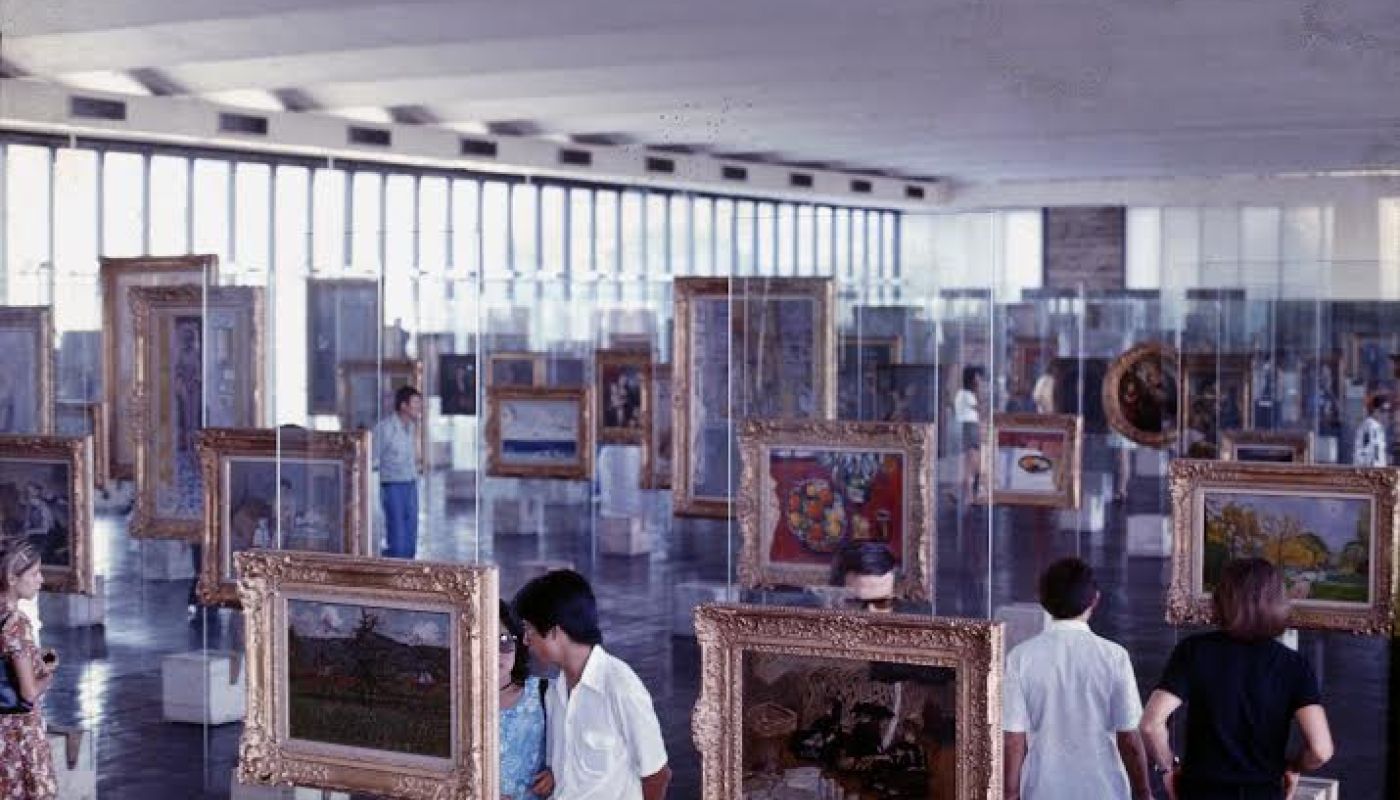
In 1968, faced with the problem of how best to display Latin America's greatest art collection, the architect Lina Bo Bardi presented a breathtaking scheme. The designer of the new Museu de Arte de São Paolo (MASP), she was also responsible for the internal layout of the main gallery, where the nation's Cézannes, Rembrandts, Goyas and van Goghs (among a great many others) were to be hung.
She elected not to hang them at all, but to mount each painting on a sheet of glass, set in a concrete base, angled slightly back, giving the appearance of a sort of modernist easel. These were positioned not around the walls of the gallery, but arrayed throughout the 80-metre-long space, each facing the entrance. Captions and explanatory text were given on the rear of each 'easel', and any anachronistic frames were removed, replaced with a simple border. The works were not presented in any kind of chronological or thematic order. (The photograph above comes from this website.)
Bo Bardi's overall intention was to prevent the gallery becoming yet another 'intellectual mausoleum', and to rid the pictures of that aura of expectation that tends to accompany works of art we already know are considered significant. Moreover, in freeing them from the walls of the room, and making the reverse of the canvas visible through the back of the glass, she presented them as three-dimensional objects, the product of craft.
In 1996, four years after Bo Bardi's death, more conservative curators reverted to standard practice. Partition walls were erected in the great space and the paintings hung on them, backs hidden and captions in the same field of view. I can only imagine, therefore, how fresh even the most familiar painting must have seemed to even the most seasoned gallery-goer while Bo Bardi's scheme still reigned.
* * *
The day after I read about Bo Bardi and MASP, I found myself standing on the road that separates La Grande Rue from La Romanée-Conti. It was lunchtime, and in my left hand was an extremely chewy baguette filled with chicken, salad and mayo. In my right was a small tulip-shaped glass, and in the glass was the first of three vintages of Vosne-Romanée Premier Cru Les Gaudichots, the little-known vineyard that overlaps with La Tâche.
I was the guest of Lucien Le Moine, along with about two dozen other customers of theirs, and this November vineyard picnic has become an annual tradition. This year, though, it carried an extra significance. Mounir Saouma, the co-founder (along with his wife) of Le Moine, had become so exasperated by the intense speculation over whether this wine was, in fact, declassified La Tâche, and the ensuing squabbles over allocations, that he stopped releasing it after the 2009 vintage. The wine, he explained, was made to be enjoyed, not fought over. The aura it had acquired was not just overshadowing it, but leaving a bitter taste to boot.
He generously poured for us the 2009, then the unreleased 2010 and 2011 from magnum. He emphasised that the wine was not from La Tâche, pointing to the non-overlapping parts of the vineyard in the distance. Here were wines, then, with an obscure origin, no monetary value, no commercial future, divorced from fine food and the pomp of restaurant service. Mounir had managed to pull off a bit of a Bo Bardi. 'This is the best way to enjoy this wine', he said. 'Outside, with a sandwich and some friends.' And he was right: I can think of no circumstances more flattering.
* * *
While we ate and drank, Mounir told us a story. He had been called by a non-winey acquaintance who sought his advice as a wine expert. Many years earlier, her husband had brought her back a bottle of wine which he explained was very grand. She had put it away and forgotten about it until recently, when she was alone of an evening, and needed something to drink with a pizza. She opened the bottle, of Grange 1990 as it happens, and then phoned Mounir the next day, wracked with guilt. 'Was it a shame, what I did?' she asked. 'Did you enjoy the wine?' replied Mounir. 'It was wonderful! In fact I finished the bottle. I can't remember ever enjoying a wine more.' 'In that case', said Mounir, 'it would have been a terrible shame if you had done anything else.'
* * *
Odd as it may sound, the enjoyment of fine wine is a fragile thing. While high expectations can sometimes generously bias our response, they can also mute our enjoyment if a wine of high status or price fails to bowl us over. When tasting, of course, we need to keep value-for-money and performance-versus-peers foremost in our minds. But when we drink, we have already decided to put a wine to the use for which it was intended; the critic's role is behind us, and so it becomes a duty to create the most flattering possible circumstances for the wine.
Combining nuanced appreciation with a child-like thrill is the goal here. This requires allowing the wine to sing (good glasses are a must) while removing as far as possible the twin burdens of expectation and comparison. Deal with the latter by not indulging in extended themed flights, where winners and losers will inevitably emerge. Pairs of wines will provide plenty to chew over; a complete mixed bag will often, through contrast, flatter even more. The most Bo Bardian way to foil expectation is of course to serve wines blind at first, although the danger is that dinner descends into a guessing game, and straining for the answer substitutes for enjoyment.
Instead, informal surroundings, simple food, and no reason for opening the bottle other than you feel like it, are hugely conducive to that bottle's tasting great. A bit of rule-breaking adds to the excitement, too: I find the already-delicious combination of high-end Pinot-based vintage champagne and take-away curry is further enhanced by that slight sense of rebellion. Or, another example: the surprise discovery this summer that chilled Barbaresco makes a brilliant garden aperitif, its aroma intoxicating while its gentle bitterness refreshes, also benefits from unorthodox context.
Surprise is perhaps the key, for it enables delight. By serving fine wines in altered settings, they regain their potential to delight those for whom familiarity may be threatening to breed, if not contempt, then ennui. It might be the only way we can experience them afresh, as if for the first time, and with the benefit of that temporary naïveté, enjoy them all the more.













