Over the past few years I have been increasingly impressed by wines made from a grape that is hardly ever written about and of which the authorities in the region where it is most important seem rather ashamed.
This historic vine variety is known as Macabeu and Maccabéo in Roussillon in southern France, Macabeo in much of its homeland Spain, and Viura in Rioja, where it is by far the most planted white wine grape. It has the unusual virtue of being capable of making dry white wines, often blends, with real nerve and character that improve with age.
Recently the governing body in Rioja decided in their wisdom that it would be a good idea to allow the international grape varieties Chardonnay and Sauvignon Blanc to produce white rioja, up to 49% of a blend, retaining (just) a majority of Viura – although the local varieties Garnacha Blanca and Malvasia as well as the much more obscure Maturana Blanca, Tempranillo Blanco and Turruntés (not theTorrontés of Argentina, apparently) are also allowed into the new white rioja regulations.
The Rioja Consejo Regulador says that they are introducing the international interlopers to make Viura/Macabeo fruitier and fresher, in response to consumer demand, and have banned all new plantings of Viura. This seems unnecessary to me. The world is not short of Sauvignons and Chardonnays – and are they really the only grapes that imbue fruitiness and freshness? I would have thought that Garnacha Blanca, already allowed into white rioja, is pretty fruity, and low acidity is not a common fault in today’s white riojas in my experience.
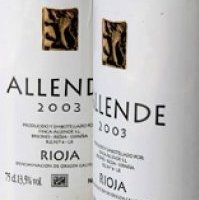
Most of us think of Rioja as being a red-wine region but according to the man responsible for Allende 2003, the finest white rioja I have ever tasted, Miguel Angel Gregorio of Finca Allende, more white wine than red was produced there until as recently as 1975.
‘In 1999 at Allende we started a project to discover a new character for our white wine’, he told me earlier this year. ‘I asked [the famous French cooper] Jean François of François Frères for Montrachet barrels. We began to understand lees management. Our first vintage had three months on lees with weekly bâtonnage [stirring of the lees]. We discovered that our wines responded well to being kept longer on the lees and more bâtonnage. From 2002 we stirred twice a week over eight months and our whites have 15-16 months total in barrel – always new François Frères barrels.’
The first, 1999, vintage of Allende white was 60% Viura and 40% Malvasia and was still alive and kicking last year, but as the proportion of Viura has increased, so has the quality, with the deliciously rich, creamy yet bracing 2003 being made up of 80% Viura to just 20% Malvasia. (Allende have only 51 Garnacha Blanca vines, so this variety hardly contributes to the blend.) Their white wine vines were planted around 1964 on average. ‘In Rioja no one planted Viura after that', according to Miguel Angel Gregorio. If he is right, then the Rioja region must be a repository of Viura vines that are much, much older than the norm in most wine regions.
Knowing that wine quality tends to increase with vine age, I asked why there isn’t more top-quality white rioja? With the exception of a handful of extremely traditional white riojas that can age superbly (but are arguably a rather minority taste) such as Viña Tondonia from Lopez de Heredia and Marqués de Murrieta’s waxy whites, white rioja nowadays tends to be extremely simple stuff for very early consumption.
The problem apparently is that the Viura/Macabeo vine tends to over-produce, with big berries that can have too low a proportion of grape skin and flavour to pulp, and with bunches that are so tight that the grapes can rot easily, especially in Rioja’s Atlantic-influenced west. ‘So', according to Miguel Angel Gregorio, ‘to make healthy white rioja in general you have to pick early. These grapes will typically have only 12% alcohol. To get aromatic maturity you need 13%. So you have to prune hard and thin the crop – which most producers are not prepared to do. The best Viura is grown on the hills not the valley floor.’
At Allende they have had such acclaim for their white wines that from the 2008 vintage they are producing a white wine from their famous Calvario hillside vineyard in the village of Briones. Miguel Angel Gregorio thinks his wine would be better with even more Viura and less Malvasia because, while Malvasia is certainly not short of character, it oxidises easily. At Finca Allende they plant a hectare of Viura a year with the old density, which is illegal – so the old vines in Rioja are technically illegal. (According to the regulations, which are generally dictated more by the needs of the merchant bottlers than the growers in Rioja, vineyards should not have more than 3,000 vines planted per hectare, whereas the old vineyards have more like 5,000.)
More good news for fans of Rioja’s finest whites is that, while the 2006, 2007 and 2008 presented considerable challenges for the dominant red wine grape Tempranillo, they were ‘spectacular for Viura’, according to Miguel Angel Gregorio, who is no longer the only grower to be taking white wine seriously (see the list below).
As Macabeo, the vine is widely planted all over north-east Spain and can make a wide range of wines both varietal (100% Macabeo) and blends.
The variety really seems to come into its own over the border in Roussillon, its French home. Even here, however, it is a demanding plant. According to Jonathan Hesford of Domaine Treloar, ‘it's prone to fungal diseases and fanleaf virus and it drops acidity from one day to the next, meaning that picking date is crucial’. All the more extraordinary, then, that so many fine dry whites are made with Macabeu in the varied terrains of Roussillon. Here it tends to be blended with plumper-tasting wines made from the Grenache Blanc (Spain’s Garnacha Blanca) and Grenache Gris that are so commonly planted in Roussillon for the likes of sweet, strong Rivesaltes and Maury.
But Gayda, an enterprise just north of Limoux in the Languedoc, has managed to make at least two successful vintages, 2005 and 2007, of 100% Maccabéo, from vines grown at 450 m altitude on granite in the exciting Agly Valley, where Domane Gauby has been making inspiring dry white blends from the old white wine vines here, including Macabeu, for years. These wines tend to have a honeyed quality, as well as the strong mineral streak that seems to come with the territory.
Below is a host of Macabeo-dominated wines either enjoyed by me or volunteered on our Members' forum by fellow enthusiasts of this intriguing vine variety.
MACABEO/MACABEU/VIURA RECOMMENDATIONS
FRENCH
Gayda, Figure Libre Maccabeo
Clos de l'Origine, L'Original
Clot de l’Oum
Mas de la Devèze, Vielles Vignes
Domaine Gardiés, Les Glaciaires
Gauby, Les Calcinaires and Vieilles Vignes
Domaine de l’Horizon Blanc
Lafage, Cuvée Centenaire
Bernard Magrez, Passion Blanche
Olivier Pithon, Cuvée Laïs and D18
Le Roc des Anges, Les Vieilles Vignes
Sarda-Malet, Le Sarda
La Tour Vieille, Les Canadells, Collioure
Three Trees, Agly Valley
Vacquer, Vin de Table
SPANISH
Tomàs Cusiné, Auzells, Costers del Segre
L’Olivera, Costers del Segre
Cercavins, Guilla Fermentado en Barrica, Costers del Segre
Cérvoles, Costers del Segre
Viñas del Vero Blanco, Somontano
Allende, Rioja
Plácet, Rioja
Palacios Remondo Blanco, Rioja
López de Heredia, Viña Gravonia and Viña Tondonia, Rioja
Marqués de Murrieta, Capellanía, Rioja
Beronia Viura, Rioja
Cosme Palacio Blanco, Rioja
Remírez de Ganuza, Erre Punto, Rioja
Tobía Blanco Rioja
Benjamin Romeo, Que Bonito Cacareaba and Predicador, Rioja