
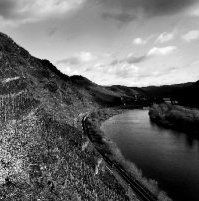
Mosel Wine Merchant, US importer of such estates as Clemens Busch, Reinhard & Beate Knebel, Peter Lauer, Günther Steinmetz, and Weingut Stein, very recently posted on its website the following lament by Ulli Stein of Weingut Stein for the worrying state of viticulture in his part of the Mosel. (He is a strong character who, inter alia, has been campaigning for the legalisation of straw wine in the Mosel.)
Viticulture on the Mosel has already experienced plenty of crises—and survived! But the ultimate endgame now threatens those old Riesling vines in the greatest steep slate slopes throughout our region.
While on the one hand thousands of euros are spent at wine auctions for a single bottle of Mosel Riesling, and though for many growers who market their own wines all is well, the price for 1000 litres of Riesling (in barrel) now sits at 600 euros. Many part-time winemakers, who have long worked age-old vineyards of extreme steepness and scenic beauty, are finally giving up. The reasons are not only economic but also psychological: if the oft-mentioned ‘heroic’ work in the steepest vineyards not only fails to generate profit but also engenders massive losses, then that signals, in the end, an extremely low regard not only for the work but also for the people engaged in it.
The causes of this unfortunate development are diverse and complex. Mistakes have been made by all involved, including Weinkellereien, winemakers, consultants and lawmakers. A sampling of what’s gone wrong:
• in the past, too many Weinkellereien (merchant houses/négociants) have placed too little value on quality, have bought and sold junk (as long as the price is low!), and have led the names ‘Riesling’ and ‘Mosel’ into the bargain bins of supermarket shelves, from which they can no longer escape.
• many winemakers have fashioned their wines accordingly, accepted any price, shared their frustrations above all with their children, in word and deed emphatically warning them against the life of a wine grower.
• consultants and lawmakers have fixated single-mindedly on sugar content as the exclusive criteria for quality; propagated the ‘wrong’ varieties (such as Kerner); and encouraged questionable winemaking methods (sweet reserve, de-acidification, etc)
• and at the end of the day, roughly 90% of all consumers refuse to pay more than $2.99 for a bottle of wine, regardless of whether the label indicates Riesling from steep slopes or Pinot Grigio from the Po Valley.
This all sounds rather pessimistic, though sadly with good reason. Half of all vines in my village of St Aldegund will be grubbed up in the coming months, and in the next two years it will be another quarter. A similar fate awaits the neighboring villages (Alf, Bullay, Neef). Most of those winemakers who are still active are over 60 years old, and for many there is no successor in sight.
Soon the 2,000-year-old winemaking landscape will cease to exist in many places along the Mosel. Whether the oft-mentioned tourists will still come to gaze upon blackberry bushes remains to be seen.
Despite positive changes on the Mosel, such as rising wine quality among those growers who sell and market their own wines; a slowly increasing number of apprentices; the re-cultivation of vineyards (such as Bremmer Calmont shown here); and such large-scale collaborations as Weingut Kallfelz’s purchase and renovation of the local teaching and research station, viticulture in many sectors is seriously imperiled. Faced in the coming years with the threat of 3,000 hectares of soon-to-be-fallow steep sites—one-third of the entire Mosel region—slogans of perseverance (‘we have to look to the future, not bemoan what is lost’) will be of as little use as supplication at the feet of the Kellereien. Such approaches obstruct our view of the bitter reality and prevent effective counter-measures, among them the following small and feasible goals:
- Every estate that directly markets its own wines but that also purchases grapes, must, or wine from colleagues should pay—for Riesling from steep slopes with at least 70° Oechsle—a baseline price of $1,200 euros, and for each degree increase in Oecshle an additional $50 more. (We’ve been doing this successfully for years with several hectares of steep sites and receive, for a fair price, grapes of corresponding quality.)
- Every grape-grower who wants to uproot vineyards in steep sites on account of low prices should speak to local winemakers in an effort to achieve better prices. (See Point 1.)
- Faced with an offer of 60 cents per liter of Riesling, bulk grape-growers should consider simply refusing to sell. Not for that price! Come what may! Hold out! Maintain a measure of self-respect!
- In-house and intra-estate reorganisation (in the case of older winemakers of declining strength) in which lesser sites are relinquished in favor of those steep slopes that define the Mosel landscape and are responsible for the reputation of her wines.
- The quality of wine produced by those estates that sell and market their own wines must be improved through simple, cost-friendly measures, among them a more selective and—as a rule—later harvest, lower yields, little or no fertilizer, controlled fermentation, etc. At the same time, the value—now also reflected in the glass!—of these steep-slope Rieslings must result in higher prices. There can be no more 3 euro Riesling Spätlese from famed steep sites (like Bremmer Calmont), no more high-quality estates consistently undercutting each other’s prices.
- The preceding sober depiction is not intended to aid and abet resignation, but instead aims to snap people to attention and to serve as a call to action. On the heels of recent notable examples of vineyard rescue must follow more of the same. It is at least worth a try—if not on our own account, at least for the old Riesling vines. They can’t do a thing about it! And they deserve our protection from thorns.
The text above was translated by Dan Melia, with assistance from David Schildknecht, who comments on it below.
I have written about this situation before (alluding to it in several introductions to Wine Advocate reports) and shall again. But the important thing we can all do is vote with our precious dollars and purchase Mosel Rieslings from those proprietors who are preserving the legacy of steep slope viticulture in this amazing region.
Thankfully, as one travels upstream from Stein, the situation is grave but not quite so dire. Without question, property is being consolidated into the hands of fewer proprietors, but where these proprietors are dedicated to top quality, that is not a complete misfortune. Every vote you place on proprietors of the caliber I cover in my reports is money invested in the future of this region, whether its with the small and long-established families like those of Joh Jos Christoffel, Eymael, Kerpen, Loosen, Joh, Jos. Prüm, Richter, Weins-Prüm, or Willi Schaefer; with famous proprietors who are still expanding or in a position to, like Haag, Haart, Moiltor, St. Urbans-Hof, Schloss Lieser, or Selbach; or with those not yet famous but whose life's work is the preservation of great steep Mosel vineyards including many names as yet little known – folks like A.J. Adam, Clüsserath-Weiler, Eva Clüsserath, Karl-Josef Loewen, Andreas Schmitges, Stefan Steinmetz, Danuiel Vollenweider, Weiser & Künstler. (Apologies to the many whose names I missed above in my haste.)
The mention of Vollenweider and Weiser-Künster serves as a reminder that good things are happening even immediately upstream from Stein. Clemens Busch, for example, is practically single-handedly sustaining top-quality, steep slope viticulture in Pünderich. Stein knows of these successes, but from where he looks – downstream toward most of his vineyards – there is little relief until one gets to the confluence with the Rhine, and the great vineyards around Winningen that are farmed by the inspired and inspiring likes of Barth (Lubentiushof), Knebel, and Löwenstein. Stein is already a hero for his own multiple-village stretch of the river. But there are too few such heroes, in addition to other deficiencies that he has detailed in his appeal.
There are a lot of big questions unanswered – and not only in the Mosel (the Nahe and Saar are at least as threatened) or in Germany (think of imperiled Beaujolais!) – as to how much of a viticultural landscape and of the larger commercial base of traditional viticulture can disappear before it jeopardizes every grower and the continuation of an entire region of production. Sadly, quite a few of the world's well-known wine regions are serving as laboratories in which these questions will be answered.
But all news from the Mosel is not doom and gloom. Contrary to the impression I may have given in this recent interview with Wine on the Rocks (the first of three), work has apparently not yet begun on the proposed despoiling Mosel bridge. Here’s what chief anti-bridge agitator Sarah Washington sent me yesterday:
The bridge building has not yet started, but trees are being cut down. The local resistance is growing now that the project is visible. Still a long way to go, but it is increasingly encouraging to see people fighting on all fronts – costs, environment, prize vineyards, lack of traffic, unstable geology, tourism, UNESCO etc.
The German press is finally taking notice – in no small part due to criticism from abroad. National radio will be here for a live radio debate on 13 Jan [today] with the State Transport Minister. That will be noisy!
Finally more people are stirring. Through the impetus of a newly involved local protester, we are building regular Sunday demonstrations circulating between three villages – Ürzig, Rachtig and Zeltingen. More people attend each week, for mulled wine, sausage and speeches! The youngsters are the most encouraging, roaring creative slogans along the streets whilst most locals remain firmly hidden behind shutters, but of course pay close attention! I hope we can keep up the momentum, it feels good at the moment.
Here's a link to a great interview Katharina Prüm recently gave to local telly:
http://www.youtube.com/watch?v=d3mAFNCDqrs
And another local and national news spots:
http://www.youtube.com/watch?v=gwDWnYYzPzg
http://www.youtube.com/watch?v=6Bq4pIbcdP4
So at last we get some of our deserved coverage. More in the pipeline.
It is definitely not too late to act. The more I hear the more I realise that we are becoming a right royal pain... and that shows real progress. If we can only make it too embarrassing to continue then we will succeed. The leader of the German conservative group in the European parliament said this week in Focus magazine that it is not a question of if the road should be built, but where. That is the first ripple of political dissent expressed in public. (He likes wine evidently!)
Foreign press hurts the politicians more than anything. I mentioned to Hugh Johnson that if we can get the story covered anywhere on the BBC we would be on the home straight. That's because the German media is always referencing the British and American press – it seems that they are keen on monitoring how they look to the world, and it is also by looking outside to the more 'with it' nations that they judge what is important to pay attention too. (This process actually works both ways – I am constantly amazed by the symbiotic relationship between Britain and Germany – BBC Radio 4 seems to mention Germany at least four times a day, in a continual process of comparison concerning: how to do things better!)













