
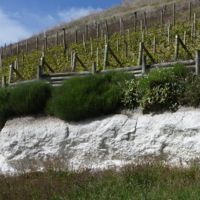
Below are my notes on the two producers that are in North Canterbury, outside the Waipara Valley wine region. Both are on Waikari soils: hard limestone, marls and clays on moderately steep slopes and escarpments.
BELL HILL
As you drive over the Weka Pass, named after a flightless bird endemic to New Zealand, you enter limestone territory, which is what drew Marcel Giesen (one of three German brothers who own and run Giesen in Marlborough) and his partner Sherwyn Veldhuizen to Waikari, further north and inland from the Waipara Valley. A few years later, limestone was a major factor in the magnetic pull of this area to Mike and Claudia Weersing of Pyramid Valley (see below).
Sherwyn was a student at Lincoln University and then at Giesen but when her relationship with Marcel became more than a working one, and they married, the family rule established by Marcel's father (no spouse shall work in the business) determined that they would have to set up a separate operation if they wanted to work together. This is what they have done, though Marcel is still pretty busy with his day job at Giesen, leaving Bell Hill largely to Sherwyn's tender-loving care.
As you can read on the Bell Hill website, their land was first surveyed in 1871 for a lime quarry, a business that continued until the late 1930s, and the current Waikari Limeworks is nearby. Planting of the vineyard with Pinot Noir and Chardonnay, a bijou total of 2.5 ha on north-facing slopes, has taken 12 years since they started in 1997, progressing very cautiously to make sure they get it right and having to wait for the right rootstocks to be imported. What is most striking about the vineyards, apart from the dazzling white of the limestone backdrop, is the high planting density, modeled on Burgundy, intended 'to reduce yield per vine and encourage deep and rapid root penetration to make the most of the site's unique terroir'. If you want the complete description of clones and planting densities of all seven vineyard blocks, it is painstakingly recorded here. The soil types are also explained in minute detail, revealing this couple's obsessive quest to understand and make the most of their vineyard.
Bill Hill's vines are at 260–290 m above sea level and at risk from frost, so they use sprinklers as their main defence mechanism, though this method does bring with it the problem of too much water in the vineyard and compaction of the soil. (After much bureaucratic wrangling, they were allowed to build a reservoir to obtain irrigation water.) Yields are tiny, partly due to the planting density but also because of deliberate thinning, generally to one bunch per shoot. The average yield per vine is just 500–700 g. The vineyards are worked organically, and much of the weeding done manually with a hoe. The heads of the vines are kept low to the ground in order to benefit from the reflected heat of the soil.
Winemaking is careful but uncomplicated: hand sorting, some whole bunch for the Pinot, depending on the vintage, no inoculated yeasts, barrel fermentation for the Chardonnay, all parcels vinified separately, quite a lot of new oak, particularly for the Pinot (they are the NZ agents for tonnellerie Mercurey, which presumably helps to reduce barrel bills), cold pre-ferment and warm post-ferment maceration for the Pinot. Most of the wines spend about a year in barrel.
The Bell Hill barrel cellar consists of a 40-foot high cube shipping container, buried underground. They did try to dig out a cellar but encountered too many difficulties in the construction.
I was particularly impressed by the purity and finesse of the Bell Hill wines. It's a shame that they make such small volumes but perhaps that is what allows them to be quite so pernickety.
Bell Hill wines are imported into the UK by John Armit. See here for distribution around the world.

100% new oak. No stems. Darker fruited than the 2009 but so...
No stems. 100% new oak. Touch of smoky toasty oak but so well...
PYRAMID VALLEY
My second visit beyond the Weka Pass into North Canterbury revealed the most beautiful sweeping vineyards minutely overseen by German-born but US-raised Claudia Weersing (pictured), who guided me through her beloved Pyramid Valley vines and then showed me a selection of the wines. Although there are only four from the home vineyard, two Pinot Noirs and two Chardonnays, the Growers' Collection includes many more small, single-vineyard bottlings from other regions.
Husband and winemaker Mike Weersing, US-born and raised, but trained in Beaune and Dijon and in the vineyards and wineries of Europe, notably Burgundy, Alsace and Germany (see their website for the full background), before he worked as winemaker at Neudorf in Nelson from 1996 to 2000, was away in Marlborough, where much of the fruit for their Growers' Collection is sourced. (See my tasting notes below for more precise details.) After a long search, they bought the Pyramid Valley farm in 2000.
The Pinot Noir and Chardonnay vineyards, densely planted, ungrafted, on clay-limestone slopes, have been farmed biodynamically from the outset. Yields are extremely low – kept down to 6-8 bunches, or 350–500 g, per vine and all weeding is done by hand. The blocks were planted by soil type, giving a patchwork impression across the slopes, and each block is vinified separately. They have about eight different Pinot Noir clones and two for Chardonnay but each block is a mix of those clones. The vineyards are named after the dominant wild plant that grows there, eg Angel Flower and Earth Smoke, and the only thing imported from outside the farm for use in the vineyard is the seaweed used to spray the vines. The photo below, taken in the tasting room, shows the lengths the Weersings go to to explain each wine's stony origin.
They describe their winemaking as 'natural' and frequently refer to 'the spirit of place', their job being to coax a wine from its 'rock bottle'. Every vintage they create a starter yeast culture for each wine from the yeast present in the source vineyard. DNA tests have revealed that these yeasts change from year to year. Grapes are destemmed by hand and basket bressed. Ferments, in big/old oak or clay amphorae, are very long (some whites take up to a year) and are allowed to stop naturally, whether the wine is dry or not. Malo may or may not take place. Wines are bottled unfiltered with little or no sulphur.
Although I did not meet Mike Weersing on this visit, I did subsequently hear him speak at the Real Wine Fair in London in March this year on the subject of skin contact and 'orange wines', of which he is an enthusiastic proponent and master craftsman. In that seminar he suggested that 95% of a grape's goodness and the expression of its terroir, including colourants, aromatic precursors and polyphenols, is in the skins, making it preposterous that in the vinification of almost all white wines, the juice/pulp and skins are divorced so abruptly and prematurely, leaving mostly sugar, acid and water.
His overriding question as to when and why we started discarding so much from the vineyard was a striking one. While I have tasted and loved many white wines that have had long skin contact and are generally more powerful, tannic and more deeply coloured than the average white wine today, though perhaps less varietally distinct, I am not convinced that the global adoption of such practices would be desirable, depriving us of so much of the incredible diversity that makes wine the most pleasurable and fascinating agricultural product on the planet. I have also tasted whites made with long skin maceration that are tough as old boots and show no signs of fruit. But he certainly made me think and reminded me to appreciate his – and others' – convinced but not unpleasantly proselytising commitment to this approach.
Total production is around 3,200 cases (that includes the wines from their home vineyard as well as the even smaller volumes of the Growers' Collection) for 27 markets, so don't expect to find the wines easily. In the UK they are available from the Caves de Pyrène and Swig.
More floral on the nose than the Angel Flower. More aromatic and...













