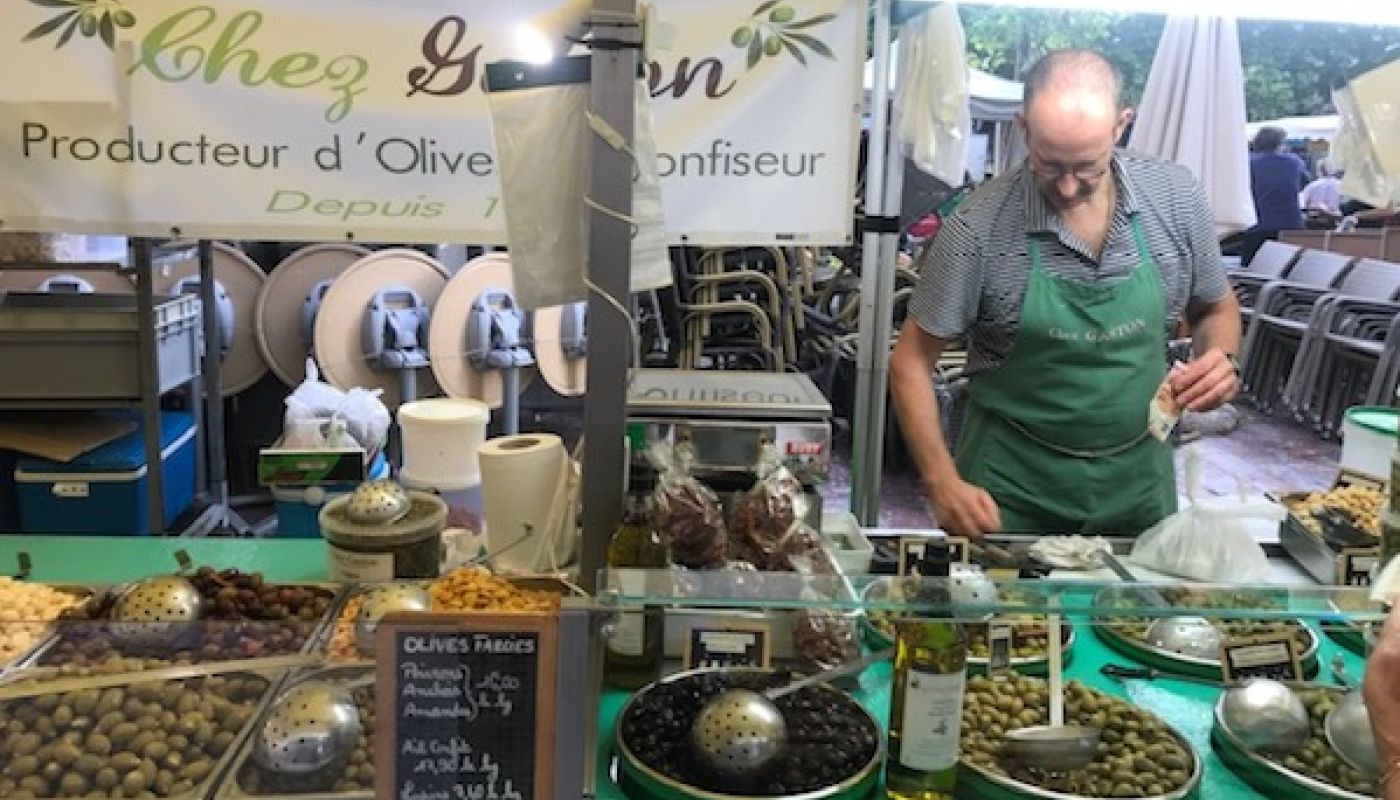
I am still not sure what it was that induced me to stop for the very first time at the Chez Gaston stand in the Place Carnot in Carcassonne, south-west France, where the open food market takes place on Tuesday, Thursday and Saturday mornings.
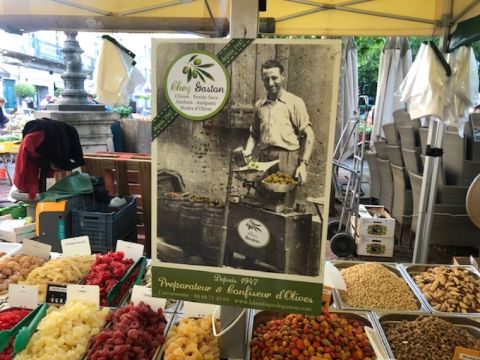
Was it the photograph of Gaston Hachay himself, smiling and dressed most fashionably in the style of the 1950s? In the photo he stands, smiling proudly in front of several barrels of olives, with the words ‘préparateur et confiseur d’olives depuis 1947’, and underneath that the name of the company’s website, added presumably some years later.
Or perhaps it was the sheer number of different items that Chez Gaston then sold. Anchovies; confit lemons; cashews, the best I have ever tasted, as well as pistachios and pine nuts, so important for any sauce; many, many, different dried fruits, particularly plump raisins; the bottles of different olive oil. In total, I discovered that there are about 400 different foodstuffs on sale just at the Chez Gaston stand.
It could have been the name, however. Gaston is not only unquestionably French but is also a name that inspires confidence and trust. Or it could have been the bonhomie associated with any panoply of good things to eat. There was Stéphane Hachay, Gaston’s grandson and his mother Jeannine, invariably smiling and chatting either with their customers, or just together, or with the several women who come to help them on Saturday mornings, the busiest day of their working week.
But I will never forget what brought me back to Chez Gaston. I had bought and paid and walked off when I heard Stéphane whistling behind me and saw him gesticulating wildly. I scurried back to discover that I had left my wallet behind!
Since then, we have become friends and I make a mental note to stop at Chez Gaston whenever we first arrive in the region. This is not just because this stall sells all the items that form the essential ingredients for cooking in this region of France – the olive oil, the confit lemons, the anchovies, the pine nuts – but also because it sells so many items that form a very generous and satisfying first course.
My style of cooking changes once we are here in the Languedoc. Carbohydrates seem less important; dessert is invariably a variation on one of the superlative local soft fruits: apricots, peaches, nectarines, and greengages later in the summer, which are invariably dirt cheap; and it is au revoir to having to think of a first course. Instead, it is just bowls of local luques, herby green olives, cashews and pistachios, all courtesy of Chez Gaston, occasionally with slices of fuet, the thin saucisson that is a speciality of the nearby Pyrenees.
And so, after many years, I took the plunge and asked Stéphane whether it would be possible for me to visit him at his depot, or usine (factory), as he refers to it. He of course agreed, handed me his business card, replete with olives, pointed to his mobile number in the bottom right hand corner, and we agreed to meet at 10 the following Monday morning, a time when he assured me he would be there.
I found the address easily but then confusion set in. I was outside what looked like a house, alongside several other similar buildings. But if this was a house, what was it doing in an industrial estate?
It turned out that I was at the HQ of Chez Gaston, and Stéphane immediately explained away my confusion. ‘When planning permission was granted for this industrial zone many years ago it was on the basis that provision was made for people to live here.’ Ever since grandfather Gaston decided to move back here the entire family has lived above l’usine.
The garage beside the house is full of neatly stacked pallets and boxes; the garden in front of the house boasts a smartly trimmed lawn, complete with olive tree; but it is in the garage on the other side that has been knocked through to accommodate all the machinery required for Chez Gaston that the year-round action takes place.
It was here that I found Stéphane and his equally smiling assistant Abidine hard at work. In front of them were the two large containers that hold the many trays that I normally see full to the brim with their produce: olives; confit lemons; and many types of dried fruits.
Just setting up these is hard work. A typical market day starts at 3 am and invariably finishes on a Saturday at 3.30 pm. And a typical market week includes appearances at Bram market on a Wednesday, at Limoux market on a Friday as well as at Carcassonne market. For his stand in Carcassonne he pays €2,000 a year, an arrangement that allows him to trade there on Tuesdays, Thursdays and Saturdays.
But for Stéphane only the Saturday market is worthwhile and while he stopped Tuesdays several years ago, he has now decided to stop trading on Thursdays as well. This chimed with his response to my question about the significant changes he has witnessed over the past 20 years. ‘There seem to be fewer and fewer people living in Carcassonne today and those that do are not big spenders. To attract customers to our stall on Saturday we have to move our products somewhat upmarket.’
One product that exemplifies this strategy has been his relatively new bottles of French olive oil. In the past Chez Gaston used to sell bottles of good quality Italian olive oil, cheap and cheerful. Then Stéphane started to process his own olive oil from his own groves at Floure, and others nearby at Trèbes and Barbaira. This he sends off to Marseille where it is processed before being returned to him in bottles that today proudly bear the Chez Gaston label. The oil is clearly superior and has a pungent finish. It is not for everyone, Stephan admits, but we love it!
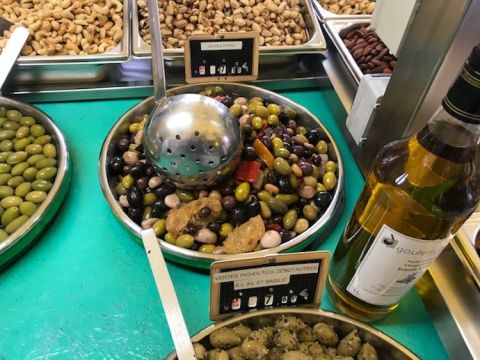
But there is also an international side to what Chez Gaston sells. A lot of the spicy olives, the aromatisés as Stéphane refers to them, come from Morocco, Turkey, South Africa and even Thailand. And, of course, his black kalamata olives come from Greece.
Olives make up 80% of Chez Gaston’s sales and along one wall of his usine are the machines that, once the olive season gets under way this season on 8 or 9 September and running through until 20 October, will keep Stéphane and his entire team extremely busy.
There is the receiving table where the olives are sorted before the brining or curing process begins. Then they fall, by size, into various boxes before they are placed into large plastic containers before being stored in the large refrigerated space opposite. The whole process can take up to six months, particularly as the olives are predominantly the green luques variety that take longer than black olives to cure. This year, 2019, the olive harvest is looking very, very promising, Stéphane explained with another smile.
We shook hands and I left. Stéphane and Abadine went back to their hard work.
Chez Gaston 8 rue Champollion, 11000 Carcassonne; tel +33 (0)4 68 25 86 81