I had been hired to work alongside André Simon fils, who had been suffering ill health, and we went together to Bordeaux in March 1970 to taste the 1969s. André was an established client of Ets Jean-Pierre Moueix in Libourne, for his West End shop André Simon fils (London) Ltd. We met with Jean-Pierre Moueix himself, in his rather dingy office on the quay of the Dordogne. He was already by then the dominant merchant, and in the process of becoming the dominant owner, of top châteaux on the right bank, including of course Petrus. It was one year before Christian Moueix joined the firm, and Jean-François, his elder brother, may have already then been running Duclot, the long-established Bordeaux-based négociant specialising in left-bank classed growths which Ets JPM acquired.
But my prime memory of those first en primeur visits relates to the 1970 vintage, not the 1969. We went back in March 1971 to taste the 1970s – at which point we bought, among others, Ch Lafleur Pétrus 1970. We had arrived too late to buy some of the top Médoc classed growths, which at the time would put their wines on the market in different slices (tranches), at different prices, during the spring. We asked Monsieur Moueix if there was a chance he could sell us some first tranche Ch Calon Ségur, even though the château had offered its second tranche at a higher price. At the time, classed growths were sold by the tonneau, each tonneau (a fictional measure) representing four actual 225-litre barriques. He offered us several tonneaux, at between first and second tranche prices, which we accepted. It was a good lesson: about the firm’s helpfulness, and also about not being late for the opening offers in future!
My other best memory of the 1970 vintage was later being offered two barrels of Mouton-Rothschild at half the price of the first growths. Mouton at the time was classified top of the second growths, but its wine had been trading at the same prices as the firsts for some years. Baron Philippe de Rothschild was lobbying for promotion within the 1855 classification, and to prove his point – that Mouton was equal to the firsts – he offered his first tranche 1970 at half price. Of course we took up our two barrels, as did everyone else. Within a few months the market price of Mouton was equal to that of Lafite, Margaux, Latour, etc, and, in 1973, Mouton got its promotion.
The Union des Grands Crus de Bordeaux was formed by a few château owners on a sales trip to Japan in the early 1970s and would not be active in promoting an en primeur campaign each spring for many years. To taste the young wines, foreign buyers went round the négociants’ tasting rooms, where all the leading châteaux – Léoville Las Cases, Cos d’Estournel, Figeac, Ducru-Beaucaillou, etc, and indeed the firsts until the mid 1980s – were happy to deliver their samples. I remember that one year, wishing to get ahead of the curve, I went out to Bordeaux in March to taste early. Peter A Sichel (whose firm Maison Sichel was co-owner of Ch Palmer and Ch d’Angludet) asked me if I would like to accompany him to a tasting in the Médoc of the young wines, including classed growths, that was organised for the négociants only (as still takes place every year).
It was at Ch Labégorce in Margaux. I remember being challenged by a young Bill Blatch (who, having trained at Delor, was setting up his own négociant business in Bordeaux, Vintex SA). ‘What are you doing here?’ he asked. I was obviously an interloper, the only person outside the Bordeaux wine trade in the room. It was an early example of how tight a control some people on the Place de Bordeaux wished to maintain over how their wines are shown and sold.
The first, second and third tranche system gradually fell into disuse in the late 1970s, as it had resulted in the same young wine being offered at widely differing prices, with downstream buyers often confused or disgruntled.
In the 1970s a few British men who straddled the divide between those who wrote and those who sold would come to Bordeaux to taste the new vintage in spring: Edmund Penning-Rowsell, who would be accompanied by the buyer from The Wine Society, David Peppercorn MW and Clive Coates MW, who went on to run Malmaison, a big buyer at one time. But it was American critics who introduced the notion of applying scores to these infant wines, and it was Robert Parker's enthusiasm for the 1982 Bordeaux vintage that put the American critic on the international wine map. See, for example, Parker's out and they're off.
It was not until the late 1980s that the UGCB started formally promoting the en primeur campaign. They fixed on a date for the showing of the young wines – generally the first week of April, although an increasing number of commentators started to arrive even earlier than this. Today the UGCB meticulously organises tastings, both in châteaux and in more neutral settings, for several thousands of visitors – both trade and media – every spring. So important have commentators' scores become that some of them are offered accommodation and transport. A host of satellite tastings organised by négociants and generic wine associations now also take place. See, for example, this report from the en primeur circus.
All that has, of course, been impossible this year. Instead I propose that in 2020, Bordeaux should consider re-introducing a first tranche, as a possibly workable way of solving the conundrum of the en primeur 2019 vintage.
A summary of the salient points for discussion
- Due to lockdown and social distancing during March, April and May, a normal en primeur campaign is impossible. Virtually no writers or buyers have been able to visit Bordeaux to taste the 2019s.
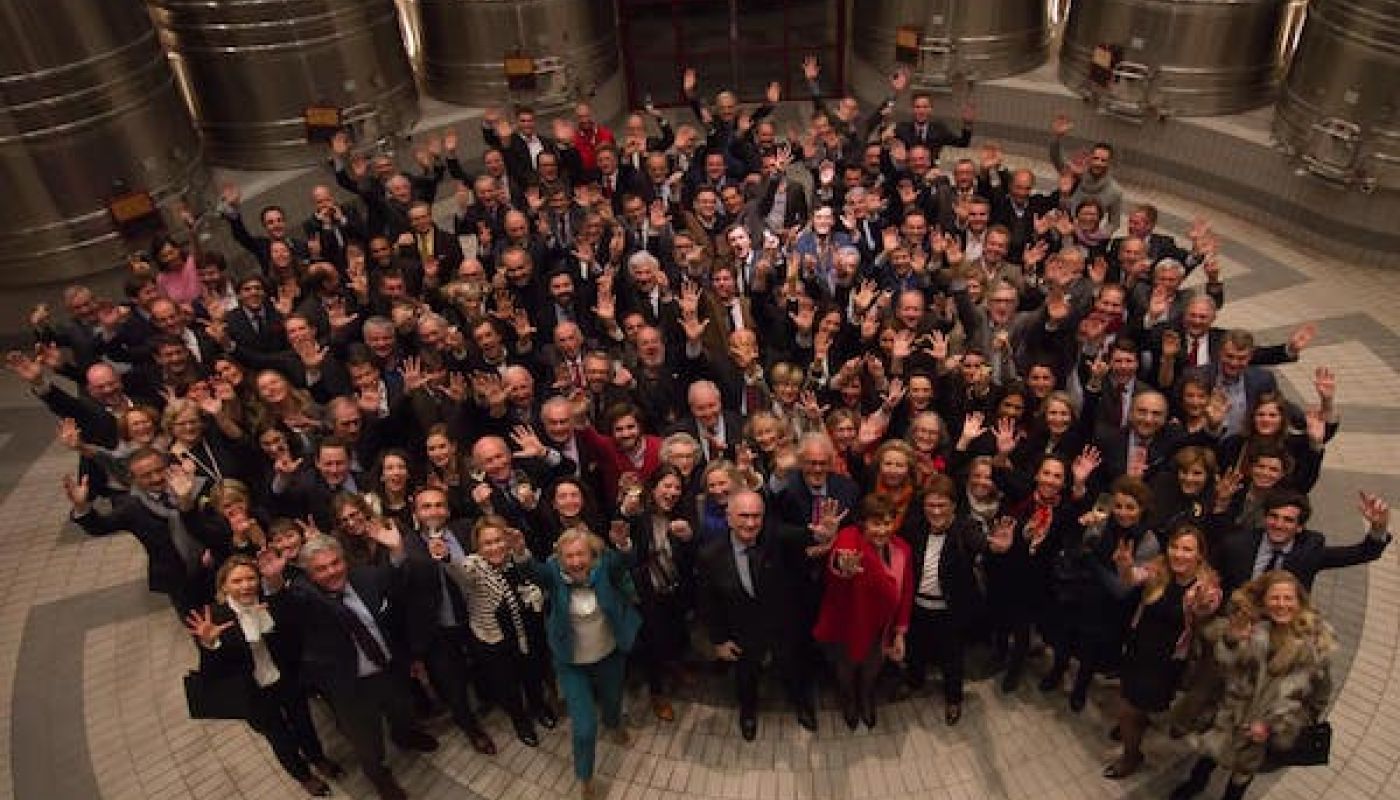
- The UGCB and some of its members (all members are pictured above) wish to launch the 2019 in May/June/July 2020 and are proposing to send samples all over the world to selected journalists, inviting their comments. And to arrange secluded tastings for professionals in key markets where the risks of COVID-19 infection will, they hope, be minimal.
- An alternative has been proposed (see Re-thinking en primeur): to shift the campaign around the 2019 vintage from spring/summer 2020 to the same period in 2021, when, it is to be hoped, travel restrictions will have been lifted.
- This solution would be welcomed by some consumers, traders and writers as judging nearly finished wines when they are 18 months old is a more accurate exercise than when they are six months old. And most people like to taste the wines, and speak with the owners and/or négociants, before buying, describing or scoring.
- But this delay would not be welcome to those many châteaux who depend on the en primeur campaign, with its payment dates stepped over the 12 months that follow it, as essential cash flow to maintain their businesses. This is a perfectly valid point for the majority of châteaux in the UGCB and many who are not members, we may imagine. Only those châteaux which have been holding back a substantial proportion of their production each year would be able to weather a 12-month period without en primeur sales (by releasing older vintages from their reserves). Nor would it be welcome to many Bordeaux négoçiants, for whom en primeur turnover can be a major profit-earner.
A possible solution – bring back first tranche
The UGCB would announce this month that the main campaign around the 2019 vintage will take place – travel restrictions permitting – in spring 2021, at which point the 2020 vintage will also be available for tasting at those châteaux who choose to show the two vintages together.
Châteaux, in concert with their local brokers and with the négociants of the Place de Bordeaux, would release a proportion of their 2019 crops as a first tranche in May, June or July 2020. To have any chance of success, it is essential that the prices reflect the current, dire economic situation – in the same way that the release of the 2008 vintage reflected the financial crisis at that time. Some châteaux may release 20% of their crop, some 40%, some 60%, some even none – depending on their needs.
It is important that négociants enter into the spirit of the exercise, passing on the wines, after taking their margins, at prices which reflect the attractive release prices declared by the châteaux. Some négociants may well opt to hold on to much, or all, of their first tranche acquisitions, waiting for the second tranche to appear, before striking a price.
If quantities of the 2019 vintage appear at attractive prices this side of summer 2020, trade and consumers may be happy to buy enthusiastically – even if wines have not been subject to the normal scrutiny.
This could be a win–win solution, inspired by Bordeaux’s history, and some of its best traditions. And if offering two vintages for comparison together in spring 2021 proves unsuccessful, or too confusing, then Bordeaux can easily return to business-as-usual - in what we hope will be a thriving, post-pandemic world – for the 2021 vintage.
Another possible solution – a courier's delight
However, it would seem that certain dynamic château-owners have other plans:
To invite their faithful clients around the globe – via their normal négociant channels – to express their interest in tasting the 2019s without delay. So, during the period mid May to mid June, literally hundreds of samples of each château’s 2019 may be despatched by courier to individual companies. This would avoid the need for buyers to taste in shared spaces, thereby reducing the risk of COVID-19 infection.
Prices will be declared, and the wines offered for sale, during the period mid June to end July. This would equate to a rather late en primeur sales campaign for the greatest wines – but the circumstances are exceptional.
The dynamic château-owners, I have been told, are conscious that opening prices need to reflect the economic crisis. If they do, and consumers perceive that they can, once again, buy top bordeaux at highly attractive prices while it's still in barrel, then a successful 2019 en primeur campaign could be achieved.
This outcome could work – but it all depends on strikingly good prices!
* Anthony Hanson MW is the Hanson of Haynes Hanson & Clark whose wines were reviewed here recently but he is no longer either a director or a shareholder. His role today is as buying consultant. Because he spends much of the year in Burgundy, his greatest involvement with the firm is in buying in that area but he is also involved in tasting young bordeaux. He was involved with the Hospices de Beaune auction through auctioneers Christie's but retired from Christie’s wine department at the end of 2016.