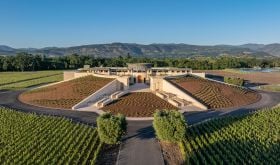
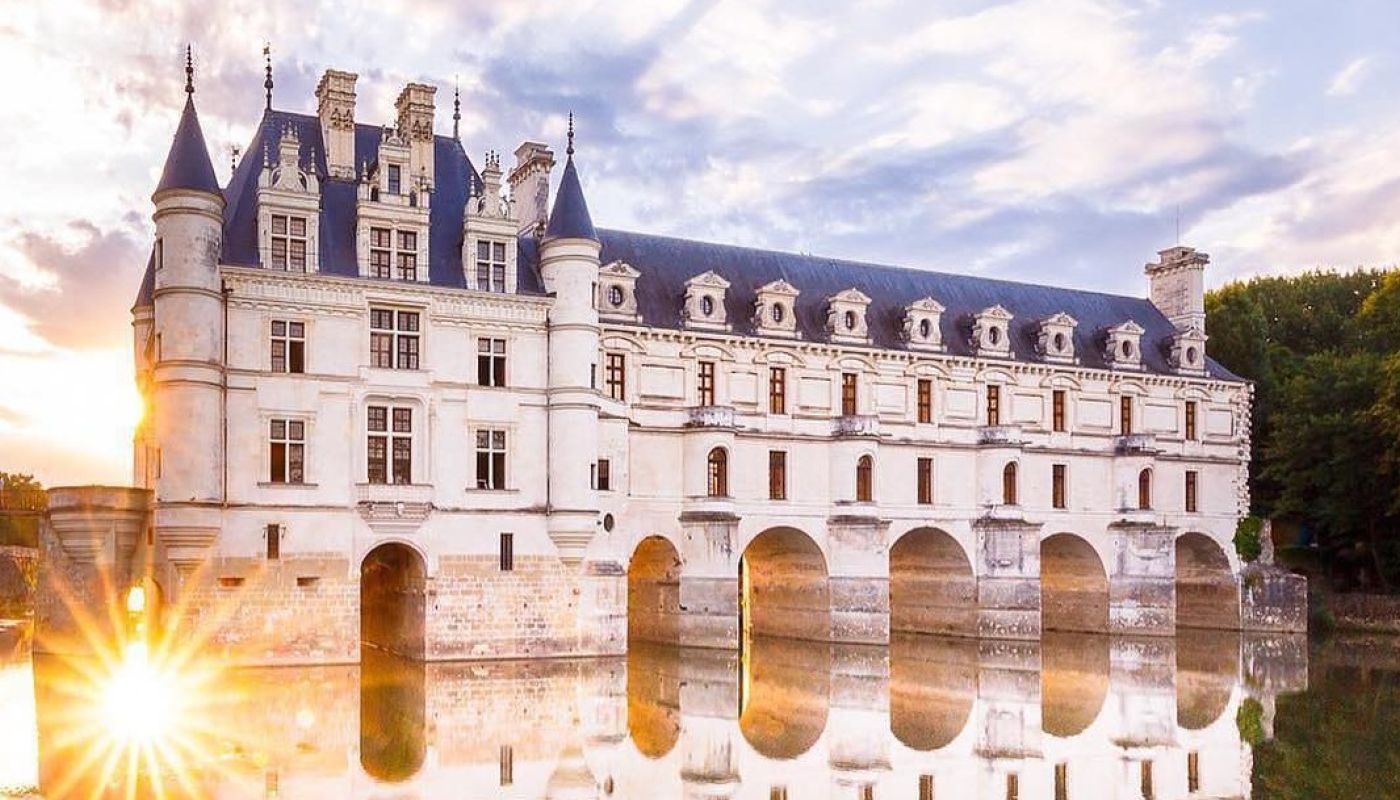
19 January 2021 The first part of a substantial series on wines of the Loire (see this guide). See also what Tam wanted to eat when tasting these wines. The photograph above, supplied by InterLoire, is of the famous Ch de Chenonceau.
The highly efficient organisational power behind my Languedoc marathon tasting last year was Victoria Kukla of Sopexa. During the flurry of emails about that tasting, Victoria mentioned that she also worked with Loire Valley Wines. My ears pricked up. Lockdown had scuppered a trip to the Loire that I was supposed to have made last May. Perhaps, I suggested to her, the Loire could come to me instead? She swung into action and, in addition to this one, I will be sharing similarly detailed reports on the Loire's reds, rosés, Muscadets, Chenins and other white varieties, as well as a small selection of sparkling and sweet wines.
Sancerre and Pouilly-Fumé arguably produce the Loire's best-known white wines, and they certainly produce its most famous Sauvignon Blanc. Touraine, on the other hand, is generally seen as the cheap alternative, quality reflected in the price. This tasting of 60 Loire Sauvignons, of which 34 were Touraines (the rest a pick'n'mix of IGP, Coteaux du Giennois, Sancerre, Pouilly-Fumé, Quincy, Menetou-Salon and Haut-Poitou) was a salient reminder that in the 21st century we dismiss 'lesser' appellations at our peril. There were some superb Touraines. Look out, too, for Fié Gris (Sauvignon Gris) – Eric Chevalier is making magic with his humble-sounding IGP Val de Loire.
In particular, I was expecting a sea of sameness – and had I flicked through the tech sheets beforehand, I would have been gloomily bracing myself. Winemaking just about across the board was uniform: machine-harvested grapes; stainless-steel, temperature-controlled, cool fermentations; less than 3 g/l residual sugar; a few months on lees. What I would never have anticipated was the diversity. There wasn't a tedious moment. That wasn't all. In fact, there were a number of other things about this tasting that surprised me.
The first and only negative was to see a handful of Sauvignons at 14% and even 14.5% alcohol. That's knocking quite high for a 'cool' region. Is this global warming at work? Is it work in the vineyard or cellars that is having an impact? Or is it sly labelling to ensure that they escape the US tariffs imposed in October 2019 on French wines under 14%? I hope anyway, if these are accurate readings, that it's not a trend we're going to see more of in the Loire. It's bad enough that bordeaux alcohols are starting to look Rhône-like.
Secondly, after having come across a few supermarket Loire Sauvignons with a distinctly pungent tropicality eerily reminiscent of a certain New World SB style, I was thrilled and relieved to find that in the selection I had in front of me there was no evidence of that. Flavours were clear and well-defined, but there was nothing brassy or brash about these wines. They were aromatic without being in your face. And whether residual sugar was less than 0.5 g/l or 3.5 g/l, in all but one or two wines the perception of dryness was in total harmony.
Sauvignon Blanc is often described as an obvious, easy-to-understand variety, with only the finest examples having much nuance. I could not say the same about these wines. The Touraines in particular, most of which retail at well under £15 a bottle, showed remarkable finesse and layers – enough to capture my attention for far longer than their New World counterparts. Not only that, but they went well with the most unlikely array of foods. Move over goat's cheese. Smoked duck, fresh blackberries, rocket and a clementine dressing was one glorious example. Rare lamb in a lemony tahini yogurt sauce was another. Carrot cake salad; Goan green coconut chutney and pakoras; kimchi omelette; sauerkraut (seriously!); pickled anchovies and tomato salad. They're wines that love food and food loves them.
In 2011, two communes in Touraine, Oisly and Chenonceaux, were authorised to append their names to the Touraine appellation (there were three other communes as well, but these are the two communes that specialise in Sauvignon Blanc). They stood out; superbly complex, serious, powerful wines that stopped me in my tracks. These are communes to be watching like a hawk.
The 60 tasting notes below (including a handful from Jancis) are presented in alphabetical order by producer (sur)name but you can reorder them by score, vintage or appellation if you prefer.

In conversion to organic. The estate of Isabelle Pangault (ex...
Certified organic. 23-year-old vines on 3 ha of clay-limestone...
Certified organic. 22-year-old vines on a 1-ha vineyard on clay...
Certified organic. 100% Sauvignon Blanc. 25-year-old vines on...
Certified Haute Valeur Environnementale. Eight-year-old vines on...
20-year-old vines on flint, clay and limestone. Six months on...
Light, frank, green vegy nose with really nice ripe fruit and a...
The most elegant and racy of these three soil-identified...
Modest but intriguing nose. The opposite of flashy! Very precise...
Pungent and intense, minerally nose with fruit that's really...
Rather diffuse nose – not crisp and sharp. Ripe, almost sweet...
Light nose, well-mannered palate and more obvious acidity than...
Heavy, broad bottle. A little more depth to the nose of this...
Certified Haute Valeur Environnementale level 3. 100% Sauvignon...
Certified Haute Valeur Enironnementale from 2019.
Textbook...
Certified Haute Valeur Environnementale. 30-year-old vines on...
In conversion to Terra Vitis certification. RS 3 g/l.
Slightly...
18-year-old vines. Three months on lees. No malo. RS 2 g/l.
A...
Made by Maryline and Francois Desloges. 100% Sauvignon Blanc. 28...
10-year-old Sauvignon Gris vines grown on a 3-ha vineyard in the...
Winegrower Francis Audiot. 100% Sauvignon Blanc on Kimmeridgian...
30% skin-contact maceration for 12 hours. No lees contact. No...
Certified organic. Vines planted in 1966. 10 months on lees.
Ric...
20-year-old vines on clay and flint. Five months on lees.
Ripe...
Certified Haute Valeur Environnementale level 3. 100% Sauvignon...
40-year-old vines, spontaneous fermentation and on lees for six...
Thirty-year-old vines. Some lees ageing.
Greengage and green fig...
Certified organic.
Gentle nose that is less gooseberry-green and...
Not much on the nose but a friendly, fruity Sancerre with more...
Certified Haute Valeur Environnementale and Terra Vitis. 100%...
100% Sauvignon Blanc. 15-year-old vines on flint and clay. Four...
100% Sauvignon Blanc, 20-year-old vines grown on sandy clay. 40%...
Certified organic. 20-year-old vines on silt and clay. Fermented...
NHB. Angular, not-quite-ripe gooseberry nose. But there is a...
In conversion to organic certification. Flint soils. Fermented...
Certified Haute Valeur Environnementale. 15-year-old vines on...
100% Sauvignon Blanc. 40-year-old vines. Aged on fine lees for...
Julien and Arnaud Moreux are the current winemakers, but it’s a...
Certified organic and biodynamic. On white calcareous clay. Hand...
Certified organic and biodynamic (Demeter).
Quite subdued on the...
Certified organic and biodynamic (Demeter). From a limestone...
Hand-picked, spontaneous fermentation, aged on lees with regular...
Certified Terra Vitis and Haute Valeur Environnementale level 3...
From parcels dotted around the village of Verdigny. A blend of...
Made by Philippe and Frédéric Cadart. 55-year-old Sauvignon...
Certified Haute Valeur Environnementale. 15-year-old vines on...
NHB. Smoke and almonds. This is stunning. Flame-grilled...
Sauvignon Blanc on calcareous clay. Fermented and aged on lees...
Certified Terra Vitis and Haute Valeur Environnementale. 100%...
Vines planted on clay limestone between 1982 and 2013.
Vanilla...
100% Sauvignon Blanc from 20-year-old vines grown on a 2-ha...
Aged for nine months in stainless steel (but not on lees). No...
100% Sauvignon Blanc vines from 10 to 65 years old. Fermented...
Certified Haute Valeur Environnementale.
Crushed gooseberry nose...
Sings clear as a bell. Grassy but scented, in the way that fresh...
Bottle 5,192 of 6,000.
So herb-scented: tarragon and Greek basil...
Made by the Oisly co-operative: Les Conférie des Vignerons de...
60-year-old vines on clay and flint.
Tense and clean with long...
Certified Haute Valeur Environnementale. 20-year-old vines on...
25-year-old vines on clay limestone and siliceous limestone...