On 2 July, while the European football tournament quarter-finals fizzed, Switzerland having ended French hopes, Russian president Vladimir Putin signed a new law and the genie of a Franco-Russian trade spat popped out of Champagne’s bottles. Henceforth, only bottles of bubbly actually made in Russia could be labelled ‘Champagne’ for sale in that country, it was reported. Proper champagne, the one from Champagne (as all informed readers of JancisRobinson.com know), was no longer allowed to call itself ‘Champagne’ in Russia. But Russian fizz was. ‘Sacré bleu!’ may well have been heard in the Champagne capital Épernay’s lunchtime haunts.
I phoned the Russian embassy in London, just to make sure I knew the truth. I asked to speak to President Putin. There was a giggle from the Russian lady. ‘I’m afraid that is impossible.’ When I explained I wished to know which champagnes President Putin loved to drink, she said I could write in and she would do her best. When I get a reply, I will write a follow-up article.
My suspicion all along had been that it was unlikely the Russians had banned the word Champagne altogether from bottles of champagne. After all, the label designs of leading champagne brands are subliminally printed on our grey matter. The average punter, let alone a champagne geek, knows the labels of Moët, Veuve Clicquot, Mumm, Dom Pérignon and Krug from 10 paces. And the front label of each one screams the word Champagne.
The facts about the Russian legislation are simple and not exactly as have been reported in the mainstream media: ‘Champagne’ is not banned from the front label. No change. But on the back label, if it is a champagne from Champagne, the phrase ‘sparkling wine’ must appear instead of the word ‘champagne’. On the other hand, Russian-made sparklers are permitted to put the word ‘champagne’ on the back label (even including those made by the simple tank method). And maybe this is the bone sticking in the craw of the Champenois. For decades, often with some justification, and certainly with legal-eagle zeal, the Champagne authorities have gone after anyone putting the word ‘champagne’ on anything other than one of their sacred bottles of the real thing from Champagne.
How it was reported
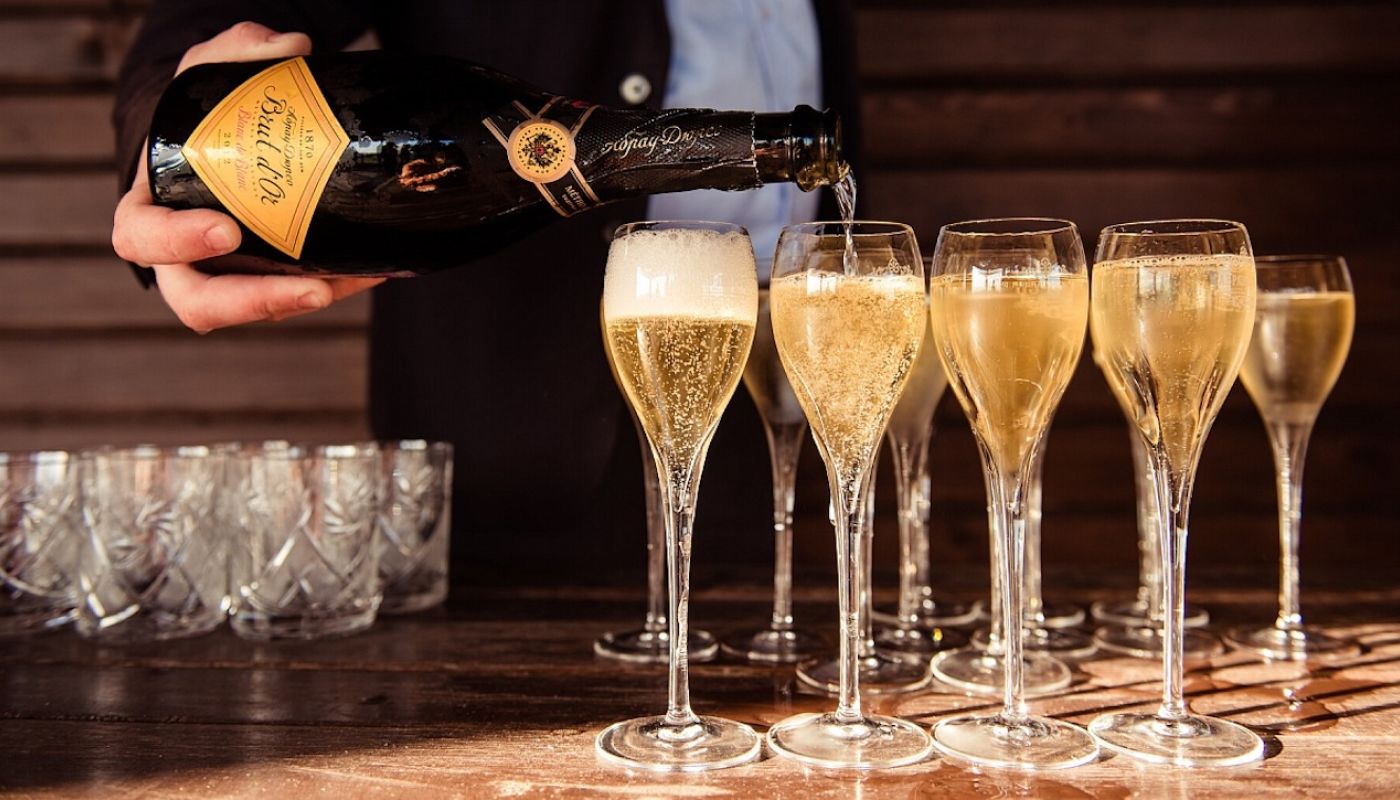
A media storm of indignation was all over the French press initially. ‘Russia grabs the Champagne appellation’, screamed Le Monde. Centre-right magazine Le Point declared ‘Russia doesn’t want French champagne’. The Washington Post (its slogan ‘Democracy Dies in Darkness’) posted a hilarious video clip of its correspondent plying young Parisian café society with samples from a bottle of Russia’s leading sparkler Abrau-Durso (from whose glamorous website the image above was taken). Some were snooty, calling it sweet, too fruity. Not champagne, bien sur. But many declared it fine.
Of the UK media, the BBC got it right, acknowledging that the front label in Russia can still say Champagne. The Guardian newspaper ingeniously reported on how the news was going down in a smart Moscow bar called Magnum and was told by the clientele and staff that the new law would make no difference. Those who could afford champagne will still drink it there. The wine list will not be reprinted.
The Sun newspaper, England’s top-selling tabloid, at least ran a fun splash about Putin’s alleged love child sipping champagne in a Parisian club. And the UK’s second most popular newspaper, the right-wing Daily Mail, got it completely wrong, with a piece falsely claiming champagne would be banned in Russia if it did not change its name.
Nevertheless, back in Champagne, the whole Moët-Hennessy group (the biggest champagne conglomerate including brands Moët et Chandon, Veuve Clicquot, Ruinart and Krug) announced they were suspending all production destined for Russia, implying champagne might disappear there altogether. But after 24 hours they explained the pause was just to reprint the back labels to comply with Russian law. And this ‘when in Rome’ approach, translated as ‘do as Moscow wants’ for now, seemed to be the growing French consensus as the row developed. The word ‘turn’ and the letter U crossed my mind.
Champagne’s ruling body, the CIVC (often called ‘Comité Champagne’), produced a ritual if understandable roar of outrage. Maxime Toubart and Jean-Marie Barillère, the CIVC co-presidents, issued a statement that stated, ‘… depriving the Champagne producers of the right to use the name ‘Champagne’ (in Cyrillic) is scandalous; it is our common heritage and the apple of our eye’. They reminded Russia that the name Champagne is protected in over 120 countries. The fact is, however, that Russia has never ceded France the right to use the word ‘champagne’ exclusively, and nor has the US. Interestingly, China does. The end of the CIVC 5 July press release rattles the champagne sabre but stops short of swiping the top off the Champagne diplomacy bottle. They want the Russian law changed by EU negotiation if possible, and they asked champagne producers to stop shipments to Russia until further notice. The Élysée Palace dispatched two government ministers to meet the CIVC in Épernay and proposals for tough initiatives are to be taken to the European Union and World Trade Organization.
Front label good, back label bad
Only a few days later my source at the CIVC was reassuring me that a halt to shipments was not a boycott but just recognition that existing (back) labels were now illegal in Russia. A procession of messages followed from champagne exporters to Russia. In summary, ‘we do not like what Russia has done, but to keep selling, we will comply’. New labels have been printed, the bottling lines are sticking them on. (Let’s hope the need to re-register the relabelled champagne does not interrupt Champagne’s consignments at the Russian border.) Hard-nosed major champagne producers, having vented anger, seem to have met the Russian fait accompli with a nimble volte-face. ‘What’s in a back label?’, they ask themselves, demonstrating once more that the Champenois may truly love the name Champagne but they love a deal just as much. And I admire them for that.
They point out they will retain the precious word Champagne on the front label in Roman script. The old back label shampanskoe (always printed ‘шампанское’ in Cyrillic) must now be changed to ‘sparkling wine’ or igristoyé (игристоыё in Cyrillic). The humiliating slight to the French is that all Russian sparkling wine will continue to call itself shampanskoe on the back label, a practice now denied the Champenois. I find myself musing how so often in the past big-brand executives from Champagne have told me they will not put more information on their back labels, such as the date the champagne was made, because, they say, hardly anyone reads back labels anyway.
In the meantime, apart from the blip in supply in order to print new, obedient labels, it seems those making and processing champagne orders in Russia, Épernay and Reims need hardly blink. The show will go on. After all, it’s not as if this storm-in-a-flute is that much threat to Champagne. Russia takes 1.9 million bottles of champagne, out of a recent (pre-pandemic) export average of comfortably more than 150 million bottles per annum in total exports. In 2020 Russia bought just 1.44% of all champagne exports, in 13th rank place of champagne-importing countries by volume and 15th by value, with no dramatic change over 10 years. There is a danger of seeing Russia as a bigger commercial force than it is. In fact its economy sits at number 11 by GDP, narrowly pipping South Korea and smaller than Italy’s in ninth place.
I discussed Putin’s move with Michel Drappier, family-owned Champagne Drappier’s shrewd and respected leader. The drinks-trade press and Reuters (who came to see him) portrayed him, he now feels ruefully, as despairing and pessimistic about Russian moves, when he is in fact quite sanguine. He plays the saga down as ‘a summer story’. Russians have loved champagne for 300 years, Drappier reminds us, and even if the quantities are modest in the scheme of things, the Russians will continue to place orders. Drappier itself is a Russia supplier, of up to 100,000 bottles a year, give or take the odd Aeroflot airline contract, and that will not change except for a single word in Cyrillic script on the back label of each bottle. In any case, he told me, for 25 years Champagne has had to put ‘vin mousseux’ (sparkling wine) on the back label of bottles going to Quebec. It’s not a big deal.
Shampanskoe
The word shampanskoe has been used on Russian-made sparkler labels since former Soviet times (see the Soviet sparkling wine entry in our online Oxford Companion to Wine), most of them not made by the traditional method that defines champagne. It’s a term well-established for the current approximately 170 million bottles of Russian fizz made each year, much of it made with imported base wines. What seems like the barefaced theft of a French vinous asset to the French is unremarkable labelling red tape to most Russians – neither here nor there. Bizarrely, makers of Russian sparkling wine might feel the term shampanskoe is more their own than Champagne’s.
The progress and prospects of Russia’s sparkling-wine industry brings us possibly right to Putin and his new law. Russia’s best big fizz producer is Abrau-Durso, making over 40 million bottles a year and attracting 250,000 tourists each year to its Krasnodar base. It’s owned by former oil oligarch Boris Titov. He drove quality by hiring Hervé Jestin as winemaker from Champagne in 2006. Jestin had been chef de cave at Champagne Duval-Leroy for 24 years and, back on home soil, is heading up the remarkable recent success of Épernay’s biodynamic Champagne Leclerc Briant. Abrau-Durso will soon farm 1,000 ha (nearly 2,500 acres) alongside its huge purchases of grapes and juice.
The kicker is this. Fizz supremo Titov is close to Putin; he is his Commissioner for Entrepreneurs’ Rights, in other words overlord of business regulation. Hedged in by international trade sanctions after his 2014 Crimean invasion, Putin is in the business of import substitution. If you can’t import the goods, make more yourself. Titov would have a willing finger in any pie Putin cooked to make it harder for Champagne to get its wines into Russia.
Another name, Yuri Kovalchuk, reported as Putin’s personal banker, also has sparkling-wine interests in the Crimea itself. I admit at this point, not being that much of a Putin-watcher, that my thoughts are speculation. Who knows? Perhaps Putin’s new law is both a gesture to help cronies, and a deliberate goad to France’s President Macron.
Champagne is a powerful and emotional icon of French national identity, a French national treasure. Putin’s meddling with its status in Russia is a put-down which may not be lost on Macron. Macron’s project just now, as Angela Merkel leaves the stage, is to be Europe’s linchpin figure. Perhaps Putin’s champagne putsch is a deliberate irritant to these plans and aimed to help his own project of dividing Europe post-Brexit, post-Merkel. Perhaps it goes right to the door of Putin’s office in the Kremlin.