
On 23 March this year 27 of us wine professionals were sent the following email message: ‘On behalf of Prince Robert of Luxembourg, we are delighted to invite you for a very special tasting event organised by Domaine Clarence Dillon at the Oswald’s Club in London on May 31st, 2022. We apologise for the tardy invitation which is unfortunately due to the current sanitary situation and uncertainties related to this.’
On the attachment it was revealed that we were expected to turn up at Robin Birley’s temple to wine at 8.30 am and that the day’s tasting would not end before 10.30 pm. In my 46+ years writing about wine, I have never been involved in such a prolonged event. I was probably not the only invitee to have assumed that this long day’s ‘work’ would be devoted to the most famous of Prince Robert’s estates, the Bordeaux first growth Ch Haut-Brion and possibly its estimable sister estate across the road in Pessac, Ch La Mission Haut-Brion. I knew how superior the setting, food and service are at Oswald’s so I was confident that the day would not be too much of a trial.
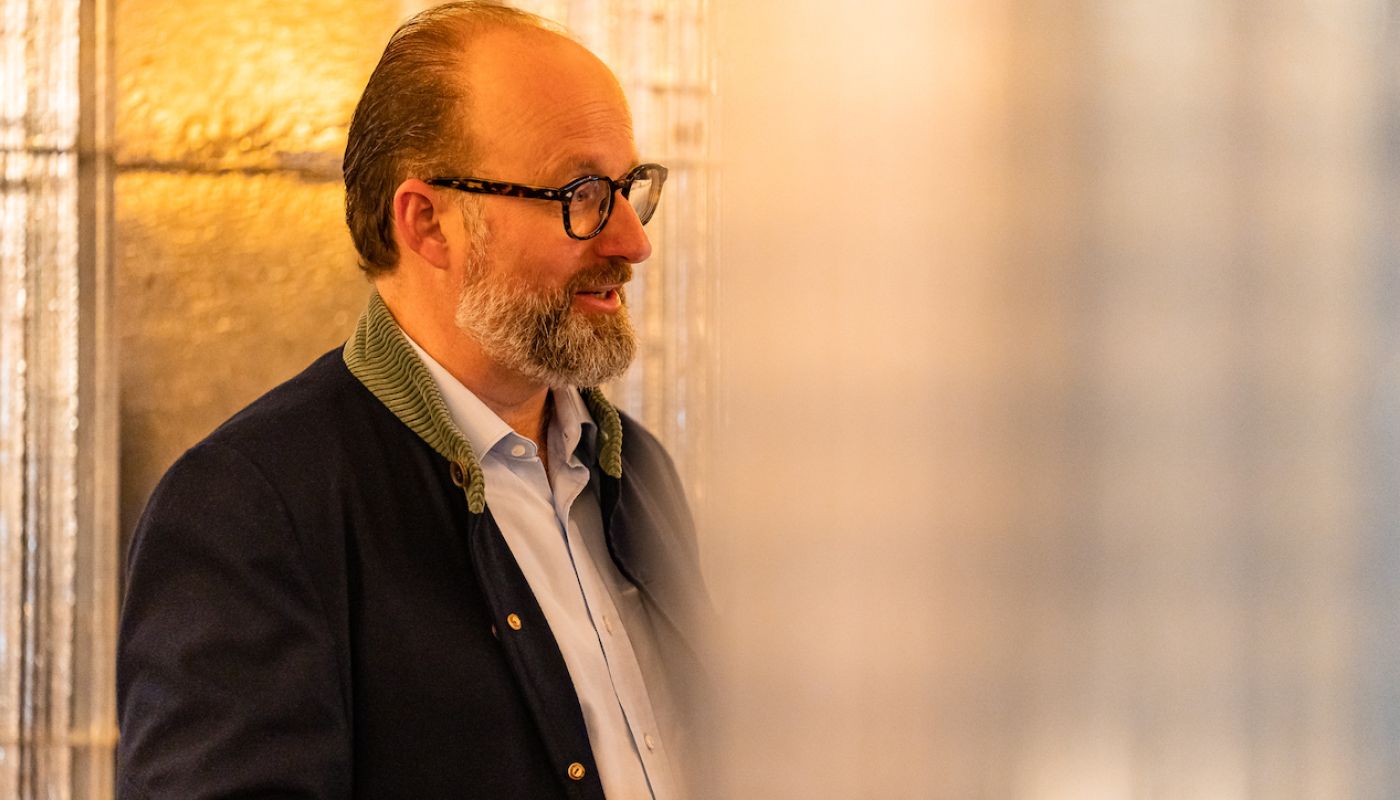
In the event we all turned up more or less on time, having used the COVID tests we had been sent. Prince Robert had flown in from Boston. The guests included Bordeaux specialist writer Jeff Leve, who had been flown in from Los Angeles and, like others, put up at The Connaught; HK-based Master of Wine Jeannie Cho Lee; New York-based Jamie Ritchie of Sotheby’s; wine writer Stuart Pigott from Germany; and quite a contingent from Bordeaux: Mathieu Chadronnier of négociant CVBG; wine writer Jane Anson; the young Chinese wine educator Alexandre Ma; and Prince Robert’s right-hand men, third-generation winemaker Jean-Philippe Delmas and sales director Guillaume-Alexandre Marx (pictured below surveying the tasters). There were also representatives of just about every important one of the many fine-wine traders based in London. I ended up sharing a table with Le Monde’s wine writer Laure Gasparotto, Neal Martin of Vinous.com and my fellow Master of Wine, Tom Parker of Farr Vintners.
The fine-wine trader Farr Vintners had been engaged to organise the nuts and bolts of this tasting, so the Farr team were the only ones in the room (reconfigured for this event for which Prince Robert had, most unusually, taken over the whole club for the day) who knew what we would be tasting before our host announced the theme.
To say it was a shock would be an understatement. In 2011 Domaine Clarence Dillon, the holding company of Prince Robert’s family’s wine-related properties, bought Ch Tertre Daugay, an underperforming estate in St-Émilion, and extended it two years later by adding its neighbour Ch l’Arrosée, naming the brand-new entity Ch Quintus. (This wholesale absorption of one château into another, with a rebranding operation, is by no means uncommon in Bordeaux.) Last year a third St-Émilion property, the non-contiguous Ch Grand-Pontet, was added to the portfolio to make a total of 45 ha (111 acres), making the Dillon family one of the biggest vineyard owners in this extensive appellation.
The Dillons are used to achieving sky-high prices for their wines and Quintus has been priced at around £90 a bottle, considerably more than Tertre Daugay or l’Arrosée used to be, a point that has not escaped the fine-wine traders. Prince Robert’s riposte would presumably be to point to the investments they have made and are making to improve these three new properties.
It turned out that the purpose of our tasting marathon was to compare Quintus with the most celebrated wines of St-Émilion, Chx Cheval Blanc, Figeac, Ausone, Pavie and Angélus. What had been lined up was eight flights of these six St-Émilions, from vintages 2011 to 2018 inclusive, the wines to be thoroughly mixed up and served blind. The hope, presumably, was that Quintus would stand up to the comparison with these wines that command prices even higher than Quintus, several hundred pounds a bottle. ‘You will respect our new baby’, was the underlying message.
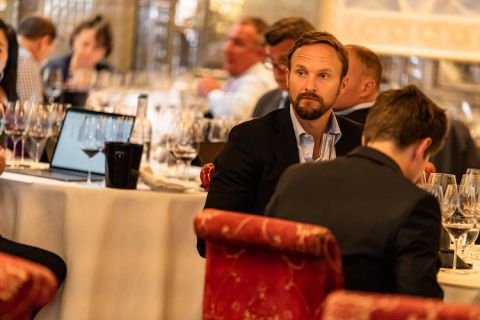
We were all urged to use the 100-point scale – quite a trial for those of us more used to scoring out of 20 – and to hand in our scores to Ben Browett of Farr Vintners, whose job was to tot them up. Needless to say, we were all keen to know how Quintus had performed. From my personal point of view it acquitted itself respectably enough.
Once I’d added up all my scores out of 20, out of a total of 160 points had I given each wine a perfect score, there was a group of top scorers – Figeac, then Angélus, then Cheval Blanc – each separated by just half a point. Then of the three wines that scored five or six points less in total, Quintus actually notched up a point more than either Ausone or Pavie according to my scores. But I should point out that the room in general was much more impressed than me by Ausone, which is not only superbly situated on the outskirts of the town but is also run impeccably by Alain Vauthier and his daughter Pauline, to whom he handed over winemaking responsibilities in 2005. Ausone is made in tiny quantities and is by far the most expensive St-Émilion.
Pavie, also superbly situated, was, as ever, a controversial wine. Since he acquired it in 1998 the owner Gérard Perse for many years pursued a policy of making a wine that was as concentrated, tough and exaggerated as possible. But the winds of change have been blowing. Concentration is no longer viewed as an asset in St-Émilion and, to my mind and palate, there has been a gradual stylistic change here so that, although I was famously critical of the 2003, I have enjoyed some recent vintages. The 2011 stuck out like a sore thumb from the rest for its top-heavy load of tannin that will surely always dominate the rather weak fruit, but I enjoyed the 2014, 2015 and 2016.
Figeac, Pavie’s polar opposite and, it should be pointed out, opposite in terms of location and soil type, made the most beautiful wine in 2016, my favourite of the whole session and overall favourite too. (In fact the top five wines for the group were all 2016s, with Pavie 2016 much lower down the overall ranking. The five bottom places were occupied by 2013s – but then we all knew which vintage we were tasting…) For me Figeac consistently scored highly apart from the 2011, a vintage in which its equally subtle neighbour Cheval Blanc triumphed.
There was a big stylistic difference between Figeac and Cheval on the one hand, both at the extreme western end of the appellation partly on gravel and with significant proportions of Cabernet as well as the more usual Merlot, and the other four wines, which tended to be sweeter overall. This was the first time for many years that I had tasted a sequence of Angélus vintages at the same time and I was impressed. The 2013 vintage was weak, as it was for all these properties (though not quite as disastrous as I was expecting), but all of the other vintages of Angélus had something to recommend them.
When all the scores were added up, Prince Robert and team must have been consoled to see that, on average for all tasters, Quintus was the fourth favourite out of six over the eight vintages, performing particularly well in 2015 when it was second only to Ausone, and coming last only in 2012.
I wonder whether the assembled fine-wine traders will find Quintus easier to sell after this tasting.
My favourite St-Émilions from 2011 to 2018
In descending order:
Ch Figeac 2016
£249.88 Lay & Wheeler
Ch Figeac 2015
£241.07 Spirits24
Ch Angélus 2016
£390.47 Vinatis UK
Ch Pavie 2016
£349 Uncorked
Ch Cheval Blanc 2016
£695 Mumbles Fine Wines
Ch Figeac 2012
$219 Du Vin, Los Angeles
Ch Figeac 2018
$229.99 Raeder's Wines & Liquors, Albertson, NY
Ch Quintus 2015
£76.67 Albany Vintners
Ch Quintus 2014
£132 L’Ami Jac
Tasting notes and more detail in A St-Émilion marathon in London. International stockists on Wine-Searcher.com.













