Pronunciation and spelling
In English, it’s spelled sake, not saké, and it’s pronounced sah-kay.
Sake ingredients
Rice, water, kōji (moulded rice, more of which later), yeast.
Most styles of sake include an addition of distilled, neutral alcohol.
Some sakes may be sweetened.
Most sake is vegan, but because there is the possibility that a sake producer could clarify a sake using animal-derived gelatin, some companies pursue vegan certification through VegeProject Japan.
How to drink sake
Sake can be enjoyed at a range of temperatures, from ice cold to hot (50 °C) – it depends on the style and quality of sake and the occasion. Warmth accentuates sweetness and umami. It is common to drink more delicate sakes at room temperature or cool.
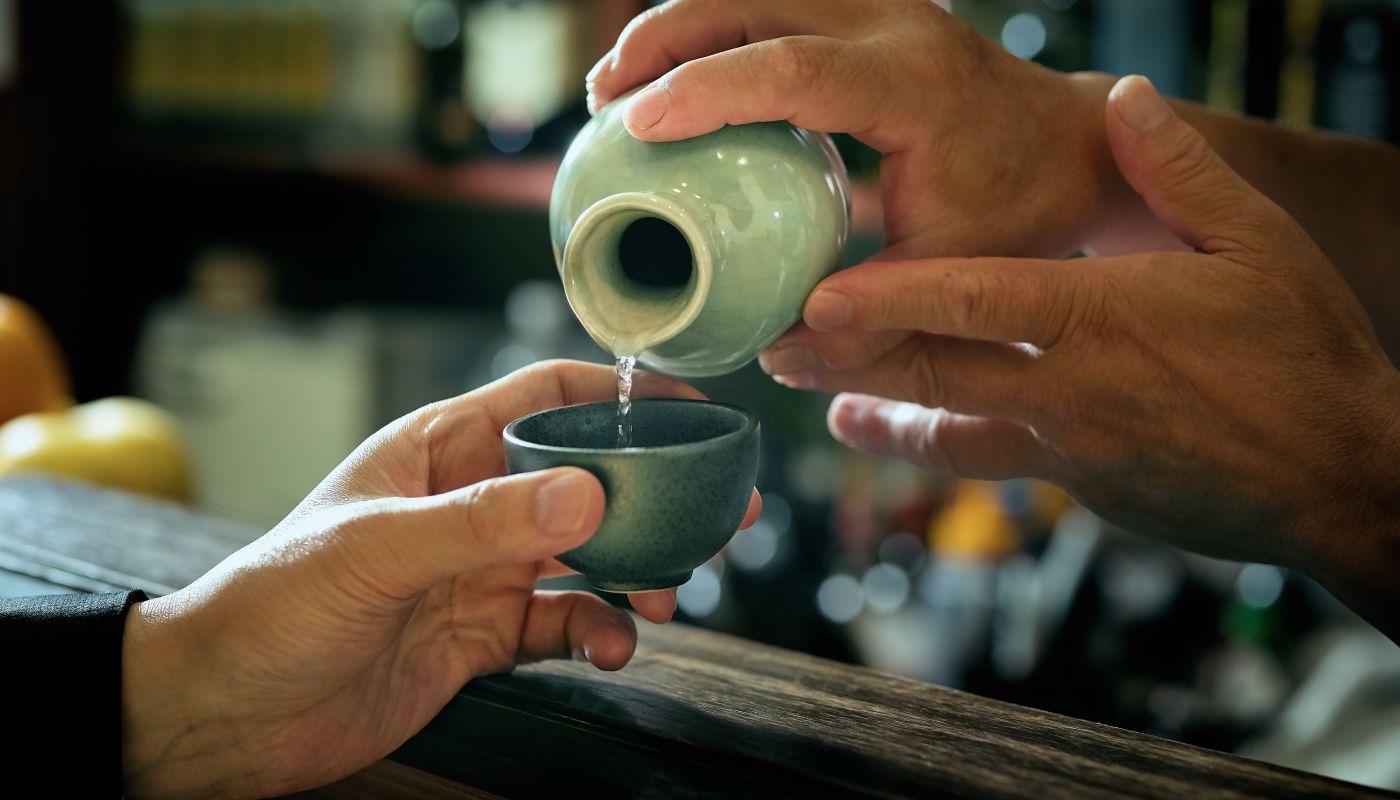
Traditionally, sake is drunk out of choko or ochoko (a small rounded cup), sakazuki (a flat saucer-like cup) or a masu (a square wooden cup – very awkward!). These range from simple and rustic to exquisitely crafted and decorated, and can be made from ceramic, glass or wood. The kikichoko is the official sake tasting cup, white with a swirl of circular blue stripes at the bottom to help the taster assess the colour and clarity of the sake. It comes in six sizes, from 30 ml to 160 ml. Good-quality wine glasses are useful if you’re tasting sake to learn about the aromas, flavours and textures. At a Japanese pub or restaurant, you are often invited to choose your own choko from an assortment, but many fine-dining restaurants all over the world serve sake in wine glasses.

Some sake-drinking etiquette
- Pour for your companion (not for yourself)
- Pour and accept with both hands
- Remember to drink yawaragi mizu (softening water)
- Toast each other with Kanpai! (Cheers!)
Parsing the sake label
What follows is a very basic overview of sake classifications and styles. For terms beyond those covered below, Urban Sake provides a very useful, extensive sake glossary.
Of course, many sake labels are not transliterated, in which case you may find Andrew Russell’s detailed guide to be very helpful.
Quality levels
There are two quality levels:
Futsu-shu – basic sake; the rice does not have to be polished. 68% of sake is futsu.
Tokutei meishō-shu – premium, ‘special designation’ sake.
Grades
Premium sake is divided into four grades called ginjō-shu, each based on the polishing ratio of the rice grain.
Junmai – no polishing percentage stipulated
Honjōzō – maximum 70% polishing
Ginjō – maximum 60% polishing
Daiginjō – maximum 50% polishing
NB 60% polishing ratio means that 40% of the rice grain has been polished away, leaving 60% of the original grain.

‘In theory if not in practice, the more the rice is polished, the higher the grade of sake.’ (Anthony Rose, Sake and the Wines of Japan)
Ginjō and Daiginjō sake can be made in two styles: with or without distilled alcohol added. Those made without added alcohol are prefixed ‘junmai’. Daiginjō and junmai daiginjō are the most fragrant and delicate of sakes; only 3% of sake is made in this way,
Honjōzō sake (fine but savoury sake) is always made with added distilled alcohol.
Sake styles
Genshu – full-strength sake. Sake can ferment to 20% alcohol but is usually watered back to 15–17%. Genshu is usually over 17% alcohol and can be any grade.
Happō-sei-seishu – sparkling sake.
Koshu – deliberately aged sake.
Nama-zake – unpasteurised sake, which must be kept refrigerated and drunk within six months of being made.
Nigori-zake – cloudy sake.
Taru-zake – sake that has been stored in cedar barrels, giving it a cedary flavour.
Sake Meter Value (SMV) and sake taste
Sake is defined as dry or sweet on a sliding scale that is called the Sake Meter Value (SMV) or, in Japanese, nihonshu-do (日本酒度). The scale measures residual sugar and alcohol in the finished sake, from –15 (sweetest, low alcohol) to +15 (driest, high alcohol). The back labels of most sakes indicate the SMV. Average SMVs for grades of sake are:
- Honjōzō – 5.2
- Ginjō – 4.5
- Junmai – 4.2
- Futsu-shu – 3.9
Sake production process
The following is a very, very basic outline of the sake production process. For more detailed explanations of each step and variations on the process, see Nada-Ken, Urban Sake or Sake World.
- The rice is milled (polished) to remove the outer husk where the proteins and fats are, and to expose the sought-after starch in the white heart of the rice grain.
- The rice is washed to remove milling powder.
- The rice is steeped in water – length of time depends on how much the rice has been milled; it could steep for a couple of minutes or 12 hours.
- The rice is steamed.
- The rice is cooled to 5 °C (41 °F), but a small amount is kept aside to make the kōji.
- Yellow Aspergillus orzyae spores are sprinkled over the steamed rice that has been set aside and the mould is propagated for three or four days in a room where temperature and humidity are kept high.
- Yeast is added to the kōji, then mixed with water and steamed rice to create a seed mash called moto.
- Acidity may be adjusted with lactic acid for stability.
- The kōji and yeast work together to break down the starch in the rice grains into glucose and then begin the fermentation process, converting the glucose to alcohol.
- Once fermentation begins, the seed mash is moved to a larger tank where water, rice and kōji are added, creating the ‘main mash’ called moromi.
- Fermentation can take 15 to 35 days.
- Once fermentation reaches a desired alcohol level, unless the sake is destined to be a junmai, distilled alcohol of about 30% is added.
- The moromi is filtered to separate it from the lees (which are used in Japanese cuisine).
- The new sake is usually pasteurised by heating it to 60 °C (140 °F).
- It is usually watered down from about 20% alcohol to 15–17% alcohol.
- The sake may be bottled or left to mature in tanks for a few months.
If you'd like to read more about sake, we have many more sake articles.
Opening photo by Yoshiyoshi Hirokawa via Getty Images.