Wine styles have changed enormously over the last four or five decades – more than in any other era – even from the same producer, and even from some of the grandest of them.
If you could possibly afford to conduct a ‘vertical tasting’ (same wine, a run of different vintages) of the bordeaux first growths from the 1970s to today, you would see a perceptible increase in concentration and alcohol towards the end of the last century and then, more recently, an increase in refinement and transparency. The same evolution would be apparent lower down the ranks, albeit perhaps with rather less subtlety. Fresher wines that communicate terroir rather than what was done in the cellar are the order of the day today throughout most of the wine world.
This switchback of aspiration is very apparent in most of the so-called New World. South American winemakers today have quite different aims and ideals from even a decade ago. Australian white wines are unrecognisably crisper than their predecessors. (Yes, the old oaky, rich Chardonnays did die young…) The most fashionable reds in Australian wine bars and restaurants today are light in every sense; the French name Syrah is worn as a badge of honour signalling a contrast with rich, turbo-charged, stereotypical Australian Shiraz.
Throughout Spain forward-thinking producers have been seeking out higher-elevation or ocean-influenced sites that yield more refreshing wines than of old. A new wave of their California counterparts are doing the same, making wines that seem to be from another planet from the late twentieth century west coast diet of super-ripe Chardonnays and Cabernets.
I have been racking my brains to think of wines that have not changed much over recent decades. In the backwaters of Europe there are still, amazingly, some wines that are as disappointing as they ever were, wines that never climbed aboard the wagon of improved winemaking technique and viticultural expertise. Such wines have rarely been exported and have to depend on local demand and ancient loyalties to find a market.
But what I’m after is good wine made by producers who have never really felt the need to make many changes. I think some burgundies would qualify – particularly at the top end. The wines of Armand Rousseau and Michel Lafarge, for instance, don’t seem to me to have changed in style over the years. When you have a winning formula and can sell every bottle 20 times over, why tinker?
On the other hand, I’d say quite a lot of red burgundy producers have changed their style since the 1970s, making cleaner, more concentrated wines from riper fruit than in the 1960s and 1970s when some less satisfactory clones of Pinot Noir dominated and winemaking expertise was not yet a given. Many of the older generation learnt experientially rather than bothering with any scientific training.
And white burgundy has changed enormously even quite recently, in much the same slimmed-down way that Australian Chardonnay has.
One important wine-producing country that I have not mentioned yet is Italy, because my prime example of a wine that has hardly changed at all since it was launched with the 1982 vintage is the Cabernet blend of the San Leonardo estate in the subalpine region of Trentino.
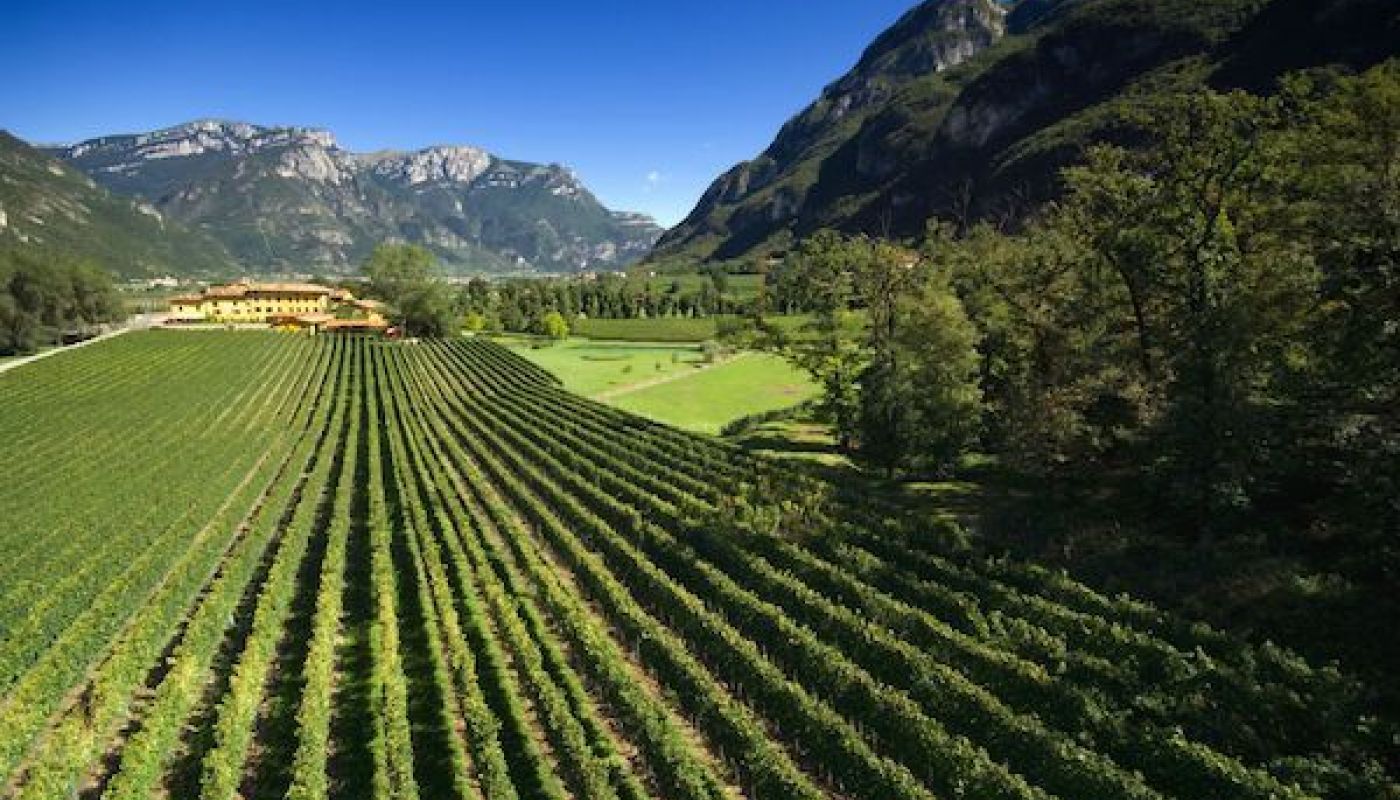
San Leonardo is exceptional in so many ways. For a start it produces wine almost in a vacuum, north west of Verona towards Lake Garda, well outside the Valpolicella zone, and much further down the Adige valley from the vineyards that supply the sparkling wine of Trento.
Although it’s an ancient estate, based on a tenth-century church, it did not produce wine until the late twentieth century. Marchese Carlo Guerreri Gonzago studied oenology in Lausanne in the late 1950s and then worked at the Tuscan estate that produces Sassicaia, Italy’s prototype Supertuscan Cabernet. Under the influence of Sassicaia’s creator, Marchese Mario Incisa della Rocchetta, Carlo was keen to see whether similar bordelais subtlety could also be coaxed out of the infertile clay-limestone benchlands of his wife’s estate in Trentino.
A certain stratum of Italian society is so tight-knit it’s effectively a pebble. Eighty-year-old Carlo and his son Anselmo are of the hand-kissing sort (though I promise it is the wine that has seduced me, not the old-fashioned courtliness), and share the same (surely Scottish?) tweed and immaculate Roman tailor as head of the eponymous Tuscan wine dynasty Marchese Piero Antinori who, like Carlo, turns 80 this year. Once Mario Incisa della Rocchetta had lit the winemaking flame, Piero lent his celebrated consultant winemaker Giacomo Tachis to fan it.
The result is a succession of vintages, all of which I have been lucky enough to taste, that are almost spookily similar and of astoundingly consistent quality (albeit arguably strongly French-influenced rather than typically Italian). When the weather is disobliging, as in 1984, 1989, 1992, 1998 and 2002, no San Leonardo is produced. Frost destroyed half of the 2017 crop. But virtually any vintage of the principal wine, generally made from about 60% Cabernet Sauvignon, 30% Carmenère and 10% Merlot, is beautifully low-key and like the most refined red bordeaux imaginable.
Carmenère, the grape variety that is nowadays common in Chile but almost extinct in its Bordeaux homeland, was supplied by mistake by a French nursery when Carlo was establishing his vineyard and was expecting Cabernet. Varietal Carmenère tastes green and unripe if the vines are allowed to be too productive and is too concentrated if they are pruned too severely but Carlo has learnt to tame it..
Only 26 of the estate’s 300 hectares are planted with vines. At one stage they raised cows and Carlo’s son Anselmo says he ‘dreamed of being a gaucho’. Instead, at the age of 22, he was charged with selling the family’s wine. At that stage, at the turn of the century, his family’s bordeaux blend was widely dismissed as being too light. Anselmo suggested to his father that they blend in some of the deep-coloured local Teroldego grape. His father called him a cretino. This was surely a good call because the style of San Leonardo is just right for today’s vogue for lightness, refreshment and relatively low alcohol (2010 was the first year the alcoholic strength given on the San Leonardo label reached 13.5%).
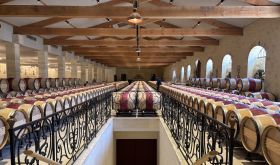
The San Leonardo literature and website suggests an almost feudal set-up. The major domo Luigini Tinelli was born on the estate. But they have known some tough times. When Anselmo, who also lives on the estate, joined the business it was saddled with debt – so much so that there was no question of replacing the Carmenère with the more conventional Cabernet Franc and, according to him, ‘there were barrels in every room’. He seriously thought that the banks might repossess the estate.
Today the wine has slowly and steadily earned global respect and an average bottle price of around £50. Last December, identifying London as ‘the place where classic wines are understood and appreciated’, father and son came over to show off 15 of their favourite vintages to media and trade, Carlo claiming this was the most moving experience of his life.
WHERE TO BUY SAN LEONARDO
The wine is easiest to find in Italy, Switzerland, Germany, UK and US, but it can also be found in South Korea, China, Canada, Czech Republic, Belgium and France. See here for a list of all importers.
The US importer is Vias Imports of New York and according to winesearcher.com a wide range of vintages is available from retailers at a regular price of about $70 a bottle but many a deal is currently advertised.
Classic Drinks of Little Island, Co Cork import the wine into Ireland.
UK importers are FortyFive10 of London SW18 and Inverarity Morton of Glasgow. The wine is offered by the case by several fine wine traders but can also be bought by the single bottle.
Honest Grapes is currently the only merchant offering the newly-released 2013 and they claim to have the UK’s most extensive back catalogue of vintages including 2010, 2008, 2007, 2005, 2003 and 2000 – offered in bond (and duty paid from April when shipped)..
2011
£43.95 Master of Malt, East Sussex; £49.95 Jeroboams; £59.99 Huntsworth Wine, London W8; £61.80 Hedonism, London W1
2010
£54 Huntsworth Wine, London W8; £49.95 Jeroboams
2007
£67.20 LadyWine at Satyrio, London EC3
2006
£79.20 LadyWine at Satyrio, London EC3
2005
£87.60 LadyWine at Satyrio, London EC3
2003
£54.95 South Downs Cellars, West Sussex, £59.95 Jeroboams
1999
£74.80 Hedonism, London W1
Vintages from 1988 are still going strong. Youngest vintage already beginning to drink well is 2011. Favourite vintages for current drinking 1996 and 1999.
International stockists from winesearcher.com. On Purple Pages are two tasting articles, verticals of these vintages: 1982-2006 and 1986-2013.