Anyone who takes a long-focus view of the earth can see that we are using up our resources far too fast. I'm delighted that awareness of the ecological effects of the use of heavyweight bottles, both in terms of production and transport, is now much more widespread than it was when I started writing about it five years ago. But we need to think about so many other aspects of making, selling and drinking wine if we are to build a solid, sustainable future for the planet. (Yes, I do sound bossy and prissy, but alas it's true.)
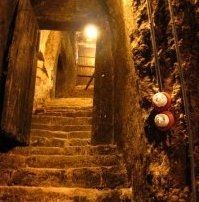
One thing that particularly troubles me, for example, is that so much cooling is needed during both making and storing wine. Most air-conditioning systems gobble fuel, yet the most traditional place to store wine, underground, uses virtually no energy, and provides admirably constant year-round temperatures. I was particularly struck by the contrast between ancient and modern methods when I visited the small northern Spanish wine region Cigales. Here there is a long-standing tradition of local people growing vines and making wine for themselves in underground cellars. The tradition is still vibrant enough for these cellars to be the sites of regular weekend feasts and entertaining. (The picture above is of the stairs down to one of these family cellars.)
But when the vast Rioja-based company Grupo Baron de Ley moved in to Cigales – a noble enterprise and one that I hope will help to spread word of the potential of this interesting wine region – they ignored local wisdom when building the vast palace that is their Finca Museum winery. Barrels are aged not underground, nor even in space-saving racks, but single height on the floor of a vast, tall, sports hall-sized chamber, part of this sprawling winery built above ground on top of a hill, presumably gobbling energy as the sun beats down on it every summer.
It is not that this Spanish wine company is wicked. It is merely following what has become the norm in so many parts of the wine world – Spain in particular, it has to be said – building a very visible, exhibitionist commercial monument. But it is, like so many of its peers, thoughtless. All it takes is a bit more awareness and long term-ism to ensure when designing winery buildings that sustainability is a major concern.
And of course this applies not just to designing new buildings but to operating methods in existing buildings. It would be wonderful if every wine producer could take a fresh look at how they use energy and, most importantly, what they do with waste, and really made a concerted effort to cut down on their use of the earth's horribly limited natural resources. Not least because the world views wine and wine production as a rather wholesome occupation. It would be nice if the reality really matched the image.
Of course some producers all over the world have been taking a fresh look at their methods and are to be congratulated. Oddly enough, one of the most pro-active has been in Spain. Some years ago now, Miguel Torres Jr, the one who is supposedly on the brink of retirement (ha!), looked at the science behind global warming and population growth and realised he had only one sensible course of action if he wanted to hand over a healthy business to the next generation. It was not long before he was organising a conference in Barcelona in June 2010 on eco-sustainability and wine. He has looked in detail at all the processes in his various wineries and instituted all manner of changes, including use of their own fuel for vehicles and development of algae designed to help absorption of the huge quantities of carbon dioxide given off by every alcoholic fermentation.
There are so many tweaks that can, and many would argue must, be made. As a result of the 2010 conference, a sort of Kyoto protocol called the Barcelona convention has been drawn up. By November 2011 there were already 20 signatories to the convention and it was hoped that there will be 150 by the time of the Alimentaria exhibition in March 2012. See www.wineriesforclimateprotection.com for more details.
But this is just Spain. What is needed is action all over the wine world. One place where there has been an admirable initiative is rather surprising. The Napa Valley is viewed from outside as being rather pampered and perhaps not the most obvious place for concerted ecologically sensitive action. But Napa Valley vintners have for many years taken the deep financial breath needed to bore caves into their beautiful hillsides for energy-neutral wine storage, and now they have an industry-wide sustainable farming initiative, just like their counterparts in New Zealand and South Africa.
Not using noxious agrochemicals and protecting the environment is of course a great start, but I would urge those in wine to think about every aspect of their business. Water use is one of the most worrying aspects of modern wine production. I have forgotten how many litres of water it is calculated are needed to produce a litre of wine – with good reason. It is widely acknowledged that the world will be fighting over supplies of fresh water before too long and that we just cannot continue to use it so profligately. Certainly, those in California and Australia already know how valuable is this resource that many of us take for granted.
Even at my rather unengaged end of the wine business, there are all sorts of small things that can be done to reduce our total carbon footprint, or just for sheer efficiency. Many producers still believe that they have to use horribly unrecyclable Styrofoam/polystyrene to package wine sent by mail or courier – but they are wrong! The progress in cardboard packaging strength in the past year or two has been nothing short of miraculous. Most of my samples now arrive in nothing less natural and biodegradable than cardboard, and I can't remember the last time a bottle was broken en route.
Mind you, I don't really understand why more wine producers don't follow Crushpad's example and use the conveniently small, screwcapped glass tubes sold by Wine in Tube (www.witfrance.com), who also provide neat little cardboard boxes to send them in. This reduces a potential shipment volume from almost 4,000 sq cm to about 300 sq cm, quite apart from the massive weight reduction. Though now that pouches, cardboard cartons and cans are so very much improved, I wonder whether we need glass at all for inexpensive wine? We consumers should certainly do our utmost to recycle our old wine bottles.
And my final tip: why does everyone persist in hauling massive spittoons to tastings? They are wasteful to transport and clean, and having only a few of them usually means that we tasters spend far too long commuting to and from them. Much more convenient for tasters, more hygienic, compact, stackable and completely biodegradable are paper cups, one per person. Up with paper cups, say I, and a much greater sensitivity to sustainability issues throughout the wine world.