Just as there is a world of difference between a five-year-old wine and 50-year-old one, tasting old wines is a completely different exercise from tasting young wines.
This was quite clear when six of us gathered round our dining table last autumn for a dinner focused on red bordeaux from the 1928 vintage, described as ‘massively tannic’ by Master of Wine Michael Broadbent of Christie’s, who has chronicled more old wine than anyone, and was one of the six. The hardback record of his wine-tasting career Vintage Wine goes back in history as far as a 1727 hock tasted from cask in Bremen in 1973.
Fortunately for us, 1928 was a famously long-lived vintage, thanks to all that tannic preservative, so the question was likely to be: was there any fruit left?
As some indication of the balance of power in today’s wine world, four of the seven bottles we were due to try had been provided by a wine merchant, and wine lover, from Hong Kong. Paulo Pong of Altaya Wines had bought these old wines in the mid to late 1990s in the UK: a 1969 cuvée of Perrier Jouët champagne no longer made, Blason de France; bottles of each of the 1928 second-growth Pichons of Pauillac – Lalande and Baron; and a bottle of first-growth Château Margaux from the 1924 vintage (a vintage Broadbent gives only three stars rather than the five awarded to 1928).
These were supplemented by a 1928 Château Cheval Blanc, the St-Émilion first growth, and a 1924 Château d’Yquem, the great sweet white bordeaux, from a particularly generous, wine-loving friend and neighbour who also attended. All that we offered was the setting, the food (including grouse in season) and a bottle of Krug 1995 with which we kicked off.
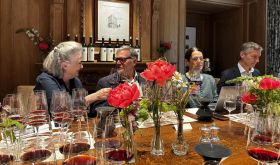
(My picture above shows Michael Broadbent bemusedly looking at Paulo's vintage Rover, a car he keeps for his UK trips but one that could perhaps do with a little more use to judge from my amateur perceptions of its performance. Paulo's wife, hotelier Sonia Cheung, perhaps wisely came under her own steam, arriving a little later after she had put their children to bed.)
Jan-Erik Paulson, a Swedish dentist who doubles as a rare wine merchant (www.rare-wine.com) in southern Germany, tastes seriously old wine more often than most and counsels generosity of spirit in those who tackle old wines. ‘If you set out to look for faults, you’re bound to find something to complain about. The point is to appreciate their elegance and complexity – and to think about the romantic notion of what was happening when the wine was made.’
Of course what was happening when these 1928s were offered for sale was the greatest economic depression the world has known, so they were slow to sell and it was perhaps just as well that they, unlike the more charming 1929s that immediately succeeded them, were chock full of the preservative tannin.
Red bordeaux vintages can crudely be divided into pre- and post-1982. Before this particularly successful vintage came along, to be followed by a succession of even warmer ones, and much greater understanding of how to grow ripe grapes and produce well-balanced, attractive wines from them (greatly helped by the teachings of the late Professor Émile Peynaud at Bordeaux University), grapes were picked much earlier than today. Pre-1982 the resulting wines were leaner and tarter and routinely had their alcohol levels boosted by the addition of beet sugar to the fermentation vat (see the Oxford Companion entry on chaptalisation). In theory, all the sugar was meant to be fermented into alcohol but I think some of the old wines that have come my way have a certain obvious sweetness that may just derive from unfermented sugar of whatever origin.
Another great advance in winemaking from the 1960s or so was mastery of the process that turns harsh malic acid into softer lactic acid known today as malolactic conversion. Today winemakers can generally control it by adding bacteria to encourage it and/or to stop it by cooling down the wine (the process is extremely sensitive to temperature). But in the old days, no one really understood what was going on. The famous Franco-Russian wine merchant Alexis Lichine was nearly ruined in the 1950s when the weather suddenly warmed up in the middle of the Atlantic, causing his big US-bound shipment of burgundies to re-ferment.
The other big difference between ancient and modern wines is the question of authenticity (see adulteration and fraud). It was only from about the 1970s that the authorities – God bless the EU – brought in enforceable controls on the paperwork accompanying wine shipments. Before then French wine merchants would routinely bring three samples of each bordeaux or burgundy over to their customers in London, containing increasing proportions of enriching red from the Rhône or North Africa. The one with the most ‘help’ was invariably favoured and, as Paulson observes and I can confirm, many of these ersatz blends were delicious. ‘I adore those old burgundies of the 1940s and 1950s', he told me, while admitting that he still finds them in old cellars today. ‘They have generally aged very well, even if you have to look quite hard to find the Pinot [the red wine grape of Burgundy].’
Until our dinner, I had notes on only five 1928 red bordeaux so I was very keen to see how they showed. Most wine slowly evaporates in the bottle so it was no surprise that the levels of most of these 1928s were what is known in the fine-wine trade as ‘top shoulder’ rather than right up into the neck.
There is an art to pulling a particularly old cork that is generally much more fragile than its modern counterpart. Paulo therefore used the Durand corkscrew designed for old wines that combines a sharp helix with the two-pronged AH-So instrument that is so popular in the US and allows you to withdraw a cork by levering it out of the bottleneck.
The Pichon Baron cork was notably longer than that in the Pichon Lalande (these details can be important) but was a bit chipped on the bottom. Perhaps it had let in more inimical oxygen than had got into the Pichon Lalande because the latter was much more appealing – so sweet that Michael Broadbent muttered ‘it’s not like a ’28 at all’. The Pichon Baron was marked by the besetting sin of really old wine: volatile acidity, a vinegary smell and a shortage of fruit. There was no shortage of tannin though.
The Margaux, from the lesser vintage, was on its last legs. ‘Interesting but spindly', I wrote, trying to remember Paulson’s advice to concentrate on the positives.
The red wine star of the evening was undoubtedly the Cheval 1928 (I gave it 20/20 as, I saw later, I had the only other time I had been lucky enough to taste it), from a bottle that had been expressly brought round earlier that day so that the sediment would settle. Like the other veterans, this bottle was opened and decanted relatively soon before pouring. Some connoisseurs will argue that we should have left all these wines for hours in a decanter beforehand but, honestly, that Pichon Baron 1928 would have tasted of pure vinegar if we had.

And then came the wine of the evening – as so often sweet and white: a Château d’Yquem 1924 that I also gave 20/20 and suggested as its suitable drinking window 1945 to 2045.
SOME GREAT WINE ANTIQUITIES
Most of the greatest old wines I have been lucky enough to taste were sweet white bordeaux, particularly the long-lasting Ch d’Yquem, but below are the finest examples of other seriously old wines to have come my way. Madeira such as Barbeito Verdelho Frasqueira 1992 (about £120 for 50 cl, much less than an equivalent red bordeaux, from Fortnum & Mason and Uncorked) is the world’s longest-living wine. Because it has already been exposed to heat and oxygen, it lasts much better than most wines in an opened bottle too.
Barbeito Terrantez 1795 Madeira
Kloster Eberbach, Steinberger Cabinet Riesling Flasche 3 1846 Rheingau
D’Oliveiras Verdelho 1850 Madeira
Bouchard Père et Fils, Charmes 1858 Meursault
Blandy’s Bual 1863 Madeira
Cockburn’s 1863 and 1868 Port
D’Oliveiras Moscatel and Malvazia 1875 Madeira
Seppeltsfield Para Tawny 1882, 1889 and 1890 Barossa Valley
Clos de Tart 1887 Burgundy
Ch Montrose 1888 and 1893 St-Estèphe
Ch Latour 1893 and 1897 Pauillac