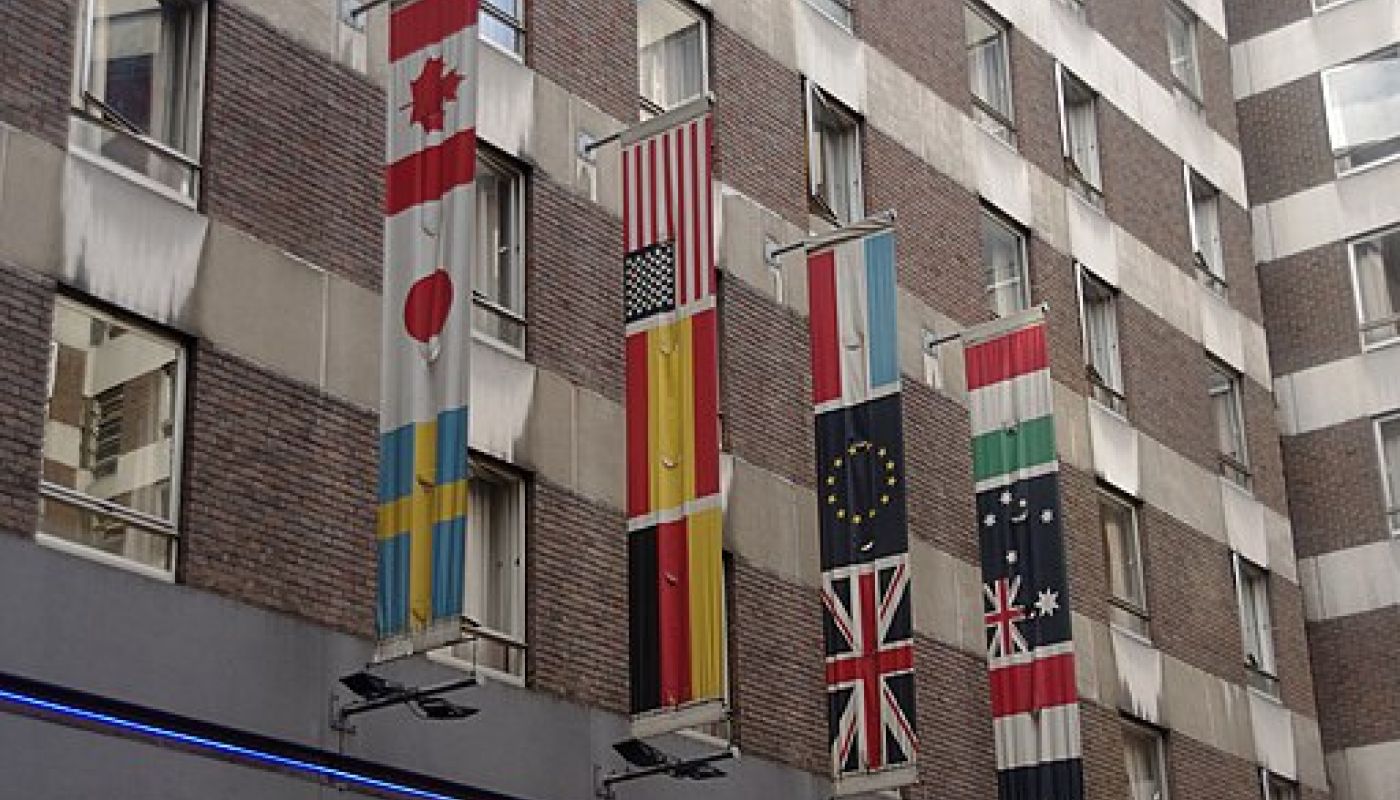
From the outside, the Royal National Hotel looks like something out of HBO's Chernobyl mini-series: a stark, Soviet-era concrete monolith plonked in central London. From the inside, the ghastly horror is confirmed, for one week in June, at least, for it is here that the annual MW exams are held (and simultaneously in California and Australia).
This year's papers are reproduced below. As usual, they contain a mix of the familiar and the exotic, with questions that seem innocent enough but which require devilish levels of detail to produce satisfying answers. The list of wines for each practical paper looks to be reasonably fair, but then it always does when you are reading them off the page. When they are lined up blind in twelve glasses in front of you, it's a rather different story...
PRACTICAL PAPERS
Paper 1
Question 1
Wines 1-4 are from two different countries. They may be blends or single varieties, but one variety is common to all. With reference to all four wines:
a) Identify the common grape variety. (20 marks)
For each wine:
b) Identify the origin as closely as possible. (4 x 10 marks)
c) Comment on quality and style with reference to winemaking. (4 x 10 marks)
Question 2
Wines 5-6, 7-8 and 9-10 are paired by country. Each pair is from a different country. For each wine:
a) Identify the origin and grape variety(ies) as closely as possible. (6 x 12 marks)
b) What are the key winemaking techniques used in the wine’s production? (6 x 7 marks)
c) Comment on the quality. (6 x 6 marks)
Question 3
Wines 11-12 are from two different Old World countries. With reference to each wine:
a) Comment on the winemaking. (2 x 10 marks)
b) Discuss the wine’s style, quality and commercial potential. Do not spend time thinking about the wine's specific origin. (2 x 15 marks)
1. Sancerre Les Boucauds, Claude Riffault, 2017. Loire, France (13%)
2. Sauvignon Blanc Reserve, Clifford Bay, Villa Maria, 2018. Awatere Valley, Marlborough, New Zealand (13%)
3. Château La Louvière, 2013. Pessac-Léognan, France (12.5%)
4. Sauvignon Blanc, The Doctors’, 2017. Marlborough, New Zealand (9.5%)
5. Rioja Blanco, Allende, 2015. Rioja, Spain (13.5%)
6. Albarino, Santiago Ruiz, 2017. Rias Baixas, Spain (13%)
7. Grillo, Isola della Fiamma, 2018. Sicily, Italy (12.5%)
8. Moscato d’Asti, Elio Perrone, 2017. Piedmont, Italy (5.5%)
9. Watervale Riesling, Mount Horrocks, 2018. Clare Valley, Australia (12.5%)
10. M3 Chardonnay, Shaw and Smith, 2016. Adelaide Hills, Australia (13%)
11. Chinuri, Iago, 2016. Kartli, Georgia (12.5%)
12. Vecchio Samperi, Marco de Bartoli, NV. Sicily, Italy (16.5%)
Paper 2
Question 1
Wines 1-4 are made from Bordeaux varieties. For each wine:
a) Identify the origin and grape variety(ies). (4 x 10 marks)
b) Comment on the quality in context of the origin, with reference to maturity and the potential for development. (4 x 10 marks)
c) Identify the key winemaking techniques used. (4 x 5 marks)
Question 2
Wines 5-8 come from four different countries in North and South America. For each wine:
a) Identify the origin and variety as closely as possible. (4 x 15 marks)
b) Comment on the quality and the likely market position. (4 x 10 marks)
Question 3
Wines 9-12 come from Europe, but not from France, Italy or Spain. For each wine:
a) Comment on the quality and commercial potential. (4 x 10 marks)
b) Assess the current state of maturity and the potential for development. (4 x 8 marks)
c) Comment on the possible origin and grape variety(ies). (4 x 7 marks)
1. Château de la Grenière, 2012. Lussac-Saint-Emilion, France (13.5%)
2. Vigna d’Alceo, Castello dei Rampolla, 2012. Tuscany, Italy (13.5%)
3. Saumur-Champigny, Le Prince, Domaine de Rocheville, 2014. Loire, France (13%)
4. ‘V’, Vergelegen, 2012. Stellenbosch, South Africa (14.5%)
5. Santa Maria Pinot Noir, Au Bon Climat, 2016. Santa Maria, California, USA (13.5%)
6. Malbec, Pulenta Estate, 2016. Mendoza, Argentina (14%)
7. Carmenère, Montes Alpha, Viña Montes, 2016. Colchagua, Chile (14.5%)
8. Single Vineyard Tannat, Bodega Garzón, 2017. Maldonado, Uruguay (14.5%)
9. Pinot Noir, Maximin Grünhaus, 2015. Mosel, Germany (13.5%)
10. Blaufränkisch, Weingut Heinrich, 2015. Leithaberg, Austria (13%)
11. Douro, Quinta da Leda, 2015. Douro, Portugal (13.5%)
12. Villányi Franc, Vylyan Winery, 2015. Villány, Hungary (13.5%)
Paper 3
Question 1
Wines 1-2 are both from the same region. For both wines:
a) Identify the region. (10 marks)
b) Compare and contrast the method of production. (15 marks)
c) Compare and contrast the style, quality and commercial appeal of the two wines. (25 marks)
Question 2
Wines 3-4 are both from the same region. For both wines:
a) Identify the region. (10 marks)
b) Compare and contrast the style and quality of the two wines. (30 marks)
c) Discuss the commercial appeal of the two wines. (10 marks).
Question 3
Wines 5-8 are from four different countries (two Old World and two New World), and are made from four different predominant varieties. For each wine:
a) Identify the origin as closely as possible. (4 x 6 marks)
b) Comment on the method of production. (4 x 7 marks)
c) Comment on the style, quality, and commercial positioning. (4 x 12 marks)
Question 4
Wines 9-10 come from two different countries. For each wine:
a) Comment on the method of production. (2 x 8 marks)
b) Identify the origin as closely as possible. (2 x 8 marks)
c) Comment on the style, quality, and commercial positioning. (2 x 9 marks)
Question 5
Wines 11-12 come from two different countries. For both wines:
a) Compare and contrast the method of production. (14 marks)
For each wine:
b) Identify the origin as closely as possible. (2 x 7 marks)
c) Comment on quality and maturity. (2 x 7 marks)
d) State the level of residual sugar (g/l). (2 x 2 marks)
e) State the level of alcohol (%). (2 x 2 marks)
1. Grand Brut, Perrier Jouët, NV. Champagne, France (12%)
2. Brut Grand Cru Millésime, Egly-Ouriet, 2007. Champagne, France (12.5%)
3. Prosecco Superiore, Giustino B, Ruggeri, 2017. Valdobbiadene, Veneto, Italy (11.5%)
4. Prosecco, La Marca, NV. Veneto, Italy (11%)
5. Rosé, Chateau Miraval, 2018. Côtes de Provence, France (13%)
6. Rosado, Cune, 2018. Rioja, Spain (13.5%)
7. Rosé of Pinot Noir, Rodney Strong, 2018. Russian River Valley, Sonoma County, USA (12.5%)
8. Rosé, Kim Crawford, 2018. New Zealand (13%)
9. Manzanilla Papirusa, Lustau, NV. Sanlúcar de Barrameda, Spain (15%)
10. Cuvée Speciale, Domaine de Montbourgeau, 2012. L’Etoile, Jura, France (13%)
11. Ben Ryé Passito de Pantelleria, Donnafugata, 2016. Sicily, Italy (14.5%)
12. Muscat, Campbells, NV. Rutherglen, Australia (17%)
THEORY PAPERS
Theory Paper 1 – Viticulture
THREE questions to be answered, ONE from Section A and TWO from Section B.
Section A
1. Are yield restrictions necessary to produce high-quality wine?
2. Your company has acquired a vineyard suitable for high-quality wine production that is currently producing grapes for bulk wine. Indicate what steps you would take to convert it.
Section B
3. Assess how drought tolerance can be achieved through viticulture.
4. Mildews continue to afflict vineyards. What strategies might a vineyard manager employ to reduce the risk?
5. What are the critical considerations for selecting rootstock when establishing a new vineyard?
6. Discuss the role of the following factors in the production of high-quality grapes:
- Aspect
- Vine density
- Row orientation
Theory Paper 2 – Vinification and Pre-bottling Procedures
THREE questions to be answered, ONE from Section A and TWO from Section B.
Section A
1. How can a winemaker manage the impact of oxygen during the winemaking process?
2. Evaluate the options available to the winemaker wishing to make wine with a lower level of alcohol.
Section B
3. Explain the procedures that might be followed in the winery when dealing with rot-degraded fruit.
4. With new French oak barrels becoming increasingly expensive, what alternative options and techniques are available to the winemaker wishing to make high-end wines?
5. Consider the impact of rosé winemaking techniques on wine quality. Are paler-coloured rosé wines better quality?
6. To what extent is it possible for producers of tank method sparkling wines to match the style and quality of wines produced by the traditional method?
Theory Paper 3 – Handling of Wines
Answer TWO questions from the FOUR listed below.
1. Explain which pre-bottling treatments and QC analyses you would consider most important for an inexpensive, organic, vegan wine.
2. What steps should a winemaker take, in preparation for bottling and at bottling, to prevent microbial spoilage? Consider both red and white wines.
3. Describe a comprehensive QA and QC system a large winery should implement for the management of dry goods.
4. What are the key factors to consider in drawing up a technical specification for:
a. a white dessert wine bottled at source with 150g/l of residual sugar; and
b. an entry-level red wine imported in bulk with 4g/l of residual sugar
Theory Paper 4 – The Business of Wine
THREE questions to be answered, ONE from Section A and TWO from Section B
Section A
1. Why does a growing number of large retailers prefer to focus on own and exclusive labels over third-party brands? Is this good for the wine category?
2. How do wine consumers in mainland China decide what wine to buy and what are the implications of their choices for producers and distributors?
Section B
3. Consider the growth in demand for vegan, organic and sustainable wines. What can and should the wine industry be doing in response?
4. Can social media drive brand loyalty in the wine category?
5. How can the fortified wine category evolve to address current consumer trends?
6. Outline the key changes in the fine wine investment market over the past decade. How do you see this developing over the next ten years?
Theory Paper 5 – Contemporary Issues
TWO questions to be answered, ONE from Section A and ONE from Section B.
Section A
1. What is the greatest threat currently facing the wine industry and how should this be addressed?
2. Does a changing climate place greater emphasis on terroir or on choice of grape variety?
Section B
3. Does wine have a significant role to play in a healthy lifestyle?
4. How responsible is the wine industry?
5. What makes wine authentic?