
See my Exotica from the Canary Islands tasting notes.
Question: Where are the highest vineyards in Europe? Switzerland, eat your heart out. In fact, they are on the slopes of the highest mountain in Spain, El Teide, the active volcano that dominates the island of Tenerife in the Canaries off the coast of Africa.
Here’s another one: How many different official wine appellations are there in the Canary islands? No fewer than 10, one for each island – Lanzarote, La Palma, Gran Canaria, El Hierro, La Gomera – except for Tenerife, which has been divided into five more. They do not exactly trip off the tongue: Tacoronte-Acentejo, Abona (home to the highest vineyards at 1,600 m above the Atlantic), Ycoden Daute Isora, Valle de la Orotava and Valle de Güimar.
More fascinating facts about Canary Island wines. They were hugely popular in Britain in the sixteenth and seventeenth centuries – as witness Sir Toby Belch’s call for ‘a cup of canary’ in Twelfth Night. The phylloxera aphid is yet to invade the island’s vineyards so, most unusually, all vines grow on their own roots rather than being grafted on to phylloxera-resistant rootstocks.
And, to reprise the topic of obscure grape varieties, part of Canary Island wines’ growing appeal in markets from the US to Korea is that there is barely a Chardonnay or Cabernet vine on the islands. Instead, their vines bear witness to the history and geography of islands that were important staging posts on maritime trading routes, and were Spain’s last acquisition, with a considerable Portuguese population and many an expatriate link nowadays to Cuba and South America.
The predominant vine variety when the Canaries were major wine exporters was called Malvasia and this is still the main vine grown in La Palma and buried in hollows in the extraordinary black lava of Lanzarote to protect them from the wind, as below.
Today the other principal white wine grape in the islands’ combined total of more than 10,000 hectares of vineyard is called Listán Blanco, the sherry grape Palomino Fino, but it is supplemented by a wide range of others such as Vijariego, Marmajuelo, two sorts of Albillo (found in central Spain), Sobra (probably Portugal’s Siria) and Verdello and Gual, respectively local names for the Verdelho and Boal of Madeira. The principal red wine grape, known as Listán Negro, is quite a different kettle of fish (the fish here is topnotch – straight out of the crashing Atlantic), a vine variety that seems to be indigenous that can make particularly fruity, peppery wine with fashionable freshness. Some producers have been experimenting successfully with carbonic maceration, a fruit-enhancing technique, for this red wine grape. Also grown are Negramoll (as Tinta Negra Mole, the main grape grown nowadays on Madeira), Baboso Negro (Portugal’s Alfrocheiro) and Tintilla, which seems to be the Jura’s Trousseau.
But it’s not just the grapes from ungrafted and often extremely senior vines that make Canary wines so intriguing. Many of the soils are volcanic, even if clay and sand predominate close to the rocky coastline, and the wines are marked by the tang and vibrancy that seems to characterise the wines of that other volcanic Atlantic island, Madeira. Alcohol levels are moderate. Thanks to government and EU subsidies designed to upgrade production, there is now a real will to put Canary Island wines on the map, with extremely sophisticated packaging and labelling designed to showcase thoroughly modern winemaking even if the vineyards may look almost medieval. I know from holidaymakers on other islands that remnants of the islands’ less glorious winemaking past certainly persist, but I was agreeably surprised by the quality and character of most of the (many) bottles that mysteriously found their way to my hotel room in Tenerife when I spent New Year there recently. (See Nick on Northern Tenerife – restaurants with views.)
I liked the labels that promised me a ‘volcanic experience’ even if I was slightly disconcerted by one that seemed to be proffering ammonia – until I worked out that the armonia on offer is actually Spanish for ‘harmony’. Some of the Maar family of wines, 15 Canary Island wineries represented in the UK via www.maarwine.com, have cleverly assembled dramatic black and white pictures of Canary Island experiences for their labels.
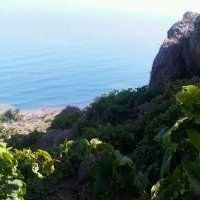
But most interesting was a visit to the painstakingly assembled 9 ha of Suertes del Marqués vineyards on a long westward slope down towards the Atlantic with the snowcapped El Teide lurking above. Surrounded by the suburbs of Puerto de la Cruz, this stretch of contiguous plots has taken Jonatan Garcia Lima and his father a quarter of a century to assemble. Suertes, the same sort of word as the sortes used by Rafa Palacios for his top Valdeorras white in Galicia, refers to the little lots of land individually owned by local families, often widely dispersed around the world and difficult to negotiate with. Most spectacular is the unique trenzado (plaited) training system, once traditional for Malvasia, which fruits only at the end of the canes. Some of these ancient multi-stranded vine tendrils stretch a total of 10 metres both up and down the hillside from the main trunk – very odd.
The winemaking team, led by Roberto Santana of Envinate (who also makes wine in Ribeira Sacra and Ribera del Guadiana on the mainland, also imported by Indigo in the UK), are aware that this is a particularly distinctive selling point, even if they have to be careful to chop off half the grapes from these potentially over-productive vines. The name of their introductory white wine has been changed from Blanco Barrica (so 1990s!) to Trenzado.
Suertes del Marqués wines are imported into the US by Eric Solomon and into the UK by Indigo Wine, both well plugged in to the restaurant and independent retailer scene in their respective markets (see the end of the article for UK prices and stockists for some of these wines). Tajinaste wines are well distributed in the US and are set to be imported into the UK by Caves de Pyrène.
FAVOURITE CUPS OF CANARY
WHITE
Bermejo, Malvasia Seco 2013 Lanzarote
Envinate, Táganan Parcela Amogoje Vinos Atlanticos 2011 Spain
£22.95 www.winedirect.co.uk
El Penitente, Arautava Seco 2012 Valle de la Orotava
Suertes del Marqués, Trenzado 2012 Valle de la Orotava
Suertes del Marqués, Blanco Barrica 2010/11 Valle de la Orotava
Suertes del Marqués, Vidonia 2011/12 Valle de la Orotava (£20–£25, see below)
Tajinaste, CAN Listán Negro/Vijariego 2012 Valle de la Orotava
RED
Aguere, Blessed Red Barrica NV Las Islas Canarias
Envinate, Táganan Parcela Margalagua Vinos Atlanticos 2011 Spain
£23 www.winedirect.co.uk
Any Suertes del Marqués 2011 red, Valle de la Orotava (£14.75-£29.95 – see below)
Or the introductory blend Suertes del Marqués, 7 Fuentes 2012 (£14.99 from Noel Young of Trumpington, Cambs – see below)
For stockists, many in the US, see wine-searcher.com.
Stockists and prices for the Suertes del Marqués wines that are available in the UK:
7 Fuentes 2012: Conolly’s, Solihull & Birmingham £14.75; Grape and Grind, Bristol £14.99; Handford Wines, SW7 £15.99; Park & Bridge, W3 £15.50; Quaff Fine Wine Merchants, Hove £15.99; Ten Green Bottles, Brighton £17.00; Wine Direct £14.95
Ciruelo 2011: The Sampler £28.80; Wine Direct £29.95
Solana 2011: Wine Direct £19.95
Vidonia 2012 (£20-25.00): Theatre of Wine, SE10; Handford Wines, SW7; Wine Bear, Chipping Norton













