10 March 2015 On 22 February 2015 the Lett family celebrated the precise 50th anniversary of the day on which the late David Lett planted the first Pinot Noir vine in Oregon’s Willamette Valley. This region was the first outside Burgundy to have devoted itself to the Pinot Noir grape (although Michael Schmidt has leaped to the defence of the Ahr Valley in Germany) and has now established itself as a nucleus of fine Pinot production peopled by like-minded, generally co-operative, underdog non-conformists. (See here for Oregon’s wine history in full in your online Oxford Companion to Wine.)
The Oregon wine industry evolved as a sort of counterculture, a Not California, although of course Pinot Noir had been grown in California, and pioneered by the likes of Paul Masson and Hanzell before anyone thought of planting it in the much cooler state to the immediate north. Although Switzerland has a much longer history of growing Pinot Noir, I find it difficult to think of anywhere else outside France that was taking the variety seriously in the mid 1960s, but perhaps someone can correct me via a post on our Members’ forum? Chacra in Argentine Patagonia has some Pinot Noir vines planted in 1932 but they were abandoned for many years. John Middleton of Mount Mary planted Pinot Noir in the Yarra Valley but not before 1972. I’m sure someone will correct me with some other suggestions, but when I began writing about wine in the mid 1970s it was accepted wisdom that Pinot Noir would never be produced successfully outside Burgundy.
So it was a special pleasure to be able to attend a commemorative tasting for several hundred friends of Eyrie Vineyards in the Portland Art Museum. They had all bought tickets, but I cannot understate the human warmth apparent in the Fields Ballroom that Sunday afternoon.

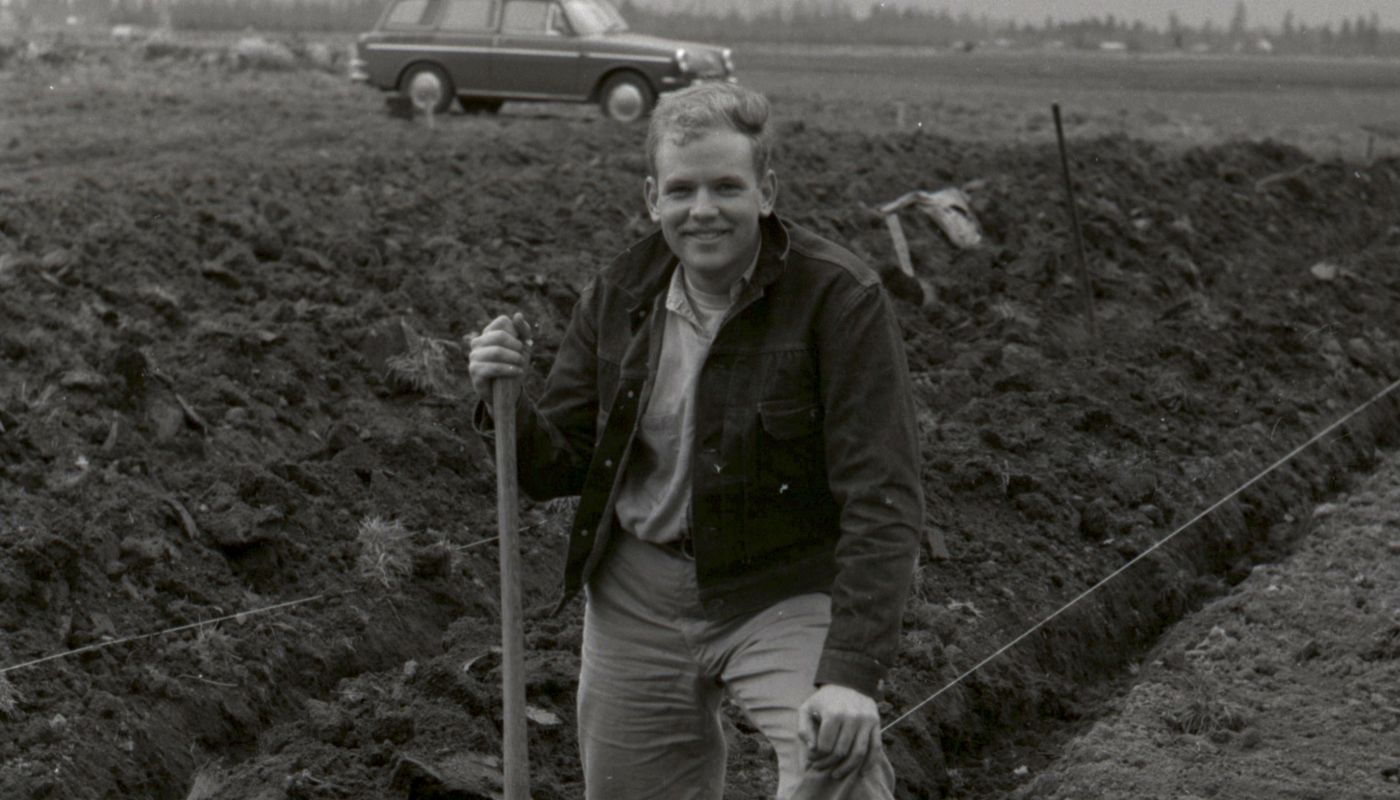
David’s widow Diana Lett, who told the room ‘we’ve known each other since before winemaking or Oregon were hip’, explained how, after David’s death at the age of 69 in 2008, they discovered a cache of his notebooks, cuttings and photographs such as the one here of him planting the early vines at the Corvallis nursery.
His son Jason, who now runs Eyrie, gave us an illustrated presentation of his father’s intentions and achievements, not least in the form of wines going back to a rare 1972 Pinot Noir and 1977 Pinot Gris in the most superb shape. Truly, it was the vivacity of the older white wines, both Chardonnay and Pinot Gris, that were the real revelation for me, as you can see from my tasting notes below. But it was heartening that he began his talk with a vote of thanks to the vineyard manager Javier Garcia, ‘who has been intimately involved, with his relatives, in making all our wines from 1985'. At Eyrie there has never been a separation between vineyard and cellar work.
The run of four flights, one for each decade, was followed by a showing of five current single-vineyard bottlings that were most convincing, and whose labels are decorated with Jason’s impressively accomplished watercolours of each vineyard site.

David Lett loved making wine but hated selling it, and was a great hoarder of bottles. The family have accordingly been left with a 6,000-case legacy of mature wine. Jason’s researches suggested that by no means all of them were in pristine condition, largely thanks to TCA, so has developed a 21–step system of checking and recorking every single one. These wines are now available commercially and profits from those sold on the day of the tasting went towards the Cascades Raptor Center. A peregrine was brought along for the ride. The red tail hawk has always been on the Eyrie label since they circle over the vineyards, the name Eyrie having been chosen by David even though ‘no one could spell, pronounce or understand it’.
Here’s to the next half-century, and to the future of Oregon wine.
The wines are presented in the flights and order tasted.
SEVENTIES

Picked 17 October, Brix 23.2, pH 3.26. Only one day in May made...
Picked 12 October, Brix 21.8, pH 3.43. Dry and relatively cool...
Picked 29 October, Brix 23.5, pH 3.6. March and April were cool...
Picked 4 October, Brix 22.5, pH 3.53. Good bloom conditions in...
EIGHTIES
Picked 4 October, Brix 20.8, pH 3.37. A perfect year! April...
Picked 5 November, Brix 18.4, pH 3.5. April and May were very...
Picked 22 September, Brix 19.0, pH 3.84. April was a beautiful...
Picked 17 October, Brix 23.4, pH 3.62. April was generally cool...
NINETIES
Picked 10 October, Brix 22.6, pH 3.31. A long, cool spring...
Picked 9 October, Brix 21.0, pH 3.44. A good growing season with...
Picked 30 September, Brix 23.8, pH 3.5. In 1998, warm winter...
Picked 5 September, Brix 23.0, pH 3.6. Even including 2014, 1992...
TWENTY-FIRST CENTURY
Picked 9/24, Brix 23.2, pH 3.44. The 2004 vintage in Oregon was...
Picked 22 October, Brix 22.6, pH 3.29. In 2002 a cool early...
Picked 14 September, Brix 20.1, pH 3.5. After four years of...
Picked 5 October, Brix 23.1, pH 3.44. The 2007 growing season...
SINGLE-VINEYARD BOTTLINGS
All five produced in 2012 for the first time, with watercolours of each vineyard by Jason Lett on the labels.
25-year-old vines at 60-110 m elevation from a terroir that...
Vines, in a 5-acre vineyard on volcanic soils that used to be...
26-year-old, 5.1-acre vineyard cooled by incoming breezes and...
The highest and smallest of these vineyards at 275 m and 1.5...
These vines, at 70-120 m, are between 30 and 50 years old, so...