Every few months we organise a Sunday evening wine tasting in London for visitors to my website. It’s always focused on a particular sort of wine we think is under-appreciated or under-represented in the UK. We started out a few years ago with Barolo, which is now well and truly part of mainstream British wine culture – not before time. We’ve since devoted events to sherry, the recently refined Brunello di Montalcino and Barolo’s less famous neighbour Barbaresco.
The tasting that has been by far the most popular, selling out almost immediately, was the most recent, devoted to a category we are always being told is difficult to sell, dry German Riesling (see Riesling Night – in pictures (and video) and Riesling Night – the tasting notes). Perhaps this website attracts a particularly strange crowd. The Members’ forum thread entitled Which German wine have you drunk this week? Is our single most popular, after all, with more than 2,500 posts.
But another recent event in London devoted to dry Riesling also drew a record crowd. Perhaps the tide is turning for the greatest white wine grape that is also, arguably, the wine world’s greatest underdog?
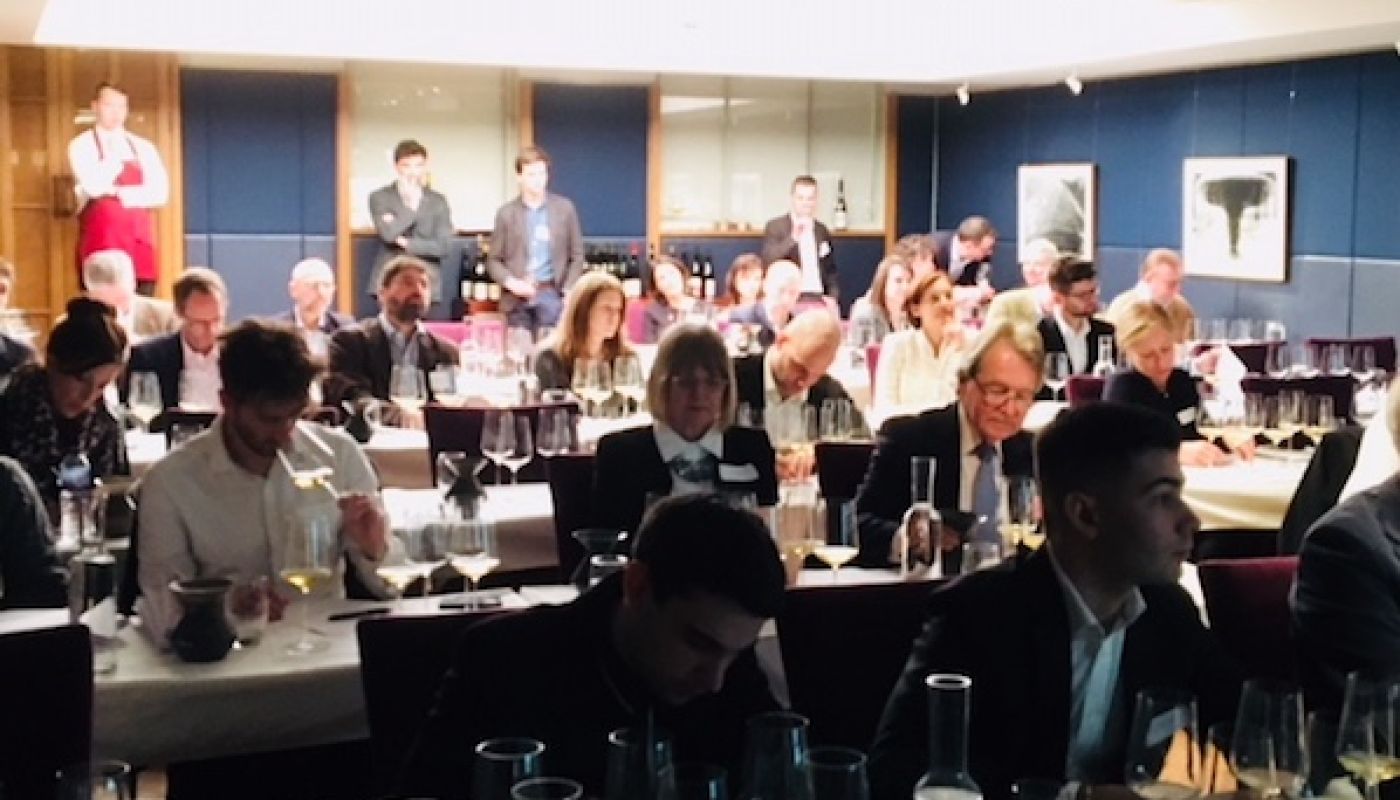
Alsace Crus & Terroirs is a group of 19 top producers formed a couple of years ago to underline Alsace’s terroir credentials – and to prove that Alsace wines are the most food-friendly wines in the world. In a masterclass led by an array of winemakers touting their granite, sandstone, schist, limestone, marly and volcanic soils, we had to take that second claim on trust, but the terroir point was rammed home via a series of Rieslings from various grands crus, each carefully delimited in theory by virtue of their different soil types (see Alsace’s new group makes a point and the picture above of the masterclass at 67 Pall Mall, Steven Spurrier on my left and somms aplenty).
Jean Trimbach of the eponymous wine producer (see Trimbach embrace grands crus) was the most explicit. ‘You have come today to meet the first growths of Alsace, and because Alsace is very interesting. Burgundy has perhaps 60 different terroirs. We have more than 800.’ Riesling was chosen to demonstrate some of the most common soil types because in Alsace it is generally dry, unlike many Alsace Gewurztraminers and Pinots Gris, so the terroir effect, always pronounced in Riesling, could be exhibited without the distraction of residual sugar. And the 2010 vintage was chosen because it was so intense, and the wines are just opening up nicely now.
In the Alsace Crus & Terroirs masterclass, and subsequent more general tasting, we did our best to identify the nerviness of Rieslings grown on granite, the breadth of those on sandstone, the delicate zest of the schistous Rieslings, a combination of warmth and austerity rather puzzlingly suggested for the rare Alsace Rieslings from volcanic soils, the richness of those from the many combinations of limestone, and the initial austerity and density of those grown on marls.
The truth of course is that – quite apart from the still-unsolved mystery of the exact mechanism that links soil types and wine character – most of these grand cru vineyards are themselves a mosaic of different soil types for they can be as extensive as the 80 ha (200 acres) of the granite-based Schlossberg, whose wines have been famous since the fifteenth century.
The main lesson I drew from both the Alsace and German tastings was that top-quality dry Riesling, wherever it comes from, is a truly thrilling drink, with – generalisation alert – more pace and variation than white burgundy. Dry Riesling with its zest and juiciness goes beautifully with food, and prices can be very attractive.
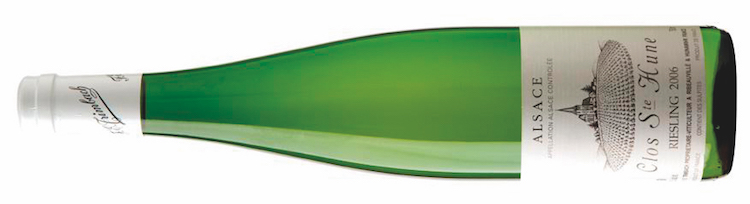
One notable exception to this is Trimbach’s Clos Ste Hune, grown in an enclave within the Rosacker Grand Cru vineyard and widely acknowledged as the finest dry Riesling in the world. The 1990 is certainly one of the finest wines I have ever tasted; I haven’t tasted it for four years but I’m sure it is still going strong. The 2010 is so backward it has not yet been released, and so great is Clos Ste Hune’s fame that the youngest current release, 2012, is well over £150 a bottle.
But the crème de la crème of German dry Rieslings that we showed at our JancisRobinson.com tasting were in the range of £30 to £40 a bottle, whereas top white burgundy can be hundreds of pounds. Clos Ste Hune apart, Alsace Grand Cru Riesling is often less than this, occasionally less than £20 a bottle, and these are wines that age beautifully. Indeed the point of our German tasting was to compare 2008 and 2016 vintages from the same producer and same top vineyard to demonstrate how well they age.
As luck would have it, I attended a third dry Riesling tasting recently, at Handford Wines in London and hosted by Stanford sinologist John Winthrop Haeger. He has written a book Riesling Rediscovered whose subtitle is, perfectly appropriately, is Bold, Bright, and Dry.
To prove his point he chose to show dry Rieslings not just from Germany and Alsace but also from two other countries that take this oft-maligned grape variety seriously, Australia and Austria, as well as from South Africa, California and New York state.
The American Rieslings were quite eye-opening – particularly the purity of Red Newt’s 2013 from the Tango Oaks vineyard in the Finger Lakes in upstate New York. The region used to be associated with sweetish wines from hybrid vines but is now a serious producer of fine Riesling. Red Newt on Seneca Lake has a good track record but has recently decided to concentrate on dry, single-vineyard Rieslings, and has taken on as winemaker Kelby Russell, a Harvard graduate in politics and economics turned Riesling obsessive. The 2013 has only 10.6% alcohol but is chock full of flavour and extract.
Elsewhere in the US, Washington state has fallen hook, line and sinker for Riesling, attempting to cash in on the mass market’s liking for affordable, medium-dry whites. In California, Haeger was keen to point out, the great grape of Germany dominated white wine plantings at the end of the nineteenth century, and was still far more widespread than Chardonnay as recently as the 1960s.
Once Chardonnay mania took hold, however, Riesling was cast into outer darkness in California with only a handful of the faithful such as Stony Hill and Navarro keeping the flame alive in the North Coast. But Graham Tatomer has more recently been seeking out promising Riesling plantings in cooler corners of the Central Coast to the south for his Tatomer label. These are so rare that he is secretive about his grape sources, not least because, according to Haeger, he has now inspired several other new-wave California producers such as Stirm and Maidenstoen to pursue the same course, equally inspired by the unique attributes of fine dry Riesling.
SOME GREAT DRY RIESLING PRODUCERS
ALSACE
Boxler
Albert Mann
Josmeyer
Kientzler
Kuentz-Bas
Meyer-Fonné
Muré
André Ostertag
Schoffit
Trimbach
Domaine Weinbach (Faller)
Zind-Humbrecht
AUSTRALIA
Crawford River
Frankland River
Grosset
Mitchell, Watervale
Pewsey Vale
AUSTRIA
Bründlmayer
Hirtzberger
Jamek
Jurtschitsch
Emmerich Knoll
Loimer
Malat
Neumayer
F X Pichler
Pichler-Krutzler
Prager
Salomon Undhof
Schloss Gobelsburg
Stift Gottweig
Domäne Wachau
GERMANY
Dr Bürklin-Wolf
Clemens Busch
A Christmann
Diel
Dönnhoff
Dreissigacker
Emrich-Schönleber
K F Groebe
Heymann-Löwenstein
Keller (Rheinhessen)
Kühling-Gillot
Peter-Jakob Kühn
Philipp Kuhn
Franz Künstler
Sybille Kuntz
Peter Lauer
Leitz
Schäfer-Fröhlich
Van Volxem
Wagner-Stempel
Winter
Wirsching
Wittmann
Tasting notes in our tasting notes database. Stockists from wine-searcher.com.