Global uncertainty is not limited to global affairs; it is reflected in the current state of the world of wine which is as metaphorically as well as literally fluid as I have ever known it. In the past wine producers and consumers were mostly headed in the same direction, driven by the same values and ideals, even if these evolved over time.
But today multiple wine creeds operate, with a sizeable minority of both producers and consumers having turned their backs on conventionally made wines, favouring instead so-called natural wines made with minimal intervention and/or wines made using unusual techniques such as making white wines as though they were reds and ageing wines of all colours in amphorae or concrete eggs. Interestingly, these techniques tend to mirror tradition as a response to what is viewed as excess additions or technology.
Virtually every wine-producing country I can think of has its increasingly vocal band of new-wave producers. They are legion throughout Europe. Outside Europe these powerful examples come immediately to mind: the band of young winemakers responsible for what they call the Swartland Revolution in South Africa (currently threatened by the sand-mining permits granted recently); the proponents of wines from the old, dry-farmed bushvines of Itata and Maule in southern Chile; the Rootstock rabble in Australia for whom this is their annual showcase for natural wines in Sydney; and a host of younger producers in California with names like Dirty and Rowdy, Donkey and Goat, and Forlorn Hope.
But this global movement has been unusually slow to catch on in New Zealand, even though the country’s important wine business is enjoying an unprecedented level of self-confidence. The ‘cultural cringe’ of yesteryear has been replaced by unrivalled export success for its flagship Sauvignon Blanc, now popular in the US as well as in the UK, and by the continuing emergence of regional styles in its signature red wine grape, the fashionable Pinot Noir.
Is it just because New Zealand is a small, relatively conservative country whose wine producers prefer to concentrate on delivering dependable versions of their most popular and hugely successful wine style Sauvignon Blanc? The New Zealand wine scene has long been dominated by a handful of big companies and that may tend to stifle experimentation. NZ-based Master of Wine, writer and educator Jane Skilton thinks it may also be because ‘we lack cities with big enough populations to fully absorb experimental wines – unlike Australia’. She also suggests, ‘New Zealanders are inherently cautious and there is a real tall poppy syndrome. So anyone who steps outside the norm is regarded as a bit odd rather than bold and innovative.’
Alex Craighead, 35, is a possibly odd exception in New Zealand, in that he, admittedly Australian-born, determinedly makes his wide range of wines with minimal intervention. So does he make natural wines, I asked. He sighed and explained, ‘I prefer the term “living wine”. It’s less confrontational. And anyway those sort of wines are not the only thing I drink.’ He admits that his approach has drawn some negative reactions. ‘You need a thick skin, but I’ve noticed more positivity this last year. And we’re starting to get on restaurant wine lists.’
We met in Martinborough, one of New Zealand’s prime Pinot Noir regions, where until recently he made the wine for the fairly conventional Alana for five years and where he makes particularly energetic Pinot for impressive new grower Devotus. But he recently bought a vineyard and winery across the Cook Strait in Nelson where organic viticulture is embraced more warmly than in big-business Marlborough (although Seresin has pioneered even the more extreme biodynamic practices in Marlborough). He makes Kindeli wines from Nelson fruit while both Nelson and Martinborough provide grapes for his Don range, named after his Argentine partner’s grandfather. And, just to keep it complicated, he also makes a bit of wine in Catalunya and Japan each year.
He is a Hispanophile and admits it was in Spain that he was first exposed to ‘the no-sulphur crowd – they’re all mad'. He doesn’t know whether to be proud or exasperated that a natural wine bar in Barcelona rejected one of his wines ‘because it was too clean – with 0.99 volatile acidity!’. From the 2016 vintage he has deliberately kept the level of this dangerously vinegary odour too low to be detected.
He started out at natural-wine pioneers, Cambridge Road, and reckons the brake on new-wave wine in NZ has been craft beer. ‘New Zealanders who want their taste buds challenged go there. In Australia natural-wine progress has been at the expense of craft beer but in New Zealand it’s the opposite.’ He’s working with the Garage Project of Wellington to make their extremely unusual combinations of wine-influenced beers.
As so often with alternatively-styled wines, I found Craighead’s own produce, whites made with up to 40 days’ contact with grape skins, resulting in considerable chewiness, highly variable. His response to my criticism that too many of his wines lacked persistence was that we should all try to stop fault finding in wine and instead celebrate the positives. ‘For example, the volatile acidity in some of those new Australian wines is far too high, but their salinity can be a really good thing.’
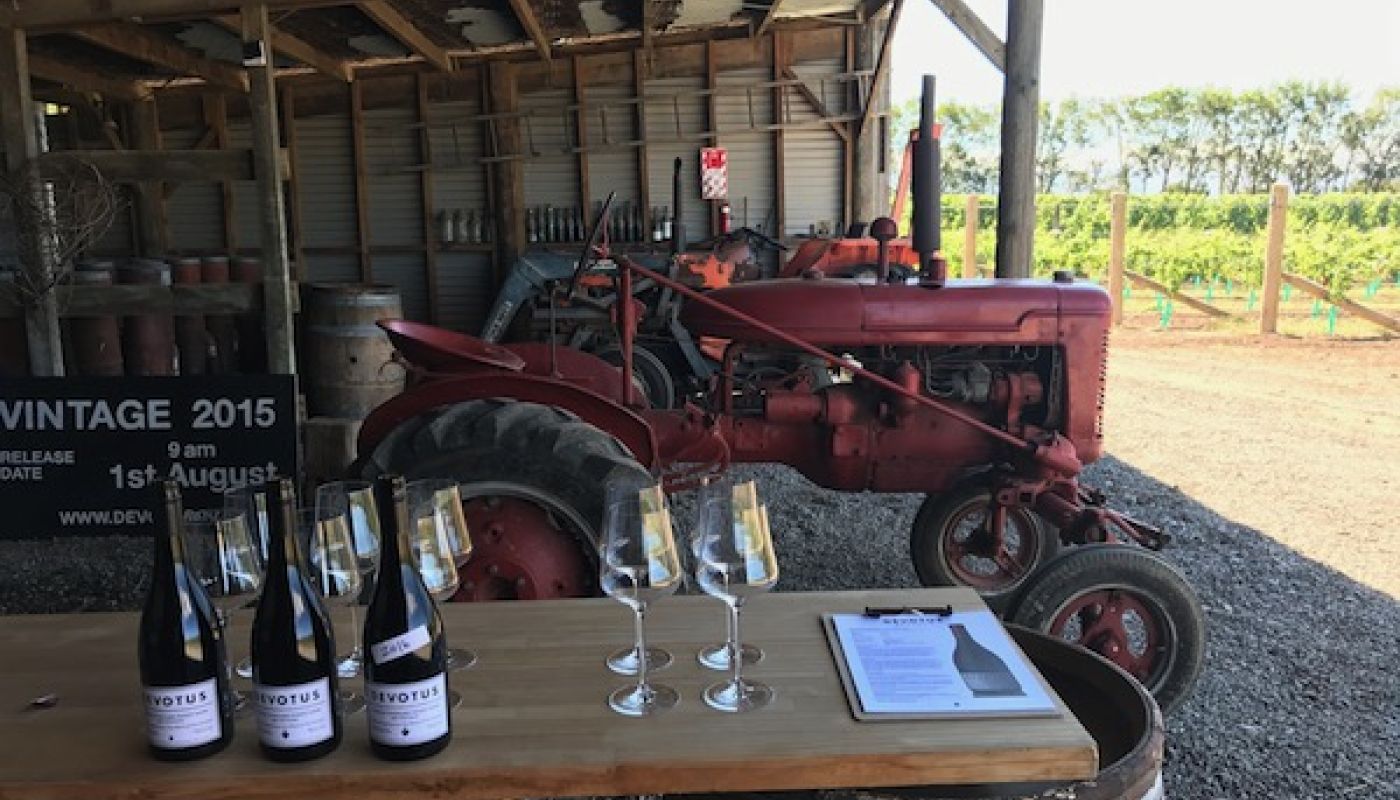
I have no complaints however about his low-sulphur, ambient-yeast rendition of the Devotus Pinot Noir that is arguably more impressive, or certainly more de nos jours, than the more heavily oaked Reserve version made by Poppy Hammond, who used to work at nearby Dry River. Devotus’s owner Don McConachy admits that younger people tend to favour Alex’s version to the Reserve one that costs very much more. (My picture above shows the Devotus range shown off in the McConachys' tasting room-cum-tractor shed.)
But, as in the rest of the wine world, conventional winemakers are starting to be tempted to try some of these new/old techniques. Helen Masters is the wizard at the celebrated Ata Rangi winery in Martinborough. Since the 2014 vintage she has been experimenting with macerating a small proportion of her Sauvignon Blanc grapes with the skins for up to six weeks, ‘to try to capture the flavour and phenolics of the grape’. In 2015 she increased that proportion from five to seven per cent, a sign of approval of the technique which certainly results in a wine unimaginably more complex than the average Marlborough Sauvignon Blanc.
If you’re on a winning streak, as New Zealand wine producers undoubtedly are, there is presumably not too much incentive to change.
SOME NEW ZEALAND DEVIANTS
Black Estate, Waipara
Cambridge Road, Martinborough
Don, Nelson and Martinborough
Ekleipsis, Waipara
Green Glow, Hawkes Bay
Kindeli, Nelson
Pyramid Valley, Canterbury (recently sold by its American biodynamic founders)
The Hermit Ram, Waipara
Sato, Central Otago