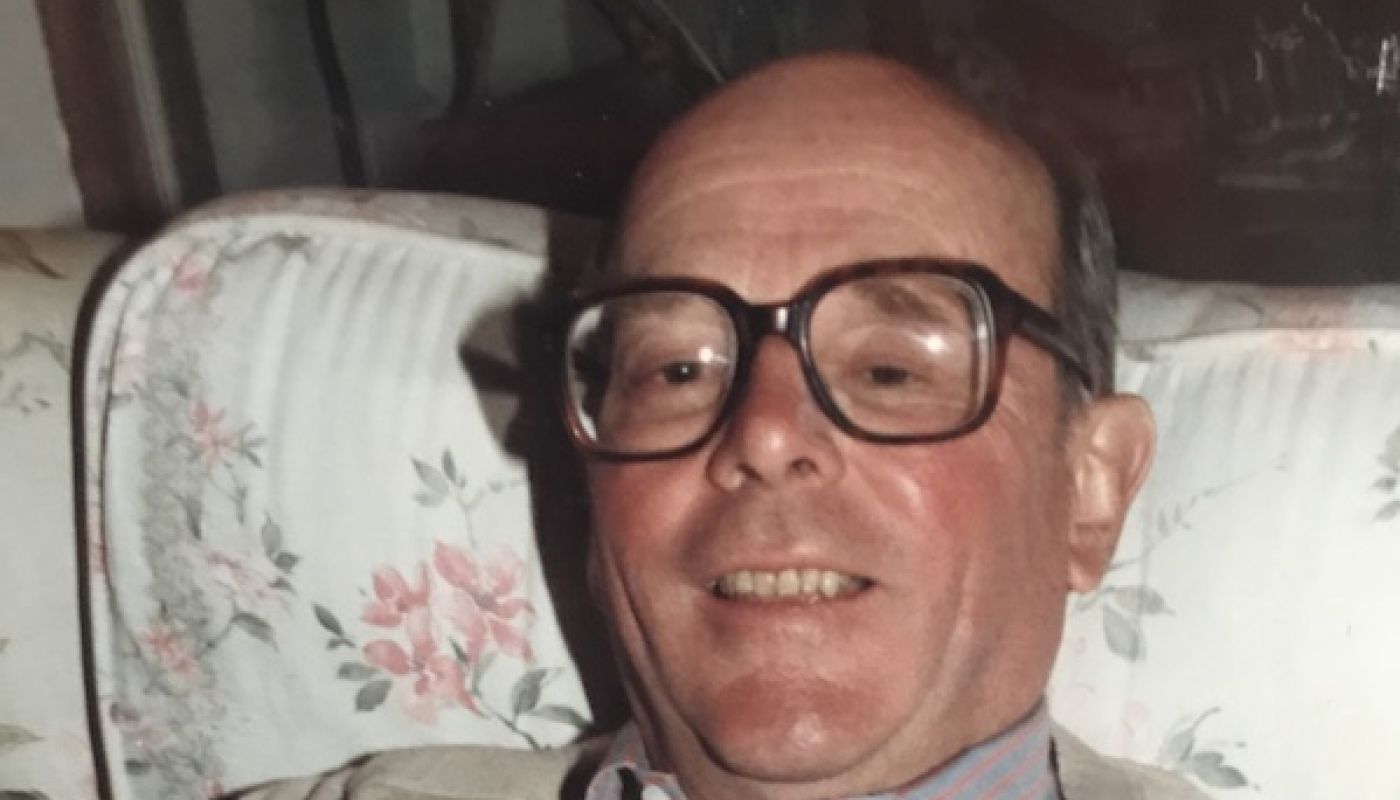
Bill was my father’s age, so to speak of him is a great honour, and I was deeply touched when Mary and Philippa asked me to do so. But although of a different generation, he was really part of my family, even though we are not related in any way. Bill’s father was close to my grandfather, and in turn, Bill was one of my father’s closest friends.
To give you some idea of the relationship, my grandfather, aged 20, wrote on 9 May 1915 from the trenches near Béthune in France: ‘I got a letter from Mrs Warre yesterday offering to put me up at any time when I come on leave’ and again in August 1917: ‘Mrs Warre has been awfully kind about writing; she scarcely ever misses a day, and has sent lots of papers and magazines.’ This was Violet Warre, sister of Bill’s father. Maurice Symington always stayed at Violet and Amyas’s house in Evelyn Gardens when on leave from the front, as it was almost impossible to get back to Portugal.
Bill served in the 12th Royal Lancers after leaving Eton and was posted to Palestine from 1945 to 1947. This was a most difficult time in that region, with vicious fighting going on between various groups. But there was some time for humour, and Philippa told me a story about Bill’s early training time in the army. We all know that he had very poor sight in one eye, so this presented him with quite a challenge for active service. One day he was being tested by a senior officer who pointed at an army tank 500 yards away.
‘Warre.’
‘Yes, sir’
‘Can you see that tank?’
‘Yes, sir.’
‘Pass.’
And that was it, he was a cavalry officer!
The old friendship between our two families was such that it was only natural that when Bill finished serving in Palestine and went to Portugal in 1948, he should stay for several months with my grandparents at their house in the Avenida de Boavista. It was during this period that Bill built the foundation of his profound knowledge of port, and continued his family’s historic connection with the Douro.
There have been virtually no British port families with such an extraordinarily long association with the Douro. The first William Warre came to Portugal in 1729 from Madras in India and joined a port company founded in 1670, just 59 years previously. This William married the sister of the British Consul in Oporto, and architect of the Factory House. Their son, another William, also became His Majesty’s Consul, as well as being a port shipper. In turn, his nephew, yet another William and Oporto-born, was to have a highly distinguished career in the Peninsular War, was the subject of Bill’s important book, and is perhaps the most famous member of this great clan.
Bill in 1948 was following in the footsteps of a family that has been closely tied to the Douro for three centuries. It is an extraordinary story. Bill told Richard Mayson that he found Oporto in 1948, ‘a world of semi-luxury accompanied by Victorian service’ , having arrived from England by steamer which crossed the bar of the Douro and moored right alongside the lodges on the waterfront at Vila Nova de Gaia. Life in Portugal, he said, was a pleasant contrast to the rationing and austerity of post-war Britain. He was apprenticed to Ron Symington for six months in the Dow’s tasting room, and got to know the vineyards very well.
But the port trade was not doing well and exports were virtually stopped, as the traditional markets were effectively bankrupt. Bill, together with my father and his cousins Ian and James, fought to keep port alive. Once Bill returned to the UK he carried the flag for port and later helped to launch the magnificent 1963 vintage. This great wine was notable not only for its outstanding quality, but also for being the first vintage port to sell successfully since before the Great Depression of the 1930s, over a quarter of a century earlier.
Bill became one of the first Masters of Wine in 1960 just a few years after the Institute was founded. This is arguably the world’s most prestigious and difficult wine qualification. It was a notable achievement. But Bill carried his knowledge lightly and without pretension. My brother Dominic remembers a dinner in the 1980s with London wine merchant Robert Rolls. When the port appeared, Robert asked Bill and Dom to tell him what it was, saying ‘you will never guess’ (because it was a rare vintage). Bill picked up the glass, gave it one sniff, turned to Dom and said; ‘this is what your grandfather served me at Boavista one night in 1955... it’s Warre 1922’. Dom said: ‘both Rob Rolls and I were totally dumbstruck; he hadn’t even tasted it!’
Shortly after our family acquired Fells in 1976, Bill joined the company and continued his illustrious wine trade career. During all this time he would frequently bring customers to Quinta do Bomfim, staying in the house that his grandfather George Warre had built in 1896. Bomfim is designed along the lines of a tea-planter’s house, India having been where the Warre family had extensive investments in the 18th century.
But it was not only port and wine that fascinated Bill; he was also a scholar of the Peninsular War, and he had strong family reasons for this. His great-grandfather’s brother of the same name had been born in Oporto in 1784. This William Warre had been thrown out of the family port business for glueing the Portuguese partner’s pig-tail to his desk while he slept off a satisfying lunch. Young Warre had little choice but to join the army, which in any case he had always wanted to do.
Warre served with General Ferguson as an ADC and went to Portugal with him in 1808, fighting at two of the early battles, Roliça and Vimeiro. He was also on the infamous retreat to Corunna with Sir John Moore, of which more later. After Corunna, Warre joined Marshal Beresford’s staff as ADC and was a key figure in the training of the new Portuguese army, being fluent in the language, and he was present at several other major battles including Oporto in 1809 and at the terrible sieges of Badajoz and Ciudad de Rodrigo. His last major battle in the Peninsular War was Salamanca in 1812 which many historians consider to be where Wellington showed his greatest ever strategic skill. At this action Warre escorted the badly wounded Marshal Beresford off the field of battle and by boat down the Douro river to Oporto.
In 1999 Bill published the diaries of Lt General Sir William Warre, originally printed in 1909 by his great Uncle Edmond Warre, Provost of Eton. Bill’s version has extensive additional notes that were unavailable in the previous edition and, perhaps even more valuably, Bill knew intimately every one of the battlefields and locations mentioned in the diaries. Bill’s book is now used as a source by historians, and I have seen the diaries quoted in several recent publications. This is a direct result of Bill’s excellent work in which I know Mary played a brilliant role, researching and typing up much of the copy.
After Bill’s retirement from Fells in 1991, he and Mary, together with my parents, would make frequent pilgrimages to the Peninsular War battlefields. These trips were organised as for campaigning in the old days: research and maps, routes of march, victuals and of course wine and port, were all part of the preparations. They would spend weeks up in the remoter areas on the Côa, near the Spanish frontier visiting the places mentioned in the diaries and other contemporary sources. Several sites in particular fascinated Bill and my father, mostly the less well-known skirmishes. One in particular was General Crauford’s nearly disastrous mistake in July 1810, when he irresponsibly risked the crack Light Division, by lingering too long on the wrong side of the Côa. As Marshal Ney’s vastly bigger army approached, Crauford had to fight his way back across the tiny stone bridge over the Côa near Almeida, suffering some considerable loss. Bill and my father took me along the still-existing old country lanes from Almeida to this bridge, pointing out exactly where every small skirmish had been fought, and who had done what.
All of this was thirsty work and when I was not with them, as I had to be working either in the Douro or Gaia, I would get messages saying that, inexplicably, the rations had run out, the troops were restless and thirsty, and could I have more port sent up?
Apart from being my father’s best friend, Bill was like an uncle to me and to my siblings, and was godfather to my brother William. Both Mary and Bill were always incredibly kind to us all, and in a repetition of what Violet and Amyas Warre had done for my grandfather in 1915, they had me to stay at their lovely flat in Westbourne Terrace when I first went to London aged 19.
In the years after Bill was retired, he and Mary shared countless holidays with my parents, always accompanied by suitcases clinking embarrassingly with numerous bottles. And at every single harvest, Bill and Mary would come and stay with my parents at their small quinta in the Douro. They would have dinner on the open terrace at Andorinhas, over-looking the Pinhão valley vineyard and discuss the many vintages that they had seen over the years, always with more than a few bottles on the table. It was a well-earned retirement for all of them.
Bill’s sense of humour, his love of port and of Portugal, his profound knowledge and his kindness, set him apart as a true gentleman. He continued an extraordinary and unique wine tradition that dates back over three centuries. It was a privilege to have known him.
I would like to end by reading a few lines from The Burial of Sir John Moore after Corunna by Charles Wolfe. Bill’s ancestor, Lt General Sir William Warre, was standing on the windswept headland at Corunna, in the far north-western corner of Spain on the night of 16 January 1809, when they buried their General, Sir John Moore, who had been killed in that day’s desperate battle. Very early the next day, William Warre was the last officer from an army of some 16,000 British soldiers to embark on the Royal Navy ships that were there to rescue them. He had the French literally on his heels. I think Bill would have appreciated this poem being read on this occasion.
Not a drum was heard, not a funeral note,
As his corse to the rampart we hurried;
Not a soldier discharged his farewell shot
O’er the grave where our hero we buried.
We buried him darkly at dead of night,
The sods with our bayonets turning;
By the struggling moonbeam’s misty light
And the lantern, dimly burning.
No useless coffin enclosed his breast,
Nor in sheet nor in shroud we wound him,
But he lay, like a warrior, taking his rest
With his martial cloak around him.
Slowly and sadly we laid him down,
From the field of his fame fresh and gory;
We carved not a line, and we raised not a stone,
But left him alone, with his glory.
Farewell Bill, we will miss you.
















