
See related thread in Members' forum
What is dark, sticky, transforms plain vanilla ice cream into a feast and can cost as little as £6.40 per half-litre?
The answer is a varietal wine that is, quite unjustifiably, unknown to the great majority of wine enthusiasts yet has unique, and uniquely useful, properties.
For a start, rich PX, made from Pedro Ximénez grapes grown in Andalucia, actually improves in an opened bottle – unlike most wines which are fragile little things that need to be drunk within days, sometimes hours, of being exposed to air. One bottle can therefore last for weeks, not least because the wine is so sweet that you really need only a tiny amount at a time. In fact, so sweet is most PX that it is probably blacklisted by any dentists who have come across it. And its extreme sweetness means that it is one of very few wines rich enough to stand up to chocolate. But it is a useful standby in the kitchen, and can be enjoyed long before the sweet course. Michelin-starred chef (and active purple pager) Roger Jones of The Harrow, Little Bedwyn near Marlborough, Wiltshire is a notable PX fan and likes to use it to make, inter alia, foie gras toffee and his signature dish of pan fried foie gras, seared scallop and black pudding with PX caramel.
PX is also unusual among dark, sweet wines in that it is not particularly high in alcohol, losing alcohol as it ages so that a really ancient example might be just 10% alcohol when drawn straight from the cask, and has to have neutral spirit added to it to bring it up to the EU legal minimum strength of 15%. (Despite the EU rule, several producers follow tradition and bottle some of their oldest PXs at cask strength. El Maestro Sierra PX VORS sherry and the following Montillas: Alvear 1830 PX, Pérez Barquero Solera Fundacional 1905 PX, Moreno Virgilio PX, and Equipo Navazos La Bota de PX nº 3 and nº 12 are some of the most notable examples – see my tasting notes.)
But it is hardly surprising that PX is not widely known. Sweet wines, unfairly, are not fashionable. And this one is the pride and joy of a wine region that has laboured for most of its history in the shadow of another region that is currently, again unfairly, unfashionable – the sherry region. For many years PX’s native region Montilla-Moriles south of Cordoba struggled to carve a separate identity from sherry – and indeed much of its sweet PX continues to find its way into bottles sold by the sherry bodegas. Today, a high proportion of the sherries most highly rated by Spain’s top wine critics are PXs matured in Jerez, even though few, if any, Pedro Ximénez vines are grown in the sherry region itself. (Sherry specialist Jesús Barquin tells me that the last notable Pedro Ximénez vineyard , Viña 25 owned by Pedro Domecq, fell victim to the Jerez-Sanlúcar motorway three or four years ago. But the variety used to be planted in the sherry region and it is probable that the oldest soleras in Jerez still have a decent proportion of local PX in the blend.)
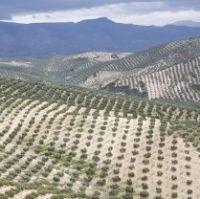
Pedro Ximénez, on the other hand, is the dominant grape variety grown in the mountain countryside shown above left around the towns of Montilla and Moriles, a good two or three hours’ drive north east of the sherry capital Jerez. Although it has the same chalky white soils as sherry country, Montilla-Moriles is higher and has a more extreme climate, naturally producing much riper grapes. It makes various wines similar to but slightly softer than the common sherry styles – in fact the name of Amontillado sherry means ‘in the style of Montilla’ – but Montilla-Moriles’ real distinction is its range of really sweet wines made by drying the Pedro Ximénez grapes in the sun for several days as shown below, thereby concentrating the sugar content, before pressing the grapes and adding neutral spirit to make a particularly unctuous liquid.

To my shame, I had not visited Montilla before this spring, and I was amazed to find such a treasure trove of wine with such a distinctive character, and extremely reasonable prices. Picking apart the stickiest pages I have ever written on in my notebooks, I see incredulous notes on PXs that are many decades old. ‘Burnt molasses’, ‘polished walnuts’, ‘treacle toffee’,‘Oxford marmalade’, ‘syrup of figs’ and even ‘David Cohen’s aftershave’ all feature in my tasting notes, and yet these wines can sell for as little as five euros a bottle at the cellar door.
Needless to say, by the time they get on to a list or shelf in the UK or US, they cost rather more than this, but they are certainly not expensive considering the amount of time a single bottle lasts. One of the most stunning examples, Alvear PX de Solera 1927 Montilla, is just £14.50 for 50cl from its UK importer Genesis Wines. The only drawback is that they sell it only by the six-pack, but I would strongly advise finding a friend or two with whom to share the total outlay of £87 for three litres of this wonderfully racy essence of treacle toffee. This is the flagship wine from the world’s biggest collection of fine PX, just one small whitewashed bodega big enough to house 5,000 butts, or two or three cattle. It even smells rather like a byre, so heady is the smell of rancio, the particularly tangy scent of strong drink kept for decades in old wood. (PX matured in the sherry region shows this characteristic even more, since the local habit is not to fill the barrels completely, unlike in Montilla-Moriles.) This particular collection of barrels was first filled in 1927 and has been continuously replenished since then. Although it is very sweet – more than 400 grams in every litre is sugar – it is not sickly because there is so much refreshing acidity and, of course after all this time, complexity.
I also had a chance to sip from Alvear’s soleras begun in 1920, 1910 and even 1830. (“It has just been moved, so it’s not very expressive,” I was warned about this oldest solera.) The 1920 is even richer than the 1927 while the 1910 is lightest and tangiest of all. It sold so well in the US, where the energetic Jorge Ordoñez has been the importer since the early 1990s, that it had to be taken off the market to maintain supply.
Arguably even more delicious were some of Alvear’s vintage-dated Añada PXs. They have deliberately aged a selection of their best PX in wood since 1998 and bottle it at about six years if they think the quality is up to it. They rejected the 1999, but the 1998 is glorious now – wonderfully round and pungent. The 2000 is richer and smoother – a bit like malted milk – and not quite as expressive yet. The 1998 can be found in Canada, Italy and Spain for the equivalent of about £30 a half-litre.
With its five year-old Gran Barquero on sale in Waitrose for £6.40 a half-litre, Pérez Barquero, imported by Premier Vintners into the UK, is the only other Montilla producer to have much presence on export markets – although at a London tasting of PXs from the five leading producers earlier this year I was impressed by all those listed in the box.
RECOMMENDED MONTILLA PXs
Alvear, Solera 1927
Alvear, Reserva 1998
Equipo Navazos, La Bota de PX nº 12
La Aurora 1981
Moreno, Virgilio
Navisa, Cobos Tres Pasas Gran Reserva
Pérez Barquero, Solera Fundacional 1905
See my tasting notes on these and other prominent Montilla PXs, and look out for top PX sherries too which are aged in a slighty more oxidative way than their counterparts in the bodegas of Montilla. For international stockists see winesearcher.com.
See related thread in Members' forum













